118847
论文已发表
注册即可获取德孚的最新动态
IF 收录期刊
- 3.6 Breast Cancer (Dove Med Press)
- 4.3 Clin Epidemiol
- 2.6 Cancer Manag Res
- 3.2 Infect Drug Resist
- 4.1 Clin Interv Aging
- 6.1 Drug Des Dev Ther
- 4.1 Int J Chronic Obstr
- 8.7 Int J Nanomed
- 2.5 Int J Women's Health
- 3.2 Neuropsych Dis Treat
- 2.4 OncoTargets Ther
- 2.6 Patient Prefer Adher
- 2.6 Ther Clin Risk Manag
- 3.1 J Pain Res
- 3.5 Diabet Metab Synd Ob
- 4.5 Psychol Res Behav Ma
- 3.4 Nat Sci Sleep
- 2.4 Pharmgenomics Pers Med
- 2.6 Risk Manag Healthc Policy
- 4.6 J Inflamm Res
- 2.3 Int J Gen Med
- 3.9 J Hepatocell Carcinoma
- 3.3 J Asthma Allergy
- 2.5 Clin Cosmet Investig Dermatol
- 3.0 J Multidiscip Healthc

利血平和氢氯噻嗪复合片用于治疗高血压的临床疗效和经济评估的多中心回顾性分析
Authors Li S, Liu X, Li L
Received 16 September 2019
Accepted for publication 15 January 2020
Published 12 February 2020 Volume 2020:12 Pages 107—114
DOI https://doi.org/10.2147/CEOR.S231210
Checked for plagiarism Yes
Review by Single-blind
Peer reviewer comments 3
Editor who approved publication: Professor Dean Smith
Background/Objective: As the first generation of anti-hypertensive drug independently developed by China, Compound Reserpine and Hydrochlorothiazide Tablet (CRH) has been widely used in China for more than 40 years. However, limited studies are available for the performance of CRH for the treatment of hypertension in real-world setting in China. This study aimed to evaluate the comparative clinical effectiveness and treatment costs between CRH and three other anti-hypertensive agents that include, Triprolidine Hydrochloride (TH: Diovan), Amlodipine Besylate Tablet (ABT: Norvasc), and Nifedipine Tablets (NT: Procardin) in real-world clinical practice.
Methods: This was a multicentre, retrospective study conducted from May 2011 to May 2016 at four tertiary hospitals in China. Data from patients’ electronic medical records (EMR) were retrieved and analysed. A retrospective propensity score-matched analysis was used for three pairs of comparisons. Systolic blood pressure (SBP), diastolic blood pressure (DBP), and overall blood pressure (BP) control rate on the 10th and 20th days after treatment were compared. The overall cost of treatment was analysed across groups.
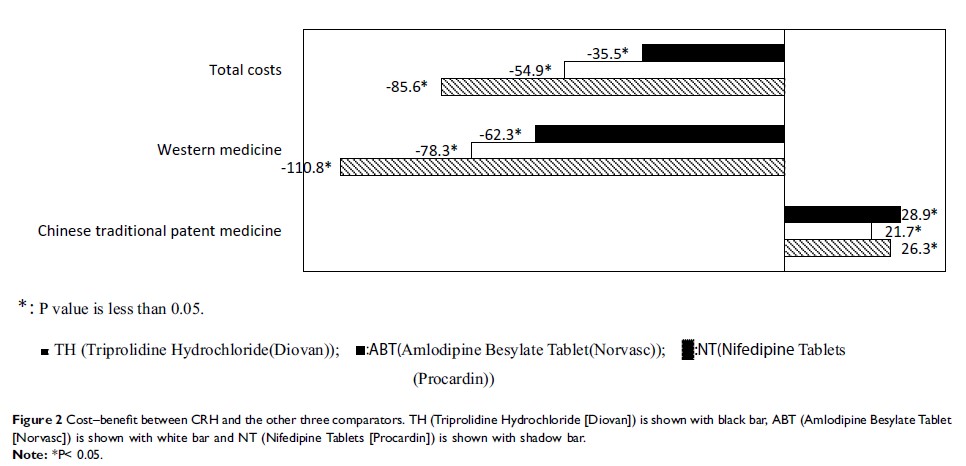
Results: In three pairs of comparison, the patients who received CRH treatment obtained better blood pressure control at both day 10 and day 20. In addition, the patients who received CRH had lower total treatment costs compared with the other three anti-hypertensive drugs. Influential factor analysis showed that CRH is associated with a higher probability of BP control compared with the other three monotherapies in real-world clinical practice.
Conclusion: The patients received CRH showed a higher overall BP control rate than the other three commonly prescribed anti-hypertensive drugs, which indicates that CRH has a better benefit in BP control for hypertensive patients. Also, the total cost for hypertension treatment is lower in CRH patients compared with the other three comparator drugs. These findings suggest that CRH could be an effective and cost-effective option for hypertensive patients.
Keywords: hypertension, compound reserpine and hydrochlorothiazide, clinical effectiveness, economic analysis