118847
论文已发表
注册即可获取德孚的最新动态
IF 收录期刊
- 3.6 Breast Cancer (Dove Med Press)
- 4.3 Clin Epidemiol
- 2.6 Cancer Manag Res
- 3.2 Infect Drug Resist
- 4.1 Clin Interv Aging
- 6.1 Drug Des Dev Ther
- 4.1 Int J Chronic Obstr
- 8.7 Int J Nanomed
- 2.5 Int J Women's Health
- 3.2 Neuropsych Dis Treat
- 2.4 OncoTargets Ther
- 2.6 Patient Prefer Adher
- 2.6 Ther Clin Risk Manag
- 3.1 J Pain Res
- 3.5 Diabet Metab Synd Ob
- 4.5 Psychol Res Behav Ma
- 3.4 Nat Sci Sleep
- 2.4 Pharmgenomics Pers Med
- 2.6 Risk Manag Healthc Policy
- 4.6 J Inflamm Res
- 2.3 Int J Gen Med
- 3.9 J Hepatocell Carcinoma
- 3.3 J Asthma Allergy
- 2.5 Clin Cosmet Investig Dermatol
- 3.0 J Multidiscip Healthc

烟酰胺对宫颈癌衍生的成纤维细胞的影响:治疗潜力的证据
Authors Hassan RN, Luo H, Jiang W
Received 31 August 2019
Accepted for publication 16 January 2020
Published 12 February 2020 Volume 2020:12 Pages 1089—1100
DOI https://doi.org/10.2147/CMAR.S229395
Checked for plagiarism Yes
Review by Single-blind
Peer reviewer comments 2
Editor who approved publication: Dr Seema Singh
Purpose: The present study aimed to examine the effects of nicotinamide (NAM) on cervical cancer-associated fibroblasts (CAF) for its in vitro efficacy, gross inhibition, and mechanism of inhibition.
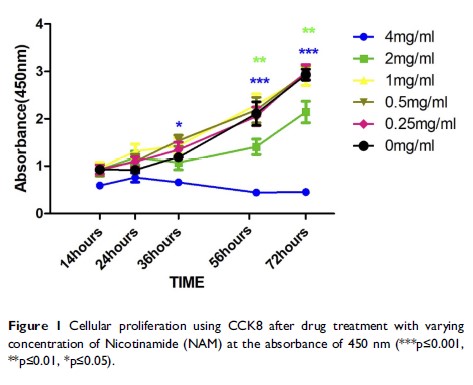
Methods: The fibroblasts were treated with pre-specified concentrations of NAM followed by measurement of the cell proliferation using CCK-8 assay. The production of reactive oxygen species (ROS) was measured by 2ʹ,7ʹ-Dichlorofluorescin diacetate. We further investigated the apoptosis by flow cytometry using Annexin-V. We employed JC-1 assay to detect changes in the potential of the mitochondrial membrane. We further determined the expression of apoptotic genes was measured using qRT-PCR. And lastly, cell cycle experiments were conducted to determine the influence of NAM on arresting the growth of CAF in a cell cycle.
Results: Our study showed that NAM was able to reduce fibroblasts viability. We specifically observed a significantly increased intracellular ROS with resultant exhaustion of cellular antioxidant defense machinery, including reduced glutathione (GSH). We further observed the involvement of mitochondrial pathway in the NAM induced apoptosis of fibroblasts.
Conclusion: Our study supports the therapeutic potential of NAM for the treatment of cervical cancer and necessitates a further investigation of the reported findings.
Keywords: apoptosis, cervical cancer, fibroblasts, mitochondrial pathway, nicotinamide, therapeutic potential