118847
论文已发表
注册即可获取德孚的最新动态
IF 收录期刊
- 3.6 Breast Cancer (Dove Med Press)
- 4.3 Clin Epidemiol
- 2.6 Cancer Manag Res
- 3.2 Infect Drug Resist
- 4.1 Clin Interv Aging
- 6.1 Drug Des Dev Ther
- 4.1 Int J Chronic Obstr
- 8.7 Int J Nanomed
- 2.5 Int J Women's Health
- 3.2 Neuropsych Dis Treat
- 2.4 OncoTargets Ther
- 2.6 Patient Prefer Adher
- 2.6 Ther Clin Risk Manag
- 3.1 J Pain Res
- 3.5 Diabet Metab Synd Ob
- 4.5 Psychol Res Behav Ma
- 3.4 Nat Sci Sleep
- 2.4 Pharmgenomics Pers Med
- 2.6 Risk Manag Healthc Policy
- 4.6 J Inflamm Res
- 2.3 Int J Gen Med
- 3.9 J Hepatocell Carcinoma
- 3.3 J Asthma Allergy
- 2.5 Clin Cosmet Investig Dermatol
- 3.0 J Multidiscip Healthc

miR-153 的上调通过靶向 ZEB2 介导的 EMT 抑制三阴性乳腺癌进展并有助于改善预后
Authors Shi D, Li Y, Fan L, Zhao Q, Tan B, Cui G
Received 17 July 2019
Accepted for publication 30 October 2019
Published 13 November 2019 Volume 2019:12 Pages 9611—9625
DOI https://doi.org/10.2147/OTT.S223598
Checked for plagiarism Yes
Review by Single-blind
Peer reviewers approved by Ms Aruna Narula
Peer reviewer comments 2
Editor who approved publication: Dr Federico Perche
Background: Triple-negative breast cancer (TNBC) is the most malignant type of breast cancer. MicroRNAs (miRs) and their corresponding molecular targets are associated with the occurrence and development of various human malignancies. However, the roles of the microRNA-153 (miR-153) and zinc finger E-box-binding homeobox 2 (ZEB2)-induced epithelial–mesenchymal transition (EMT) in TNBC and predictive effect of miR-153 on the prognosis of TNBC have not been fully elucidated.
Materials and methods: Relative miR-153 expression level was examined by RT-qPCR assay in TNBC tissues of 60 patients and TNBC cell lines (SKBR3, BT-549 and MDA-MB-231). Cell proliferation ability, invasion ability and migration ability were measured by CCK8 assay, Transwell invasion assay and wound healing assay, respectively. Luciferase reporting experiment was used to confirm that there was a miR-153-binding site in ZEB2 3ʹ-UTR. The expression of ZEB2 in tissues and its relationship with miR-153 were analyzed with immunohistochemistry method. Relative ZEB2, E-cadherin, N-cadherin and Vimentin mRNA and protein expression levels were observed with RT-qPCR and Western blot, respectively. Based on risk factors, a prognostic model was established according to the Cox proportional risk model, and the prognostic risk factors of TNBC patients were predicted and analyzed.
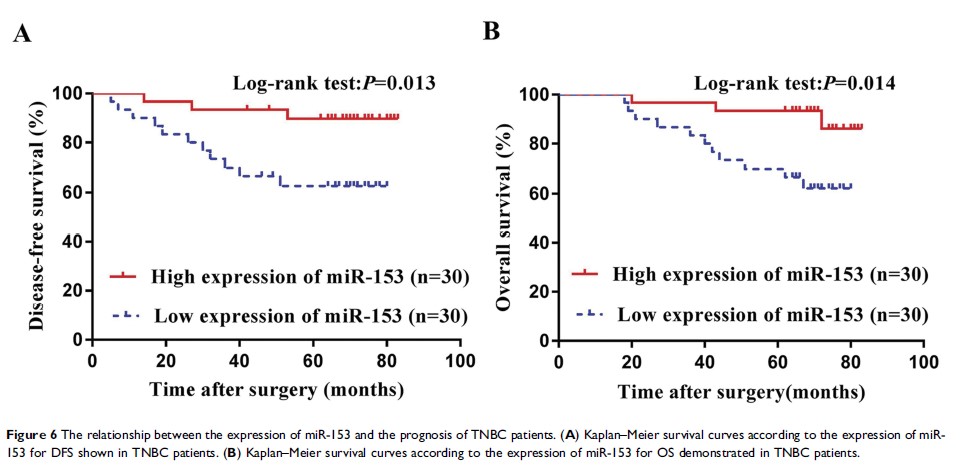
Results: The expression of miR-153 in TNBC tissues and cells was declined (all P <0.01), and upregulation of miR-153 inhibited proliferation, invasion and migration of TNBC cells (all P <0.01). In addition, miR-153 regulated ZEB2/EMT link in TNBC, and ZEB2 overexpression reversed the tumor-suppressive effect of miR-153 in TNBC. Moreover, miR-153 was an independent predictive factor that was associated with excellent prognosis in TNBC patients.
Conclusion: miR-153 may inhibit TNBC proliferation, invasion and migration by regulating ZEB2/EMT link. Therefore, miR-153 is expected to be a molecular target and prognostic marker for TNBC.
Keywords: microRNA-153, zinc finger E-box-binding homeobox 2, epithelial-mesenchymal transition, proliferation, invasion, migration