118847
论文已发表
注册即可获取德孚的最新动态
IF 收录期刊
- 3.6 Breast Cancer (Dove Med Press)
- 4.3 Clin Epidemiol
- 2.6 Cancer Manag Res
- 3.2 Infect Drug Resist
- 4.1 Clin Interv Aging
- 6.1 Drug Des Dev Ther
- 4.1 Int J Chronic Obstr
- 8.7 Int J Nanomed
- 2.5 Int J Women's Health
- 3.2 Neuropsych Dis Treat
- 2.4 OncoTargets Ther
- 2.6 Patient Prefer Adher
- 2.6 Ther Clin Risk Manag
- 3.1 J Pain Res
- 3.5 Diabet Metab Synd Ob
- 4.5 Psychol Res Behav Ma
- 3.4 Nat Sci Sleep
- 2.4 Pharmgenomics Pers Med
- 2.6 Risk Manag Healthc Policy
- 4.6 J Inflamm Res
- 2.3 Int J Gen Med
- 3.9 J Hepatocell Carcinoma
- 3.3 J Asthma Allergy
- 2.5 Clin Cosmet Investig Dermatol
- 3.0 J Multidiscip Healthc

MicroRNA-769-5p 通过靶向赖氨酸甲基转移酶 2A 促进神经胶质瘤细胞的生长
Authors Chang M, Yan P, Zhang B, Zhang G, Wang J, Ge H, Han N, Du C, Shi W, Tian Y
Received 11 July 2019
Accepted for publication 18 October 2019
Published 5 November 2019 Volume 2019:12 Pages 9177—9187
DOI https://doi.org/10.2147/OTT.S222836
Checked for plagiarism Yes
Review by Single-blind
Peer reviewers approved by Ms Aruna Narula
Peer reviewer comments 2
Editor who approved publication: Dr Sanjeev Srivastava
Background: Accumulating evidence supports the involvement of microRNAs (miRNAs) in the progression of human cancers including glioma. Recently, miR-769-5p has been reported to play a tumor suppressive role in colorectal cancer and lung cancer, whereas it exerts an oncogenic role in melanoma. However, the role of miR-769-5p and its related mechanism are poorly elucidated.
Methods: The levels of miR-769-5p in glioma tissues and adjacent non-tumor tissues were detected by qRT-PCR. In addition, the effects of miR-769-5p on cell proliferation and apoptosis were evaluated by CCK-8, EdU, colony formation and flow cytometric assays, respectively. Meanwhile, the dual-luciferase reporter assay was used to investigate the interaction of miR-769-5p and lysine methyltransferase 2A (KMT2A) in glioma.
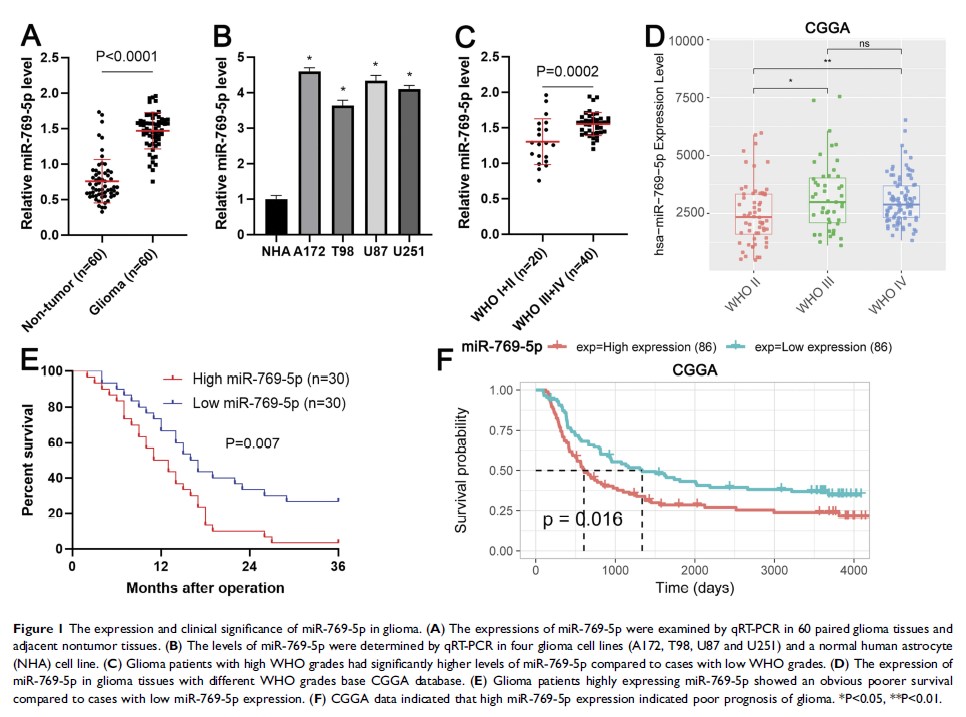
Results: We found that miR-769-5p expression was strongly upregulated in glioma tissues and cell lines. Glioma tissues with high World Health Organization (WHO) grades had obvious higher levels of miR-769-5p compared to samples with low WHO grades. Interestingly, glioma patients highly expressing miR-769-5p showed prominent poorer survivals. Knockdown of miR-769-5p significantly suppressed cell proliferation and resulted in apoptosis in glioma cells. Additionally, miR-769-5p silencing restrained in vivo growth of glioma cells in mice. Interestingly, KMT2A was identified to be a direct target of miR-769-5p in glioma cells. The expression of KMT2A mRNA was downregulated in glioma tissues and inversely correlated with miR-769-5p level. KMT2A overexpression inhibited cell proliferation and induced the apoptosis of A172 cells. Moreover, siRNA-mediated KMT2A silencing could partially abolish miR-769-5p knockdown-induced suppressive effects on A172 cells.
Conclusion: In summary, our findings suggest that targeting miR-769-5p/KMT2A axis may be a promising therapeutic target for glioma treatment.
Keywords: miR-769-5p, glioma, KMT2A, tumor growth, apoptosis