118847
论文已发表
注册即可获取德孚的最新动态
IF 收录期刊
- 3.6 Breast Cancer (Dove Med Press)
- 4.3 Clin Epidemiol
- 2.6 Cancer Manag Res
- 3.2 Infect Drug Resist
- 4.1 Clin Interv Aging
- 6.1 Drug Des Dev Ther
- 4.1 Int J Chronic Obstr
- 8.7 Int J Nanomed
- 2.5 Int J Women's Health
- 3.2 Neuropsych Dis Treat
- 2.4 OncoTargets Ther
- 2.6 Patient Prefer Adher
- 2.6 Ther Clin Risk Manag
- 3.1 J Pain Res
- 3.5 Diabet Metab Synd Ob
- 4.5 Psychol Res Behav Ma
- 3.4 Nat Sci Sleep
- 2.4 Pharmgenomics Pers Med
- 2.6 Risk Manag Healthc Policy
- 4.6 J Inflamm Res
- 2.3 Int J Gen Med
- 3.9 J Hepatocell Carcinoma
- 3.3 J Asthma Allergy
- 2.5 Clin Cosmet Investig Dermatol
- 3.0 J Multidiscip Healthc

乳腺癌中与癌症相关的成纤维细胞诱导的微管定向化疗药物耐药性的逆转
Authors Li X, Li Q, Yu X, Li H, Huang G
Received 5 April 2019
Accepted for publication 26 August 2019
Published 27 September 2019 Volume 2019:12 Pages 7963—7973
DOI https://doi.org/10.2147/OTT.S211043
Checked for plagiarism Yes
Review by Single-blind
Peer reviewers approved by Ms Aruna Narula
Peer reviewer comments 2
Editor who approved publication: Dr Leo Jen-Liang Su
Purpose: This study was designed to expound the underlying mechanism of microtubule-directed chemotherapeutic drugs resistance induced by cancer-associated fibroblasts (CAFs) in breast cancer.
Materials and methods: We collected 10 microtubule-directed chemotherapeutic drugs resistant breast tumor samples and 10 normal breast tumor samples to analyze the CAFs distribution by immunohistochemistry and flow cytometry. We also detected the collagen expression in CAFs by real-time PCR. We detected the activation of PI3K/AKT signaling pathway in tumor cells by Western blotting and immunofluorescence. The subcutaneous 4T1/MCF-7 bearing mice were used to investigate the anticancer effects of integrin β1 inhibitor combined with microtubule-directed chemotherapeutic drugs.
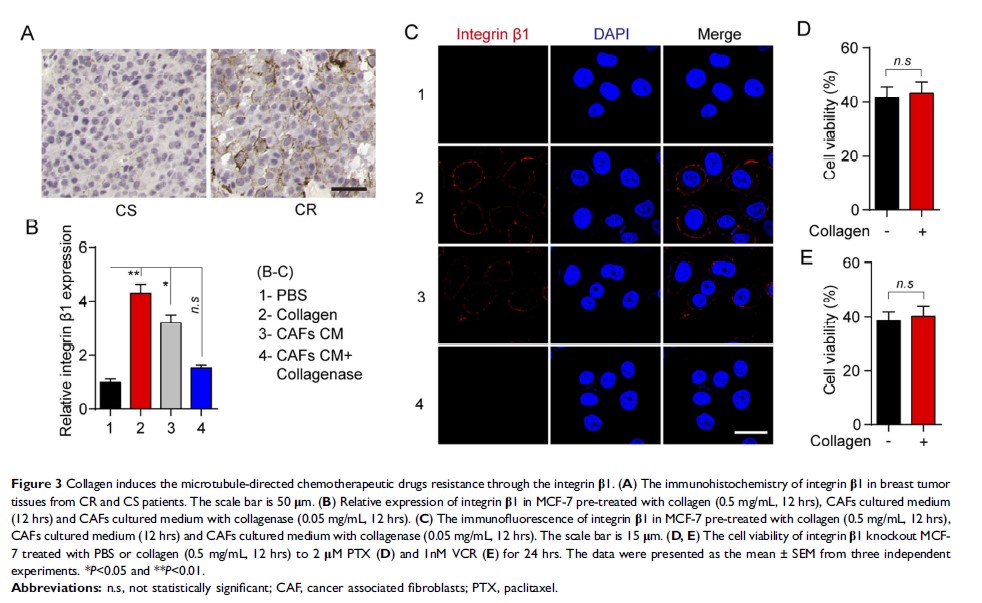
Results: In our studies, accumulation of CAFs was observed in tumor samples from microtubule-directed chemotherapeutic drugs resistant patients. Those isolated CAFs could efficiently induce the acquisition of microtubule-directed chemotherapeutic drugs resistance in breast cancer cells. More importantly, we found that CAFs could regulate the microtubule-directed chemotherapeutic drugs resistance through the secretion of collagen to activate the integrin β1/PI3K/AKT signaling pathway. Combination of integrin α2β1 inhibitor and paclitaxel/vincristine sulfate could efficiently overcome the microtubule-directed chemotherapeutic drugs resistance induced by CAFs and enhanced the anticancer effects of chemotherapy in subcutaneous 4T1/MCF-7 bearing mice.
Conclusion: Our results demonstrated that CAFs constitute a supporting niche for cancer drug resistance acquisition. Thus, traditional microtubule-directed chemotherapeutic drugs combined with integrin β1 inhibitor may present an innovative therapeutic strategy for breast cancer therapy.
Keywords: breast cancer, cancer-associated fibroblasts, collagen, PI3K/AKT, drug resistance