118847
论文已发表
注册即可获取德孚的最新动态
IF 收录期刊
- 3.6 Breast Cancer (Dove Med Press)
- 4.3 Clin Epidemiol
- 2.6 Cancer Manag Res
- 3.2 Infect Drug Resist
- 4.1 Clin Interv Aging
- 6.1 Drug Des Dev Ther
- 4.1 Int J Chronic Obstr
- 8.7 Int J Nanomed
- 2.5 Int J Women's Health
- 3.2 Neuropsych Dis Treat
- 2.4 OncoTargets Ther
- 2.6 Patient Prefer Adher
- 2.6 Ther Clin Risk Manag
- 3.1 J Pain Res
- 3.5 Diabet Metab Synd Ob
- 4.5 Psychol Res Behav Ma
- 3.4 Nat Sci Sleep
- 2.4 Pharmgenomics Pers Med
- 2.6 Risk Manag Healthc Policy
- 4.6 J Inflamm Res
- 2.3 Int J Gen Med
- 3.9 J Hepatocell Carcinoma
- 3.3 J Asthma Allergy
- 2.5 Clin Cosmet Investig Dermatol
- 3.0 J Multidiscip Healthc

NLRP3 炎性小体促进糖尿病诱导的内皮炎症和动脉粥样硬化
Authors Wan Z, Fan Y, Liu X, Xue J, Han Z, Zhu C, Wang X
Received 5 July 2019
Accepted for publication 26 August 2019
Published 20 September 2019 Volume 2019:12 Pages 1931—1942
DOI https://doi.org/10.2147/DMSO.S222053
Checked for plagiarism Yes
Review by Single-blind
Peer reviewers approved by Dr Nicola Ludin
Peer reviewer comments 2
Editor who approved publication: Dr Juei-Tang Cheng
Background: NLRP3 inflammasome can be activated by high glucose and links inflammation and metabolic disease. This study aimed to investigate the role of NLRP3 inflammasome in hyperglycemia-induced endothelial inflammation and diabetic atherosclerosis.
Methods: NLRP3 levels in peripheral blood mononuclear cell (PBMC) and plasma IL-1β level were measured in diabetes patients. The activation of NLPR3 was detected in diabetic ApoE−/− mice and human umbilical vein endothelial cells (HUVECs).
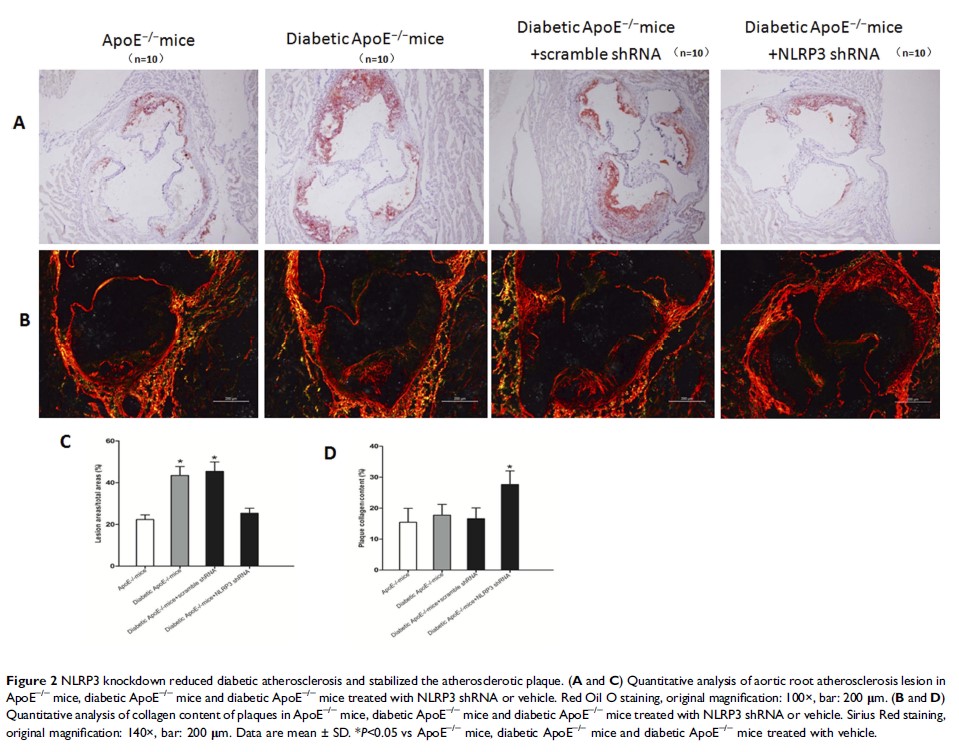
Results: Compared with healthy controls, NLRP3 expression levels in PBMC and plasma IL-1β level were significantly higher in diabetes patients but considerably decreased after lifestyle interventions and medicine. Moreover, carotid atherosclerosis was significantly related to plasma IL-1β level in diabetes patients. In diabetic atherosclerosis mouse model, NLRP3 knockdown suppressed NLRP3 inflammasome activation, inhibited the expression of adhesion molecules ICAM-1 and VCAM-1 in intima, reduced atherosclerosis and stabilized atherosclerotic plaque. In vitro, the expression of NLRP3 inflammasome components and the secretion of IL-1β were augmented by high glucose in HUVECs. Moreover, either high glucose or IL-1β promoted the expression of adhesion molecules, which were suppressed by NLRP3 knockdown or IL-1β receptor antagonist.
Conclusion: These findings provide novel insights into pathological mechanisms of diabetic atherosclerosis and have potential therapeutic implications for cardiovascular complications in diabetes.
Keywords: NLRP3 inflammasome, diabetes, atherosclerosis, inflammation