118847
论文已发表
注册即可获取德孚的最新动态
IF 收录期刊
- 3.6 Breast Cancer (Dove Med Press)
- 4.3 Clin Epidemiol
- 2.6 Cancer Manag Res
- 3.2 Infect Drug Resist
- 4.1 Clin Interv Aging
- 6.1 Drug Des Dev Ther
- 4.1 Int J Chronic Obstr
- 8.7 Int J Nanomed
- 2.5 Int J Women's Health
- 3.2 Neuropsych Dis Treat
- 2.4 OncoTargets Ther
- 2.6 Patient Prefer Adher
- 2.6 Ther Clin Risk Manag
- 3.1 J Pain Res
- 3.5 Diabet Metab Synd Ob
- 4.5 Psychol Res Behav Ma
- 3.4 Nat Sci Sleep
- 2.4 Pharmgenomics Pers Med
- 2.6 Risk Manag Healthc Policy
- 4.6 J Inflamm Res
- 2.3 Int J Gen Med
- 3.9 J Hepatocell Carcinoma
- 3.3 J Asthma Allergy
- 2.5 Clin Cosmet Investig Dermatol
- 3.0 J Multidiscip Healthc

山东省一家教学医院出现产生 KPC-2 的肺炎克雷伯菌 ST11 暴发的基因组分析
Authors Chi X, Hu G, Xu H, Li X, Xiao T, Zhou Y, Xia H, Zou H, Han H, Zheng B, Gao H, Li X
Received 3 July 2019
Accepted for publication 7 September 2019
Published 19 September 2019 Volume 2019:12 Pages 2961—2969
DOI https://doi.org/10.2147/IDR.S221788
Checked for plagiarism Yes
Review by Single-blind
Peer reviewers approved by Dr Cristina Weinberg
Peer reviewer comments 2
Editor who approved publication: Dr Eric Nulens
Purpose: Klebsiella pneumoniae carbapenemase (KPC)-producing K. pneumoniae bacteria causes nosocomial infections worldwide. However, KPC-producing K. pneumoniae outbreak has never been reported in Shandong Province, China. The purpose of our study was to elucidate the epidemiological and drug resistance mechanisms of KPC-producing K. pneumoniae strains collected from a large teaching hospital in Shandong during the outbreak. Moreover, we attempted to characterize the genetic environment and phylogenetic analysis of bla KPC-2 in outbreak isolates.
Methods: We monitored a 64-day outbreak of infection in a general hospital in Shandong Province, and the bacteria causing the infection were all ST11-type K. pneumoniae . The genotype correlation of KPC-producing K. pneumoniae isolates was assessed by whole-genome sequencing (WGS) phylogenetic analysis. Subsequent studies included antibiotic susceptibility testing, multilocus sequence typing (MLST) and S1-pulsed-field gel electrophoresis (S1-PFGE), Southern blot hybridization.
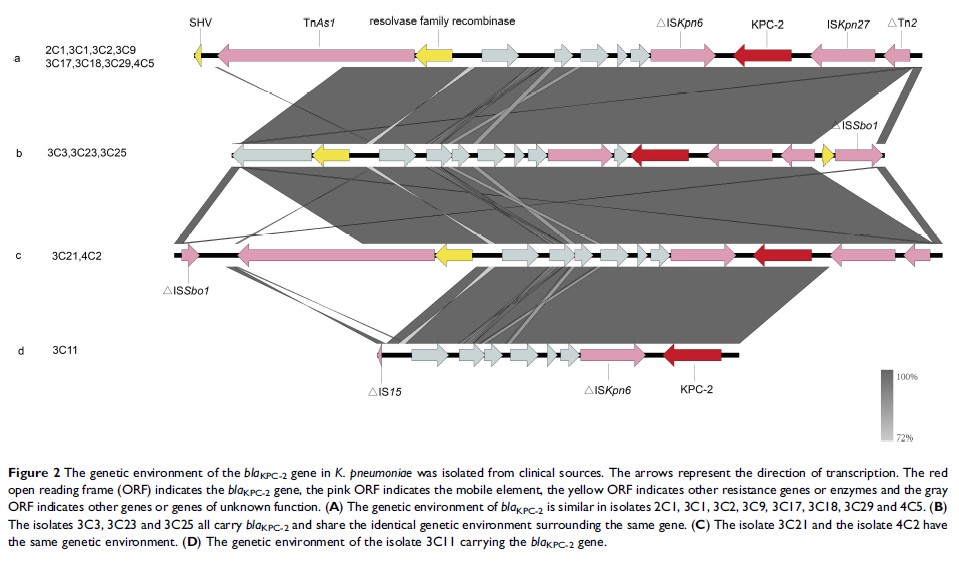
Results: From February 1, 2018 to April 5, 2018, 14 KPC-producing K. pneumoniae isolates from different wards were collected. All 14 isolates were resistant to carbapenems and carried the extended-spectrum β-lactamase (ESBL) gene as well as fosA , and sul genes. Whole-genome analysis showed that all 14 the outbreak isolates were all ST11 type. The bla KPC-2 carrying plasmids were all belong to IncFIIK2 type, and the size ranged from 94 kb to 368 kb.
Conclusion: As far as we know, this report first describes the genomics characterization of KPC-2-producing K. pneumoniae outbreak isolates from Shandong Province, China. In our study, these isolates appeared to be cloned, and ST11 K. pneumoniae was the major clone caused the outbreak. Therefore, routine surveillance of such strains in this region is urgently warranted.
Keywords: Klebsiella pneumoniae , ST11, whole-genome sequencing, SNP, outbreak, IncFIIK2