118847
论文已发表
注册即可获取德孚的最新动态
IF 收录期刊
- 3.6 Breast Cancer (Dove Med Press)
- 4.3 Clin Epidemiol
- 2.6 Cancer Manag Res
- 3.2 Infect Drug Resist
- 4.1 Clin Interv Aging
- 6.1 Drug Des Dev Ther
- 4.1 Int J Chronic Obstr
- 8.7 Int J Nanomed
- 2.5 Int J Women's Health
- 3.2 Neuropsych Dis Treat
- 2.4 OncoTargets Ther
- 2.6 Patient Prefer Adher
- 2.6 Ther Clin Risk Manag
- 3.1 J Pain Res
- 3.5 Diabet Metab Synd Ob
- 4.5 Psychol Res Behav Ma
- 3.4 Nat Sci Sleep
- 2.4 Pharmgenomics Pers Med
- 2.6 Risk Manag Healthc Policy
- 4.6 J Inflamm Res
- 2.3 Int J Gen Med
- 3.9 J Hepatocell Carcinoma
- 3.3 J Asthma Allergy
- 2.5 Clin Cosmet Investig Dermatol
- 3.0 J Multidiscip Healthc

罗哌卡因和右美托咪定结合使用的局部麻醉镇痛疗法:透明质酸修饰的含有皮肤渗透剂的长效纳米结构脂质载体
Authors Yang Y, Qiu D, Liu Y, Chao L
Received 8 April 2019
Accepted for publication 19 August 2019
Published 18 September 2019 Volume 2019:13 Pages 3307—3319
DOI https://doi.org/10.2147/DDDT.S211443
Checked for plagiarism Yes
Review by Single-blind
Peer reviewers approved by Dr Amy Norman
Peer reviewer comments 2
Editor who approved publication: Dr Sukesh Voruganti
Purpose: Hyaluronic acid-poly(ethylene glycol)-distearoyl phosphoethanolamine (HA-PEG-DSPE) modified and tocopheryl polyethylene glycol 1000 succinate (TPGS) contained nanostructured lipid carriers (NLCs) were prepared loading ropivacaine and dexmedetomidine to improve the topical anesthetic analgesic anesthesia efficiency.
Methods: NLCs were prepared by the solvent diffusion method. The average particle size, zeta potential, release behavior, and cytotoxicity of the NLCs were tested. Ex vivo skin permeation was studied using a Franz diffusion cell mounted with depilated rat skin. Local anesthesia antinociceptive efficiency was evaluated by rat tail flick latency study in vivo.
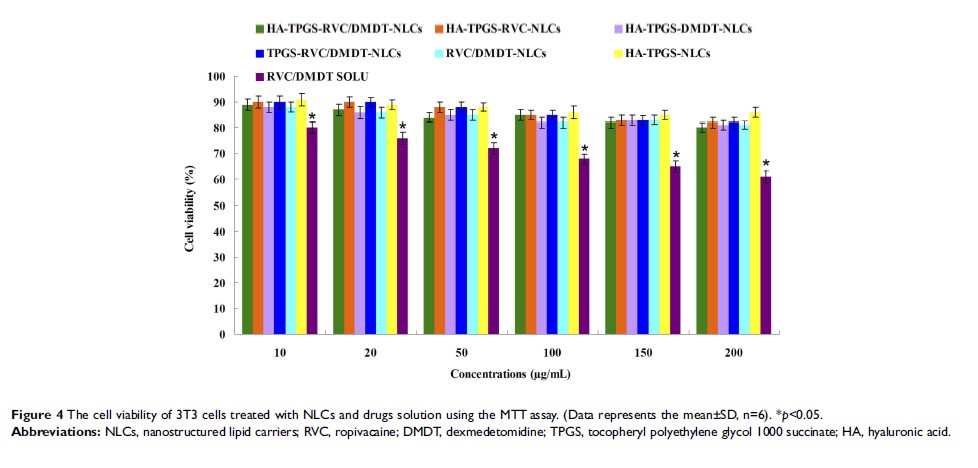
Results: NLCs have sizes of about 100 nm, with negative zeta potentials. All the NLCs formulations were found to be significantly less cytotoxic than free drugs at equivalent concentrations. The cumulative amount of drugs penetrated through rat skin from NLCs was 2.0–4.7 folds higher than that of the drugs solution. The in vivo anesthesia antinociception study displayed that NLCs showed stronger and longer anesthesia antinociceptive effect when compared with single drugs loaded NLCs and drugs solution even at a lower dosage of drugs.
Conclusion: The results demonstrated that the HA modified, TPGS contained, dual drugs loaded NLCs could perform a synergistic effect and may reduce the amount of drugs, which can lower the toxicity of the system and at the meanwhile, increase the anesthesia antinociceptive efficiency.
Keywords: topical anesthetic analgesic, skin penetration, hyaluronic acid, long-acting nanostructured lipid carriers, tocopheryl polyethylene glycol 1000 succinate