118847
论文已发表
注册即可获取德孚的最新动态
IF 收录期刊
- 3.6 Breast Cancer (Dove Med Press)
- 4.3 Clin Epidemiol
- 2.6 Cancer Manag Res
- 3.2 Infect Drug Resist
- 4.1 Clin Interv Aging
- 6.1 Drug Des Dev Ther
- 4.1 Int J Chronic Obstr
- 8.7 Int J Nanomed
- 2.5 Int J Women's Health
- 3.2 Neuropsych Dis Treat
- 2.4 OncoTargets Ther
- 2.6 Patient Prefer Adher
- 2.6 Ther Clin Risk Manag
- 3.1 J Pain Res
- 3.5 Diabet Metab Synd Ob
- 4.5 Psychol Res Behav Ma
- 3.4 Nat Sci Sleep
- 2.4 Pharmgenomics Pers Med
- 2.6 Risk Manag Healthc Policy
- 4.6 J Inflamm Res
- 2.3 Int J Gen Med
- 3.9 J Hepatocell Carcinoma
- 3.3 J Asthma Allergy
- 2.5 Clin Cosmet Investig Dermatol
- 3.0 J Multidiscip Healthc

叶酸修饰纳米颗粒递送叶黄素用于神经胶质瘤治疗
Authors Wu C, Xu Q, Chen X, Liu J
Received 6 May 2019
Accepted for publication 6 July 2019
Published 16 September 2019 Volume 2019:14 Pages 7515—7531
DOI https://doi.org/10.2147/IJN.S214585
Checked for plagiarism Yes
Review by Single-blind
Peer reviewers approved by Dr Melinda Thomas
Peer reviewer comments 2
Editor who approved publication: Dr Linlin Sun
Background: Glioblastoma mutliforme is the most common and has the poorest prognosis of any malignant tumor of the central nervous system. Luteolin, the most abundant xanthone extracted from vegetables and medicinal plants, has been shown to have treatment effects in various cancer cell types. Luteolin is however, hydrophobic and has poor biocompatibility, which leads to low bioavailability.
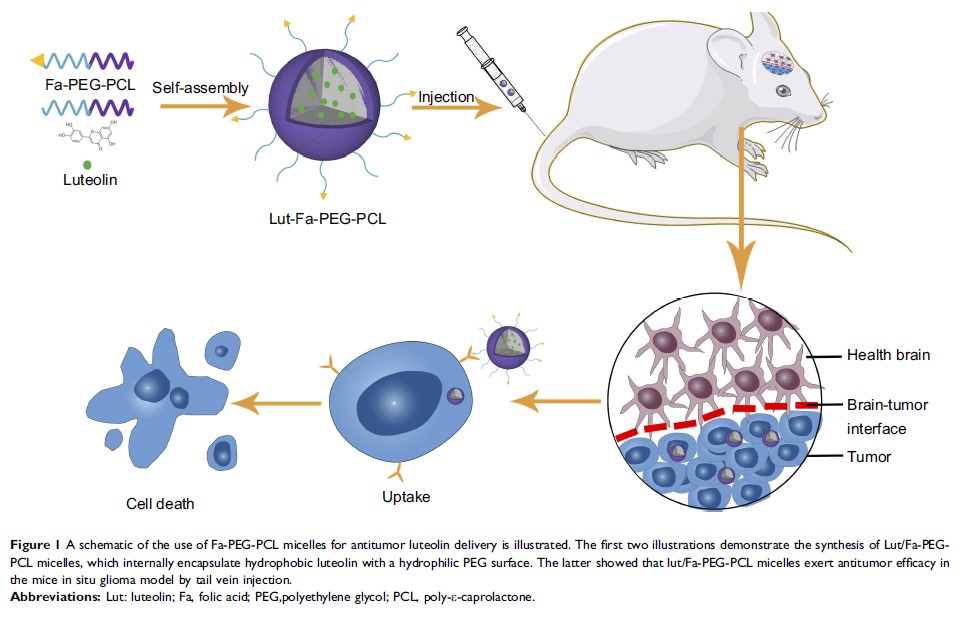
Patients and methods: In this study, folic acid modifiedpoly(ethylene glycol)-poly(e-caprolactone) (Fa-PEG-PCL) nano-micelles was used to encapsulate the luteolin, creating luteolin loaded PEG-PCL (Lut/Fa-PEG-PCL) micelles to treat glioma both in vitro and in vivo.
Results: When compared with the free luteolin and Lut/MPEG-PCL, Lut/Fa-PEG-PCL induced a significant cell growth inhibition and more apoptosis of GL261 cells both in vitro and in vivo. The safety assessment also showed no obvious side effects were observed in mice which were administrated with free luteolin or Lut/MPEG-PCL and Lut/Fa-PEG-PCL.
Conclusion: These results suggested Lut/Fa-PEG-PCL may be used as an excellent intravenously injectable formulation for the treatment and chemoprevention.
Keywords: luteolin, PEG-PCL, glioma, folic acid, apoptosis