118847
论文已发表
注册即可获取德孚的最新动态
IF 收录期刊
- 3.6 Breast Cancer (Dove Med Press)
- 4.3 Clin Epidemiol
- 2.6 Cancer Manag Res
- 3.2 Infect Drug Resist
- 4.1 Clin Interv Aging
- 6.1 Drug Des Dev Ther
- 4.1 Int J Chronic Obstr
- 8.7 Int J Nanomed
- 2.5 Int J Women's Health
- 3.2 Neuropsych Dis Treat
- 2.4 OncoTargets Ther
- 2.6 Patient Prefer Adher
- 2.6 Ther Clin Risk Manag
- 3.1 J Pain Res
- 3.5 Diabet Metab Synd Ob
- 4.5 Psychol Res Behav Ma
- 3.4 Nat Sci Sleep
- 2.4 Pharmgenomics Pers Med
- 2.6 Risk Manag Healthc Policy
- 4.6 J Inflamm Res
- 2.3 Int J Gen Med
- 3.9 J Hepatocell Carcinoma
- 3.3 J Asthma Allergy
- 2.5 Clin Cosmet Investig Dermatol
- 3.0 J Multidiscip Healthc

通过 tafazzin 靶向,恢复 miR-26b 表达可以部分地逆转 NSCLC 的顺铂耐药性
Authors Zang S, Zhao S, Gao X, Li Y, Zhong C, Gao J
Received 17 April 2019
Accepted for publication 8 July 2019
Published 13 September 2019 Volume 2019:12 Pages 7551—7560
DOI https://doi.org/10.2147/OTT.S212649
Checked for plagiarism Yes
Review by Single-blind
Peer reviewers approved by Ms Shreya Arora
Peer reviewer comments 3
Editor who approved publication: Dr Leo Jen-Liang Su
Background: Dysregulation of microRNAs has been reported to be responsible for drug resistance of cancers. However, the association between aberrant expression of miR-26b and cisplatin resistance in non-small cell lung cancer (NSCLC) remains unclear.
Methods: PC9 and A549 were used to establish the cisplatin resistance models on NSCLC. Expression of miR-26b in cisplatin-resistant PC9 and A549 cells (PC9/R and A549/R) was detected by quantitative real-time PCR assays. Drug sensitivity and mitochondrial apoptosis were detected by Cell Counting Kit-8 assay and flow cytometry assay, respectively. The target relationship between miR-26b and tafazzin (TAZ) was validated by dual-luciferase reporter assay.
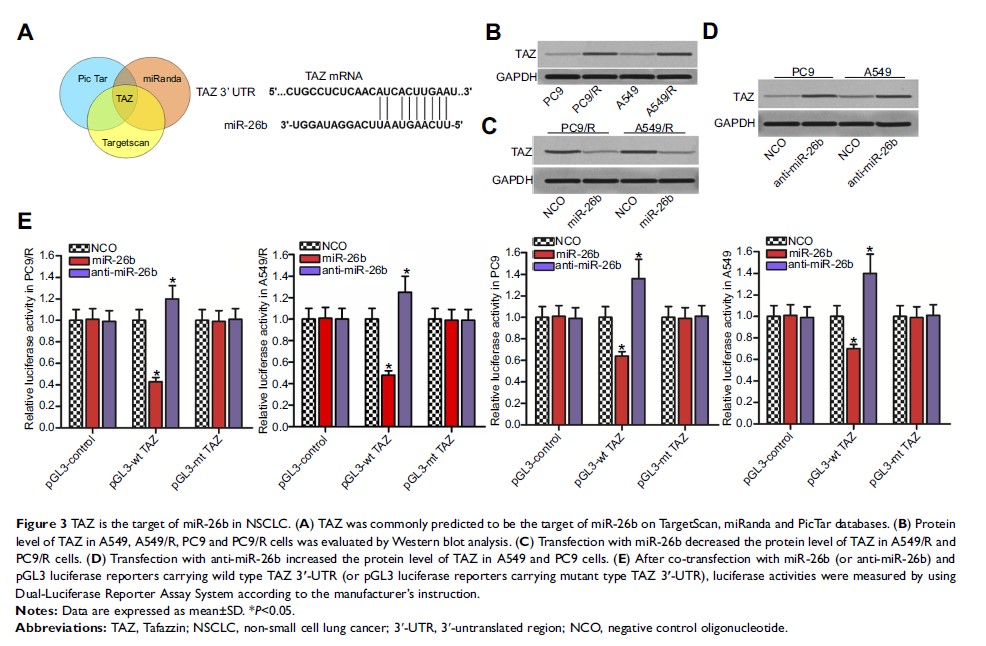
Results: Obvious downregulation of miR-26b was observed in PC9/R and A549/R cells. Restoration of miR-26b partially reversed the cisplatin resistance of PC9/R and A549/R cells. Expression of TAZ was increased in PC9/R and A549/R cells compared to the parental PC9 and A549 cells. Results of dual-luciferase reporter assays verified that TAZ was targeted by miR-26b. We showed that restoration of miR-26b expression inhibited the TAZ expression and thus expanded the mitochondrial pathway of apoptosis induced by cisplatin in PC9/R and A549/R cells.
Conclusion: Restoration of miR-26b expression partially reverses the cisplatin resistance of NSCLC by targeting TAZ. miR-26b/TAZ axis may represent a potential strategy to reverse the cisplatin in NSCLC.
Keywords: NSCLC, cisplatin, resistance, miR-26b, TAZ