118847
论文已发表
注册即可获取德孚的最新动态
IF 收录期刊
- 3.6 Breast Cancer (Dove Med Press)
- 4.3 Clin Epidemiol
- 2.6 Cancer Manag Res
- 3.2 Infect Drug Resist
- 4.1 Clin Interv Aging
- 6.1 Drug Des Dev Ther
- 4.1 Int J Chronic Obstr
- 8.7 Int J Nanomed
- 2.5 Int J Women's Health
- 3.2 Neuropsych Dis Treat
- 2.4 OncoTargets Ther
- 2.6 Patient Prefer Adher
- 2.6 Ther Clin Risk Manag
- 3.1 J Pain Res
- 3.5 Diabet Metab Synd Ob
- 4.5 Psychol Res Behav Ma
- 3.4 Nat Sci Sleep
- 2.4 Pharmgenomics Pers Med
- 2.6 Risk Manag Healthc Policy
- 4.6 J Inflamm Res
- 2.3 Int J Gen Med
- 3.9 J Hepatocell Carcinoma
- 3.3 J Asthma Allergy
- 2.5 Clin Cosmet Investig Dermatol
- 3.0 J Multidiscip Healthc

2007-2016 年中国侵袭性非伤寒沙门氏菌的分子流行病学和抗药性
Authors Zhan Z, Xu X, Gu Z, Meng J, Wufuer X, Wang M, Huang M, Chen J, Jing C, Xiong Z, Zeng M, Liao M, Zhang J
Received 3 April 2019
Accepted for publication 8 August 2019
Published 12 September 2019 Volume 2019:12 Pages 2885—2897
DOI https://doi.org/10.2147/IDR.S210961
Checked for plagiarism Yes
Review by Single-blind
Peer reviewers approved by Dr Melinda Thomas
Peer reviewer comments 2
Editor who approved publication: Dr Joachim Wink
Purpose: Human infections caused by invasive non-typhoidal Salmonella (iNTS) are highly prevalent worldwide. However, data for such infections in China are scarce. This study reports the epidemiology of iNTS in China.
Methods: INTS isolates were recovered from blood and other clinical specimens collected during 2007–2016 across five provinces (Shanghai, Xinjiang, Fujian, Guangxi, and Chongqing) in China. Antimicrobial susceptibility was performed using the agar dilution method and molecular epidemiology was performed using standard microbiological techniques.
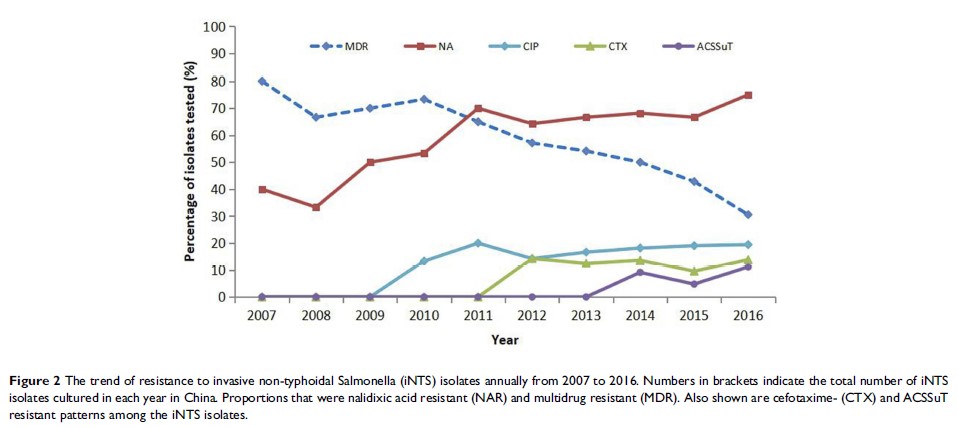
Results: A total of 178 iNTS isolates were recovered from approximately 9700 patient specimens during 2007–2016. The predominant serovars were Salmonella Enteritidis (57/178, 32%), Salmonella Choleraesuis (47/178, 26.4%), and Salmonella Typhimurium (24/178, 13.5%). Up to 50 isolates (28.1%) were from patients who were ≤1 year of age, while 28 (15.7%) were from patients who were ≥60 years. Among these isolates, high rates of resistance to nalidixic acid (114/178, 64%), sulfisoxazole (59%), ciprofloxacin (15.2%), and cefotaxime (8.4%) were found. Moreover, 53.4% (95/178) exhibited multidrug resistance, and 3.9% (7/178) showed co-resistance to third-generation cephalosporins and ciprofloxacin. Steadily increasing numbers of nalidixic acid, cefotaxime, and ciprofloxacin-resistant isolates, but decreasing numbers of multidrug resistance isolates were detected during the study period. Detection of quinolone genes in 114 nalidixic acid-resistant isolates showed that 58.3% (67/114) harbored plasmid-mediated quinolone resistance (PMQR) genes [aac(6´)-Ib-cr, qnrA, qnrB, oqxAB, qepA, qnrS , and qnrD ] and 98.2% (112/114) exhibited mutations in quinolone resistance determining regions [gyrA, parC, and parE ]. Furthermore, we detected beta-lactamases genes in the ceftriaxone-resistant isolates. The most common were blaTEM-1 (93.3%), followed by blaCTX-M-55 (40%), blaCMY-2 (33.3%), and blaOXA-1 (33.3%). Finally, a range of pulsed-field gel electrophoresis patterns were detected among the Salmonella Enteritidis and Salmonella Typhimurium isolates.
Conclusion: High rates of multidrug resistance and steadily increasing cefotaxime and ciprofloxacin-resistant iNTS could pose a significant challenge for the effective treatment of salmonellosis in China.
Keywords: invasive non-typhoidal Salmonella , fluoroquinolones, multidrug resistant, beta-lactamases, pulsed field gel electrophoresis, China