118847
论文已发表
注册即可获取德孚的最新动态
IF 收录期刊
- 3.6 Breast Cancer (Dove Med Press)
- 4.3 Clin Epidemiol
- 2.6 Cancer Manag Res
- 3.2 Infect Drug Resist
- 4.1 Clin Interv Aging
- 6.1 Drug Des Dev Ther
- 4.1 Int J Chronic Obstr
- 8.7 Int J Nanomed
- 2.5 Int J Women's Health
- 3.2 Neuropsych Dis Treat
- 2.4 OncoTargets Ther
- 2.6 Patient Prefer Adher
- 2.6 Ther Clin Risk Manag
- 3.1 J Pain Res
- 3.5 Diabet Metab Synd Ob
- 4.5 Psychol Res Behav Ma
- 3.4 Nat Sci Sleep
- 2.4 Pharmgenomics Pers Med
- 2.6 Risk Manag Healthc Policy
- 4.6 J Inflamm Res
- 2.3 Int J Gen Med
- 3.9 J Hepatocell Carcinoma
- 3.3 J Asthma Allergy
- 2.5 Clin Cosmet Investig Dermatol
- 3.0 J Multidiscip Healthc

由两亲性杂合肽和脂质组成的低密度脂蛋白模拟纳米颗粒,用于紫杉醇的肿瘤靶向递送
Authors Qian J, Xu N, Zhou X, Shi K, Du Q, Yin X, Zhao Z
Received 9 May 2019
Accepted for publication 1 August 2019
Published 11 September 2019 Volume 2019:14 Pages 7431—7446
DOI https://doi.org/10.2147/IJN.S215080
Checked for plagiarism Yes
Review by Single-blind
Peer reviewers approved by Dr Alexander Kharlamov
Peer reviewer comments 2
Editor who approved publication: Dr Lei Yang
Background: Low density lipoprotein (LDL) has been regarded as a promising antitumor drug vehicle. However some problems, such as rare source, difficulty of large-scale production, and potential safety concerns, hinder its clinical application.
Purpose: The objective of this study is to develop a biomimetic LDL nanocarrier by replacing the native apolipoprotein B-100 (apoB-100) with an artificial amphipathic peptide and demonstrate its antitumor efficacy.
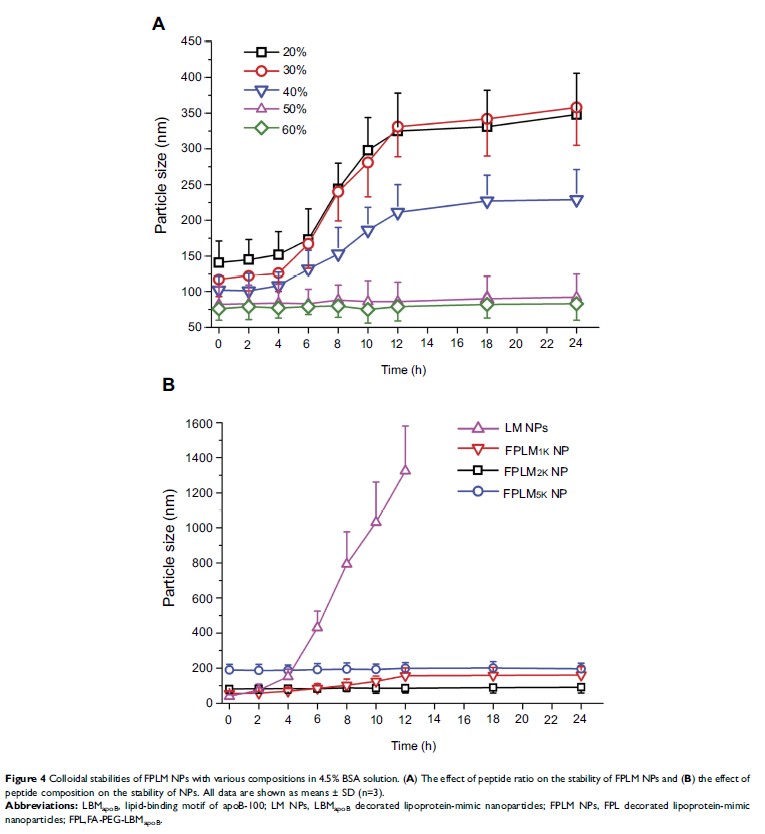
Methods: The amphipathic hybrid peptide (termed as FPL) consisting of a lipid binding motif of apoB-100 (LBMapoB)-polyethylene glycol (PEG)-folic acid (FA) was synthesized and characterized by 1H NMR and circular dichroism. FPL decorated lipoprotein-mimic nanoparticles (termed as FPLM NPs) were prepared by a modified solvent emulsification method. Paclitaxel (PTX) was incorporated into NPs and its content was quantified by HPLC analysis. The morphology of NPs was observed by transmission electron microscopy (TEM), and the particle size and zeta potential of NPs were determined by dynamic light scattering (DLS). The colloidal stability of FPLM NPs was evaluated in PBS containing bovine serum albumin (BSA). In vitro release of PTX loaded FPLM NPs was evaluated using the dialysis method. Cellular uptake and cytotoxity assayswere evaluated on human cervical cancer cells (HeLa) and lung cancer cells (A549). Tumor inhibition in vivo was investigated in M109 tumor-bearing mice via tail vein injection of Taxol formulation and PTX loaded NPs.
Results: The composition of FPLM NPs, including cholesteryl oleate, glyceryl trioleate, cholesterol, 1,2-dioleoyl-sn-glycero-3-phosphoethanolamine (DOPE), and FPL peptides, was optimized to be 5:1:1:3:10 (w/w). FPLM NPs had a spherical shape with a mean diameter of 83 nm and a negative charge (-12 mV). FPLM NPs with optimum formulation had good colloidal stability in BSA solution.The release of PTX from FPLM NPs was slow and sustained. The uptake of FPLM NPs was higher in folate receptor (FR) overexpressing tumor cells (HeLa cells) than in FR deficient tumor cells (A549 cells). The intracellular distribution indicated that FPLM NPs had the lysosome escape capacity. The internalization mechanism of FPLM NPs was involved with clathrin- and caveolae-mediated endocytosis and FR played a positive role in the internalization of FPLM NPs. The CCK-8 assay demonstrated that FPLM NPs exhibited notably better anti-tumor effect than Taxol formulation in vitro. Moreover, PTX loaded FPLM NPs produced very marked anti-tumor efficiency in M109 tumor-bearing mice in vivo.
Conclusion: FPLM NPs is a promising nanocarrier which can improve the therapeutic effect and reduce the side effects of antitumor drugs.
Keywords: LDL mimic nanoparticles, amphipathic peptide, folic acid, paclitaxel, tumor targeting