118847
论文已发表
注册即可获取德孚的最新动态
IF 收录期刊
- 3.6 Breast Cancer (Dove Med Press)
- 4.3 Clin Epidemiol
- 2.6 Cancer Manag Res
- 3.2 Infect Drug Resist
- 4.1 Clin Interv Aging
- 6.1 Drug Des Dev Ther
- 4.1 Int J Chronic Obstr
- 8.7 Int J Nanomed
- 2.5 Int J Women's Health
- 3.2 Neuropsych Dis Treat
- 2.4 OncoTargets Ther
- 2.6 Patient Prefer Adher
- 2.6 Ther Clin Risk Manag
- 3.1 J Pain Res
- 3.5 Diabet Metab Synd Ob
- 4.5 Psychol Res Behav Ma
- 3.4 Nat Sci Sleep
- 2.4 Pharmgenomics Pers Med
- 2.6 Risk Manag Healthc Policy
- 4.6 J Inflamm Res
- 2.3 Int J Gen Med
- 3.9 J Hepatocell Carcinoma
- 3.3 J Asthma Allergy
- 2.5 Clin Cosmet Investig Dermatol
- 3.0 J Multidiscip Healthc

抑制刺猬信号可以逆转难治性急性髓细胞性白血病的耐药性
Authors Huang K, Sun Z, Ding B, Jiang X, Wang Z, Zhu Y, Meng F
Received 22 May 2019
Accepted for publication 16 August 2019
Published 11 September 2019 Volume 2019:12 Pages 7477—7488
DOI https://doi.org/10.2147/OTT.S216628
Checked for plagiarism Yes
Review by Single-blind
Peer reviewers approved by Ms Shreya Arora
Peer reviewer comments 2
Editor who approved publication: Dr William Cho
Background: Hedgehog (Hh) signaling is involved in the pathogenesis of tumors. By performing gene chip analysis, we predicted that Hh signaling might regulate multiple downstream pathways in acute myeloid leukemia (AML).
Methods: In this study, the potential role of the Hh pathway in refractory AML, and the impact of Hh expression on clinical prognosis were examined. We also investigated the role of the Hh inhibitor NVP-LDE225 in reversing drug resistance of refractory primary AML cells in vitro and the roles of multiple drug-resistant HL60/Adriamycin-resistant cells in vitro and in vivo (in a xenograft mouse model). Finally, we explored the underlying mechanisms.
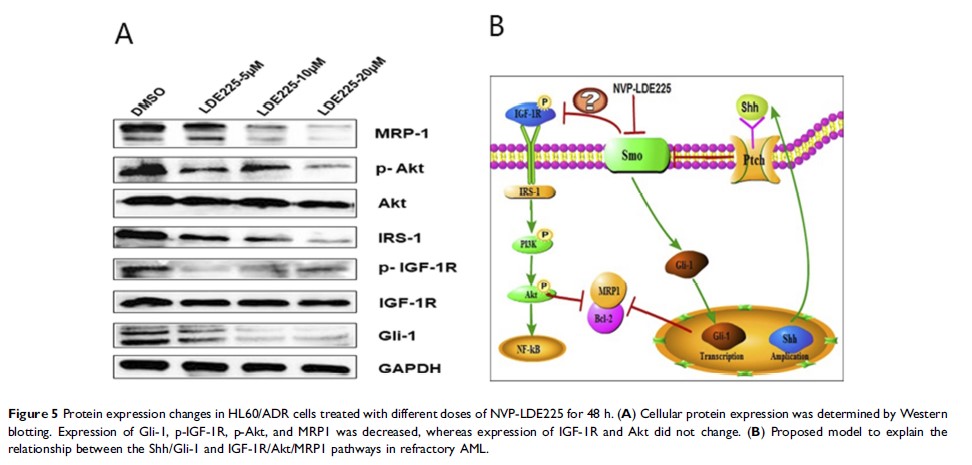
Results: Hh pathway was highly active in chemotherapy-resistant AML cells; by contrast, activation was less pronounced in chemosensitive cells and non-refractory primary cells. Strong activation of this pathway was associated with higher recurrence rates and poorer relapse-free and overall survival. NVP-LDE225 inhibited MRP1 protein expression, increased intracellular accumulation of Adriamycin, and reversed chemotherapeutic resistance. These effects were likely mediated through inhibition of the IGF-1R/Akt/MRP1 pathway. In the AML xenograft mouse model, NVP-LDE225 plus Adriamycin resulted in marked tumor regression.
Conclusion: These findings suggest that targeting the Hh pathway might be a therapeutic avenue for overcoming MDR resistance and preventing refractory AML.
Keywords: Hedgehog pathway, drug resistance, acute myeloid leukemia