118847
论文已发表
注册即可获取德孚的最新动态
IF 收录期刊
- 3.6 Breast Cancer (Dove Med Press)
- 4.3 Clin Epidemiol
- 2.6 Cancer Manag Res
- 3.2 Infect Drug Resist
- 4.1 Clin Interv Aging
- 6.1 Drug Des Dev Ther
- 4.1 Int J Chronic Obstr
- 8.7 Int J Nanomed
- 2.5 Int J Women's Health
- 3.2 Neuropsych Dis Treat
- 2.4 OncoTargets Ther
- 2.6 Patient Prefer Adher
- 2.6 Ther Clin Risk Manag
- 3.1 J Pain Res
- 3.5 Diabet Metab Synd Ob
- 4.5 Psychol Res Behav Ma
- 3.4 Nat Sci Sleep
- 2.4 Pharmgenomics Pers Med
- 2.6 Risk Manag Healthc Policy
- 4.6 J Inflamm Res
- 2.3 Int J Gen Med
- 3.9 J Hepatocell Carcinoma
- 3.3 J Asthma Allergy
- 2.5 Clin Cosmet Investig Dermatol
- 3.0 J Multidiscip Healthc

氨苄西林在实验室诱导的大肠杆菌耐药机制
Authors Li M, Liu Q, Teng Y, Ou L, Xi Y, Chen S, Duan G
Received 28 June 2019
Accepted for publication 29 August 2019
Published 11 September 2019 Volume 2019:12 Pages 2853—2863
DOI https://doi.org/10.2147/IDR.S221212
Checked for plagiarism Yes
Review by Single-blind
Peer reviewers approved by Dr Nicola Ludin
Peer reviewer comments 2
Editor who approved publication: Professor Suresh Antony
Background: Multi-drug-resistant Escherichia coli poses a great threat to human health, especially resistant to ampicillin (AMP), but the mechanism of drug resistance is not very clear.
Purpose: To understand the mechanism of resistance of E. coli to beta-lactam antibiotics by inducing drug resistance of sensitive bacteria in laboratory.
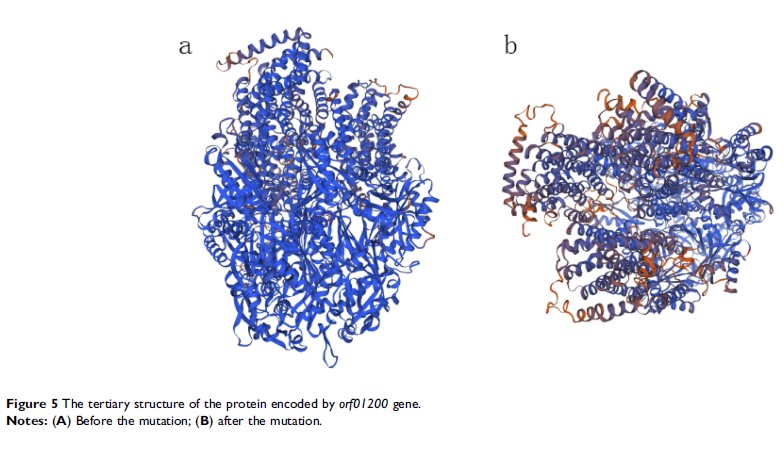
Methods: Clinical sensitive E. coli strain was induced into resistance strain by 1/2 minimum inhibitive concentration (MIC) induced trails of AMP. The drug resistance spectrum was measured by modified K-B susceptibility test. Whole-genome sequencing analysis was used to analyze primary sensitive strain, and resequencing was used to analyze induced strains. Protein tertiary structure encoded by the gene containing single nucleotide polymorphism (SNP) was analyzed by bioinformatics.
Results: After 315 hrs induced, the MIC value of E. coli 15743 reached to 256 μg/mL, 64 times higher than that of the sensitive bacteria. During the induction process, the bacterial resistance process is divided into two stages. The rate of drug resistance occurs rapidly before reaching the critical concentration of 32 μg/mL, and then the resistance rate slows down. Sequencing of the genome of resistant strain showed that E. coli 15743 drug-resistant strain with the MIC values of 32 and 256 μg/mL contained four and eight non-synonymous SNPs, respectively. These non-synonymous SNPs were distributed in the genes of frdD, ftsI, acrB, OmpD, marR, VgrG, and envZ.
Conclusion: These studies will improve our understanding of the molecular mechanism of AMP resistance of E. coli , and may provide the basis for prevention and control of multi-drug-resistant bacteria and generation of new antibiotics to treat E. coli infection.
Keywords: Escherichia coli , ampicillin, drug resistance