118847
论文已发表
注册即可获取德孚的最新动态
IF 收录期刊
- 3.6 Breast Cancer (Dove Med Press)
- 4.3 Clin Epidemiol
- 2.6 Cancer Manag Res
- 3.2 Infect Drug Resist
- 4.1 Clin Interv Aging
- 6.1 Drug Des Dev Ther
- 4.1 Int J Chronic Obstr
- 8.7 Int J Nanomed
- 2.5 Int J Women's Health
- 3.2 Neuropsych Dis Treat
- 2.4 OncoTargets Ther
- 2.6 Patient Prefer Adher
- 2.6 Ther Clin Risk Manag
- 3.1 J Pain Res
- 3.5 Diabet Metab Synd Ob
- 4.5 Psychol Res Behav Ma
- 3.4 Nat Sci Sleep
- 2.4 Pharmgenomics Pers Med
- 2.6 Risk Manag Healthc Policy
- 4.6 J Inflamm Res
- 2.3 Int J Gen Med
- 3.9 J Hepatocell Carcinoma
- 3.3 J Asthma Allergy
- 2.5 Clin Cosmet Investig Dermatol
- 3.0 J Multidiscip Healthc

反馈环境与创造力之间的关系:自我激励的视角
Authors Gong Z, Shan C, Yu H
Received 2 July 2019
Accepted for publication 29 August 2019
Published 11 September 2019 Volume 2019:12 Pages 825—837
DOI https://doi.org/10.2147/PRBM.S221670
Checked for plagiarism Yes
Review by Single-blind
Peer reviewers approved by Dr Colin Mak
Peer reviewer comments 2
Editor who approved publication: Dr Einar Thorsteinsson
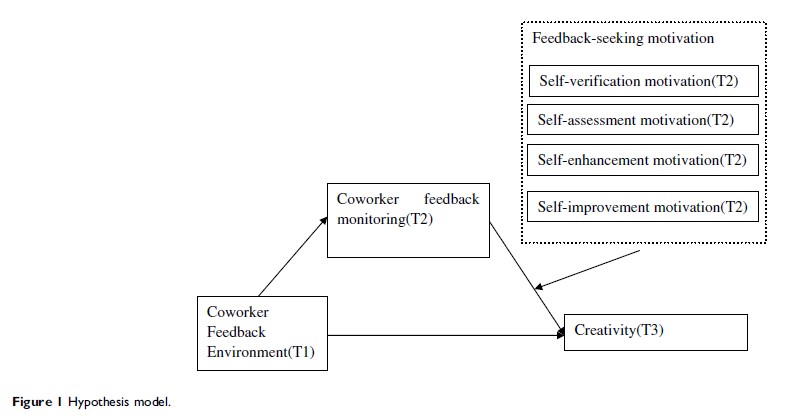
Background: For companies, employee creativity is vital to gaining competitive business advantages. Research regarding creativity has focused on contextual factors such as feedback, but results of studies on the relationship between feedback and creativity are inconsistent; further, only a handful of studies have been carried out from the perspective of coworkers. In this study, we aimed to analyze the association between the coworker feedback environment and creativity, to test the mediating role of feedback monitoring in this relationship and to test the moderating role of self-motivation among employees in China.
Methods: A coworker feedback environment survey, a coworker feedback monitoring questionnaire, a self-motivation scale and a creativity scale were used. The staff submitted 264 questionnaires, of which 235 (74.6%) were completed by the participants. Among the respondents in the sample, 132 (56.2%) were men, and 103 (43.8%) were women. The mean age is 30 and age range from 24–49. Mplus 7.11 software was used to perform descriptive analysis, Spearman’s correlation analysis, mediating analysis and moderation analysis.
Results: Coworker feedback environment was positively associated with creativity (β =0.60, p <0.01) after controlling for the demographic variable. Coworker feedback monitoring partially mediated the relationship between coworker feedback environment and creativity (χ2/df=2.5 , RMSEA=0.05; CFI=0.93; GFI=0.93). When self-assessment motivation is lower, the positive relationship between coworker feedback monitoring and creativity becomes stronger (β =0.19); the same relationship becomes weaker (β =0.01) when self-assessment motivation is higher.
Conclusion: It was suggested that a coworker feedback environment could improve employee creativity by promoting coworker feedback monitoring; creativity could be improved especially among employees who have lower self-assessment motivation.
Keywords: feedback environment, creativity, feedback seeking, self-motivation