118847
论文已发表
注册即可获取德孚的最新动态
IF 收录期刊
- 3.6 Breast Cancer (Dove Med Press)
- 4.3 Clin Epidemiol
- 2.6 Cancer Manag Res
- 3.2 Infect Drug Resist
- 4.1 Clin Interv Aging
- 6.1 Drug Des Dev Ther
- 4.1 Int J Chronic Obstr
- 8.7 Int J Nanomed
- 2.5 Int J Women's Health
- 3.2 Neuropsych Dis Treat
- 2.4 OncoTargets Ther
- 2.6 Patient Prefer Adher
- 2.6 Ther Clin Risk Manag
- 3.1 J Pain Res
- 3.5 Diabet Metab Synd Ob
- 4.5 Psychol Res Behav Ma
- 3.4 Nat Sci Sleep
- 2.4 Pharmgenomics Pers Med
- 2.6 Risk Manag Healthc Policy
- 4.6 J Inflamm Res
- 2.3 Int J Gen Med
- 3.9 J Hepatocell Carcinoma
- 3.3 J Asthma Allergy
- 2.5 Clin Cosmet Investig Dermatol
- 3.0 J Multidiscip Healthc

调强放疗治疗 250 例宫颈癌及上胸段食管癌患者的临床结果
Authors Zhang J, Zhang W, Zhang B, Qian D, Li X, Zhang H, Wang Q, Zhao L, Pang Q, Wang P
Received 30 January 2019
Accepted for publication 26 July 2019
Published 10 September 2019 Volume 2019:11 Pages 8285—8294
DOI https://doi.org/10.2147/CMAR.S203575
Checked for plagiarism Yes
Review by Single-blind
Peer reviewers approved by Dr Amy Norman
Peer reviewer comments 2
Editor who approved publication: Dr Eileen O'Reilly
Purpose: To evaluate and analyze the efficacy and prognostic factors of intensity-modulated radiotherapy in 250 patients with cervical and upper esophageal carcinoma.
Patients and methods: From September 2009 to September 2016, we retrospectively analyzed 250 patients with cervical and upper esophageal carcinoma treated with intensity-modulated radiotherapy (IMRT). In our study, all patients received IMRT, 54 patients with cervical esophageal carcinoma and 196 patients with upper esophageal carcinoma. Treatment response, survival status and failure modes of treatment were observed, and prognostic factors were analyzed.
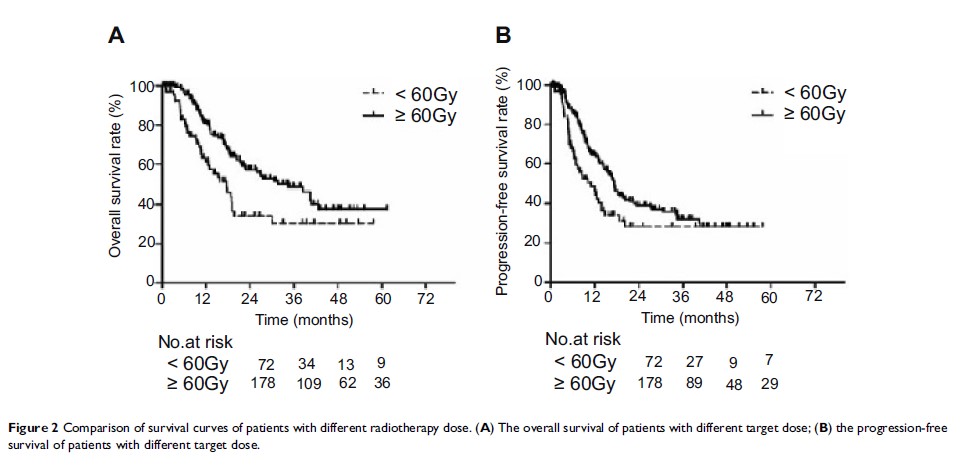
Results: The median survival time was 22.60 months and 3-year survival rate was 42%. The median progress-free survival time was 14.52 months and 3-year progress-free survival rate was 29.3%. The median survival time and the median progress-free survival time for cervical esophageal carcinoma were 20.40 and 15.15 months, respectively. The median survival time and the median progress-free survival time for upper esophageal carcinoma were 25.80 and 14.52 months, respectively (P >0.05). The significant clinical factors associated with survival were patient age, radiotherapy dose and T stages (P <0.05). Radiotherapy dose and concurrent chemoradiotherapy were the significant clinical factors related to progression-free survival (P <0.05). Recurrence appeared in 55.2% patients, including local recurrence in 22.40%, region relapse in 10.40% and distant metastasis in 12.40%. Local recurrence was the main mode of treatment failure. During treatment, the main treatment-related acute toxicity was leukocytopenia and anemia.
Conclusion: In this study, IMRT demonstrated clinical benefit and well-tolerated toxicity in patients with cervical and upper esophageal carcinoma.
Keywords: cervical esophageal carcinoma, upper esophageal carcinoma, intensity-modulated radiotherapy, prognosis