118847
论文已发表
注册即可获取德孚的最新动态
IF 收录期刊
- 3.6 Breast Cancer (Dove Med Press)
- 4.3 Clin Epidemiol
- 2.6 Cancer Manag Res
- 3.2 Infect Drug Resist
- 4.1 Clin Interv Aging
- 6.1 Drug Des Dev Ther
- 4.1 Int J Chronic Obstr
- 8.7 Int J Nanomed
- 2.5 Int J Women's Health
- 3.2 Neuropsych Dis Treat
- 2.4 OncoTargets Ther
- 2.6 Patient Prefer Adher
- 2.6 Ther Clin Risk Manag
- 3.1 J Pain Res
- 3.5 Diabet Metab Synd Ob
- 4.5 Psychol Res Behav Ma
- 3.4 Nat Sci Sleep
- 2.4 Pharmgenomics Pers Med
- 2.6 Risk Manag Healthc Policy
- 4.6 J Inflamm Res
- 2.3 Int J Gen Med
- 3.9 J Hepatocell Carcinoma
- 3.3 J Asthma Allergy
- 2.5 Clin Cosmet Investig Dermatol
- 3.0 J Multidiscip Healthc

经皮穴位电刺激对围手术期老年冠心病患者的心脏保护作用:一项前瞻性、随机、对照临床试验
Authors Li H, Wu C, Yan C, Zhao S, Yang S, Liu P, Liu X, Wang M, Wang X
Received 8 April 2019
Accepted for publication 10 July 2019
Published 6 September 2019 Volume 2019:14 Pages 1607—1614
DOI https://doi.org/10.2147/CIA.S210751
Checked for plagiarism Yes
Review by Single-blind
Peer reviewers approved by Dr Cristina Weinberg
Peer reviewer comments 3
Editor who approved publication: Dr Zhi-Ying Wu
Purpose: The purpose of this study was to evaluate the effects of transcutaneous electrical acupoint stimulation (TEAS) on postoperative autonomic nervous system function and serum biomarkers in the elderly.
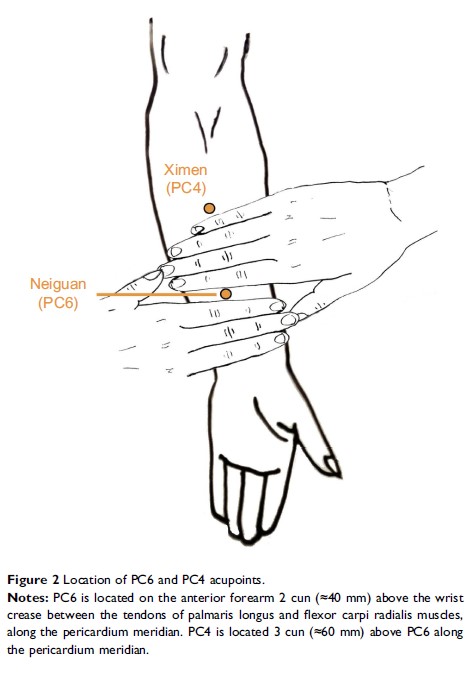
Patients and methods: A total of 122 American Society of Anesthesiologists class II or III patients with coronary heart disease undergoing spinal surgery were randomly divided into two groups: TEAS (received TEAS at Neiguan [PC6] and Ximen [PC4] for 30 minutes before anesthesia induction until the end of surgery) and control (received electrode plate at the same acupuncture points without any electrical stimulation). Serum was isolated for the measurement of concentration of high-sensitive troponin T (hs-cTnT), CRP, and CK. Heart rate (HR) and heart rate variability (HRV) including: total power (TP), low-frequency (LF) power, high-frequency (HF) power, and LF/HF ratio were used to assess autonomic nervous system function. The primary outcome was to evaluate whether TEAS changed the postoperative serum hs-cTnT. The secondary outcomes were to observe the effects of TEAS on HRV, circulating CK and CRP after surgery.
Results: Hs-cTnT, CRP, and CK concentrations were significantly higher on first, third and fifth day after surgery than those before anesthesia induction in both groups. Hs-cTnT concentration was significantly lower on the first and third day after surgery in TEAS group than in control group. Compared with 1 day before surgery, TP, LF, and HF decreased significantly and HR, LF/HF increased significantly on first, third, and fifth day after surgery in control group. Compared with control group, HR was significantly lower on the first, third, and fifth day after surgery, LF/HF decreased and TP, LF, HF were significantly higher on the first day after surgery in TEAS group.
Conclusion: TEAS at PC6 and PC4 could reduce postoperative serum hs-cTnT concentration and change HRV index to improve autonomic nervous system activity.
Keywords: transcutaneous electric acupuncture point stimulation, coronary artery disease, autonomic nervous system, high-sensitive troponin T, heart rate variability