118847
论文已发表
注册即可获取德孚的最新动态
IF 收录期刊
- 3.6 Breast Cancer (Dove Med Press)
- 4.3 Clin Epidemiol
- 2.6 Cancer Manag Res
- 3.2 Infect Drug Resist
- 4.1 Clin Interv Aging
- 6.1 Drug Des Dev Ther
- 4.1 Int J Chronic Obstr
- 8.7 Int J Nanomed
- 2.5 Int J Women's Health
- 3.2 Neuropsych Dis Treat
- 2.4 OncoTargets Ther
- 2.6 Patient Prefer Adher
- 2.6 Ther Clin Risk Manag
- 3.1 J Pain Res
- 3.5 Diabet Metab Synd Ob
- 4.5 Psychol Res Behav Ma
- 3.4 Nat Sci Sleep
- 2.4 Pharmgenomics Pers Med
- 2.6 Risk Manag Healthc Policy
- 4.6 J Inflamm Res
- 2.3 Int J Gen Med
- 3.9 J Hepatocell Carcinoma
- 3.3 J Asthma Allergy
- 2.5 Clin Cosmet Investig Dermatol
- 3.0 J Multidiscip Healthc

热休克蛋白(HSP)10 和 HSP70 的表达增加与鼻咽癌的预后不良有关
Authors Feng J, Zhan Y, Zhang Y, Zheng H, Wang W, Fan S
Received 5 June 2019
Accepted for publication 5 August 2019
Published 6 September 2019 Volume 2019:11 Pages 8219—8227
DOI https://doi.org/10.2147/CMAR.S218427
Checked for plagiarism Yes
Review by Single-blind
Peer reviewers approved by Dr Melinda Thomas
Peer reviewer comments 2
Editor who approved publication: Dr Antonella D'Anneo
Background: Heat shock proteins (HSPs) are a large family of chaperones implicating in occurrence and progression of tumor. In our previous study, we found HSP10 correlates with poor prognosis of oral squamous cell carcinoma and astrocytoma. HSP70 is also an important part of this family and whether the alterations of HSP10 and HSP70 expression and their common expression correlates with carcinogenesis and progression of nasopharyngeal carcinoma (NPC) has not been reported.
Method: In this study, we investigate the correlation between the expression of HSP10 and HSP70 and clinicopathological characteristics in NPC by immunohistochemistry (IHC).
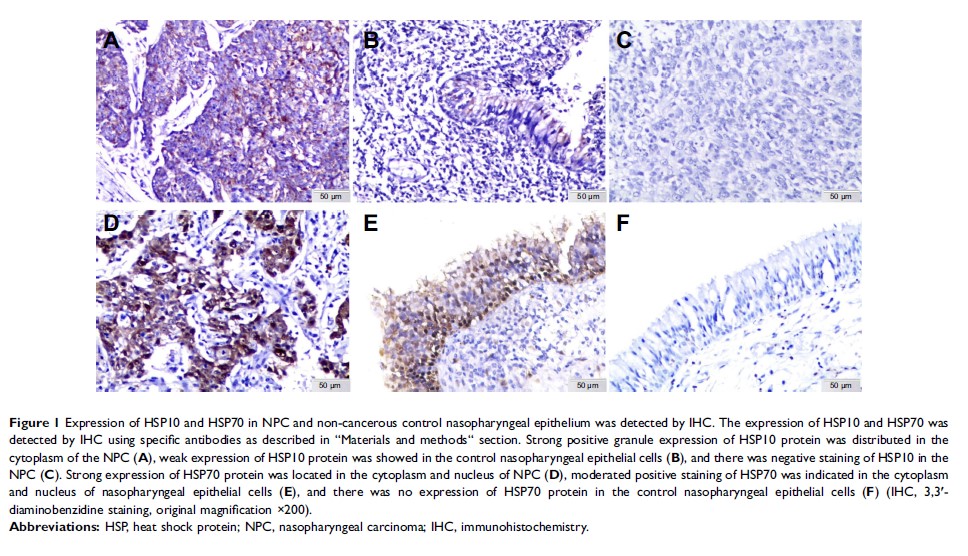
Results: Results indicated that positive expression of HSP10 and HSP70 was higher in NPC tissues (both P <0.001). Positive expression of HSP10 and HSP70 proteins, and common positive expression of the two HSPs analyzed in advanced clinical stages were higher than that in early clinical stages (All P <0.05). There was significantly higher expression of HSP10, HSP70, and common expression in NPC with LNM (lymph node metastasis) compared with NPC without LNM (All P <0.05). Interestingly, positive expression of HSP10 and HSP70 proteins and common expression had an evidently inverse correlation with survival status (All P <0.05). Spearman’s correlation analysis showed expression of HSP10 was positively associated with HSP70 (r=0.407, P <0 0.001). Kaplan–Meier analysis showed that the overall survival rates for NPC patients with positive expression of HSP10 and HSP70 and common expression were significantly lower than these patients with negative expression (All P <0.05). Furthermore, positive expression of HSP10 and HSP70 proteins was identified as independent poor prognostic factors for NPC patients (both P <0.05) by Cox regression analysis.
Conclusion: In conclusion, HSP10 and HSP70 can serve as the poor prognostic factors for NPC patients.
Keywords: nasopharyngeal carcinoma, HSP10, HSP70, prognosis