118847
论文已发表
注册即可获取德孚的最新动态
IF 收录期刊
- 3.6 Breast Cancer (Dove Med Press)
- 4.3 Clin Epidemiol
- 2.6 Cancer Manag Res
- 3.2 Infect Drug Resist
- 4.1 Clin Interv Aging
- 6.1 Drug Des Dev Ther
- 4.1 Int J Chronic Obstr
- 8.7 Int J Nanomed
- 2.5 Int J Women's Health
- 3.2 Neuropsych Dis Treat
- 2.4 OncoTargets Ther
- 2.6 Patient Prefer Adher
- 2.6 Ther Clin Risk Manag
- 3.1 J Pain Res
- 3.5 Diabet Metab Synd Ob
- 4.5 Psychol Res Behav Ma
- 3.4 Nat Sci Sleep
- 2.4 Pharmgenomics Pers Med
- 2.6 Risk Manag Healthc Policy
- 4.6 J Inflamm Res
- 2.3 Int J Gen Med
- 3.9 J Hepatocell Carcinoma
- 3.3 J Asthma Allergy
- 2.5 Clin Cosmet Investig Dermatol
- 3.0 J Multidiscip Healthc

通过钛纳米管表面改性增强整形外科植入物的抗菌性能:当前技术综述
Authors Li Y, Yang Y, Li R, Tang X, Guo D, Qing Y, Qin Y
Received 17 May 2019
Accepted for publication 9 August 2019
Published 5 September 2019 Volume 2019:14 Pages 7217—7236
DOI https://doi.org/10.2147/IJN.S216175
Checked for plagiarism Yes
Review by Single-blind
Peer reviewers approved by Dr Amy Norman
Peer reviewer comments 2
Editor who approved publication: Dr Linlin Sun
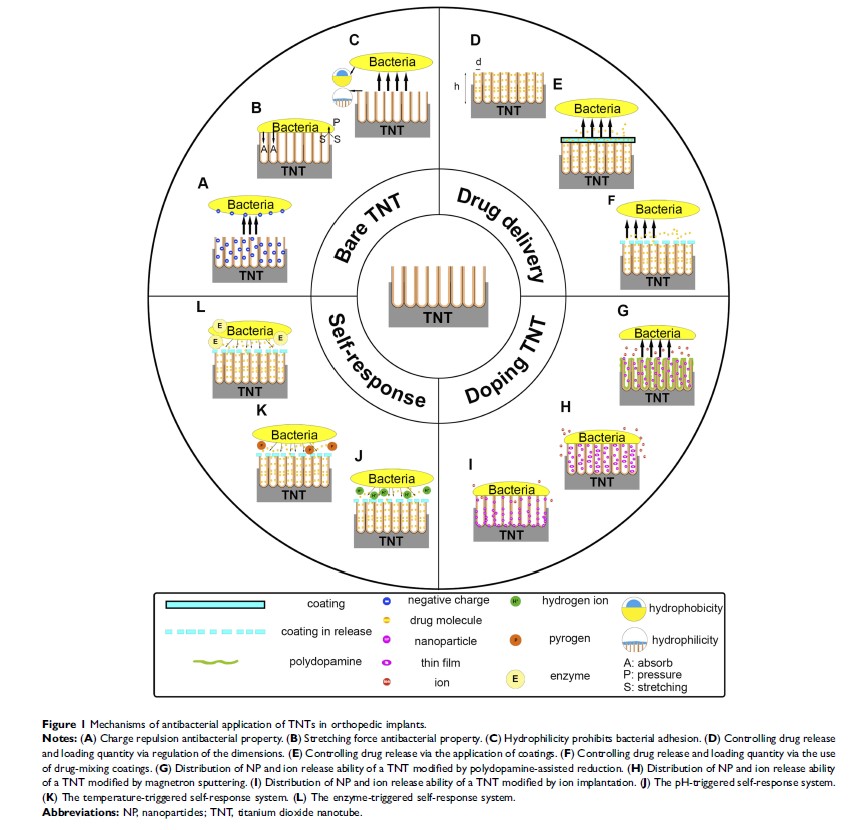
Abstract: Prosthesis-associated infections are one of the main causes of implant failure; thus it is important to enhance the long-term antibacterial ability of orthopedic implants. Titanium dioxide nanotubes (TNTs) are biomaterials with good physicochemical properties and biocompatibility. Owing to their inherent antibacterial and drug-loading ability, the antibacterial application of TNTs has received increasing attention. In this review, the process of TNT anodizing fabrication is summarized. Also, the mechanism and the influencing factors of the antibacterial property of bare TNTs are explored. Furthermore, different antibacterial strategies for carrying drugs, as well as modifications to prolong the antibacterial effect and reduce drug-related toxicity are discussed. In addition, antibacterial systems based on TNTs that can automatically respond to infection are introduced. Finally, the currently faced problems are reviewed and potential solutions are proposed. This review provides new insight on TNT fabrication and summarizes the most advanced antibacterial strategies involving TNTs for the enhancement of long-term antibacterial ability and reduction of toxicity.
Keywords: antibacterial property, drug delivery, titanium dioxide nanotube, orthopedic implant, surface modification