118847
论文已发表
注册即可获取德孚的最新动态
IF 收录期刊
- 3.6 Breast Cancer (Dove Med Press)
- 4.3 Clin Epidemiol
- 2.6 Cancer Manag Res
- 3.2 Infect Drug Resist
- 4.1 Clin Interv Aging
- 6.1 Drug Des Dev Ther
- 4.1 Int J Chronic Obstr
- 8.7 Int J Nanomed
- 2.5 Int J Women's Health
- 3.2 Neuropsych Dis Treat
- 2.4 OncoTargets Ther
- 2.6 Patient Prefer Adher
- 2.6 Ther Clin Risk Manag
- 3.1 J Pain Res
- 3.5 Diabet Metab Synd Ob
- 4.5 Psychol Res Behav Ma
- 3.4 Nat Sci Sleep
- 2.4 Pharmgenomics Pers Med
- 2.6 Risk Manag Healthc Policy
- 4.6 J Inflamm Res
- 2.3 Int J Gen Med
- 3.9 J Hepatocell Carcinoma
- 3.3 J Asthma Allergy
- 2.5 Clin Cosmet Investig Dermatol
- 3.0 J Multidiscip Healthc

格拉斯哥预后评分对食管癌患者的预后价值:一项荟萃分析
Authors Wang Y, Li P, Li J, Lai Y, Zhou K, Wang X, Che G
Received 29 January 2019
Accepted for publication 22 July 2019
Published 4 September 2019 Volume 2019:11 Pages 8181—8190
DOI https://doi.org/10.2147/CMAR.S203425
Checked for plagiarism Yes
Review by Single-blind
Peer reviewers approved by Dr Cristina Weinberg
Peer reviewer comments 2
Editor who approved publication: Dr Rituraj Purohit
Objectives: To examine the predictive role of Glasgow Prognostic Score (GPS) on long-term survival in esophageal cancer.
Method: Comprehensive searches of electronic databases were performed to identify potential studies that evaluated the prognostic value of pretreatment GPS in esophageal cancer patients. We combined the hazard ratios (HRs) with 95% confidence intervals (CIs) to assess the association of GPS with overall survival (OS), disease-free survival (DFS) and cancer-specific survival (CSS).
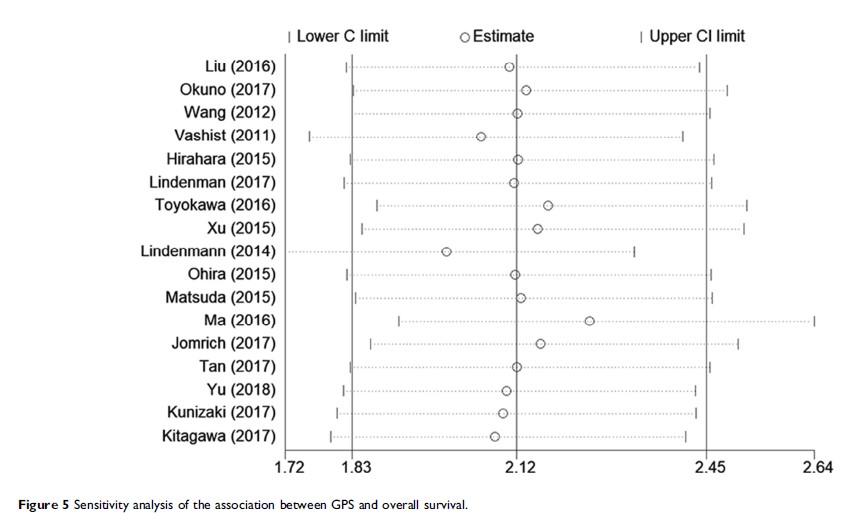
Results: A total of 21 studies including 6115 patients were analyzed. Compared with patients with GPS 0, patients with elevated GPS had poorer OS (HR =2.12, 95% CI: 1.83–2.45, P <0.001) and CSS (HR =2.16, 95% CI: 1.56–2.98, P <0.001); but no significant relationship was observed between the elevated GPS and DFS (HR=2.14, 95% CI:1.00–4.61, P =0.051). Subgroup analysis outcomes were similar to overall analyses.
Conclusion: Pretreatment GPS could serve as a valuable factor in predicting the prognosis of patients with esophageal cancer. More well-designed prospective studies are warranted to confirm our findings.
Keywords: esophageal cancer, Glasgow Prognostic Score, survival, meta-analysis