118847
论文已发表
注册即可获取德孚的最新动态
IF 收录期刊
- 3.6 Breast Cancer (Dove Med Press)
- 4.3 Clin Epidemiol
- 2.6 Cancer Manag Res
- 3.2 Infect Drug Resist
- 4.1 Clin Interv Aging
- 6.1 Drug Des Dev Ther
- 4.1 Int J Chronic Obstr
- 8.7 Int J Nanomed
- 2.5 Int J Women's Health
- 3.2 Neuropsych Dis Treat
- 2.4 OncoTargets Ther
- 2.6 Patient Prefer Adher
- 2.6 Ther Clin Risk Manag
- 3.1 J Pain Res
- 3.5 Diabet Metab Synd Ob
- 4.5 Psychol Res Behav Ma
- 3.4 Nat Sci Sleep
- 2.4 Pharmgenomics Pers Med
- 2.6 Risk Manag Healthc Policy
- 4.6 J Inflamm Res
- 2.3 Int J Gen Med
- 3.9 J Hepatocell Carcinoma
- 3.3 J Asthma Allergy
- 2.5 Clin Cosmet Investig Dermatol
- 3.0 J Multidiscip Healthc

大黄素诱导的自噬通过人肝细胞中的 PI3K/AKT/mTOR 通路抵抗细胞凋亡
Authors Zheng X, Yang S, Zhang R, Wang S, Li G, Zhou S
Received 12 February 2019
Accepted for publication 5 July 2019
Published 3 September 2019 Volume 2019:13 Pages 3171—3180
DOI https://doi.org/10.2147/DDDT.S204958
Checked for plagiarism Yes
Review by Single-blind
Peer reviewers approved by Dr Cristina Weinberg
Peer reviewer comments 2
Editor who approved publication: Dr Tuo Deng
Background: Emodin, a major component of Polygonum multiflorum (PM), has been reported to exert both protective and toxic effects in several cell types. However, the effects and underlying mechanisms of action of emodin in hepatic cells are still obscure.
Methods: The present study used the normal human liver cell line L02 to investigate the effects and mechanisms of emodin in hepatic cells. After treatment with emodin, L02 cells were examined for viability, apoptosis and autophagy with the Cell Counting Kit-8 (CCK-8), annexin V/PerCP staining and GFP-LC3 plasmid transfection. The expression of proteins including cleaved caspase-3, LC3B-I/II, p-PI3K, PI3K, p-AKT, AKT, p-mTOR, mTOR and actin was examined by using Western blot.
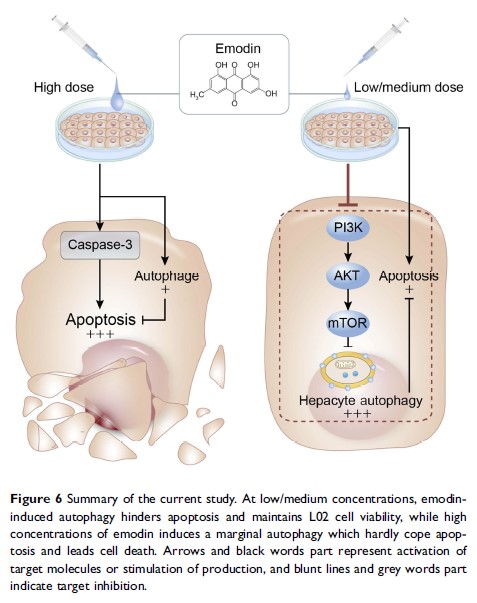
Results: Emodin significantly inhibited the viability of and induced apoptosis in L02 cells in a dose- and time-dependent manner. In addition, emodin increased the number of GFP-LC3 puncta in L02 cells and upregulated the expression of LC3B-II compared to those in control cells. Furthermore, emodin significantly decreased the expression of p-PI3K, p-AKT and p-mTOR in a dose-dependent manner compared to that in control cells without altering the expression of PI3K, AKT and mTOR. Notably, cotreatment with emodin and 3-methyladenine (3-MA) or rapamycin significantly increased and decreased the apoptosis rate of L02 cells, respectively, compared to that of cells treated with emodin alone.
Conclusion: In conclusion, emodin exhibited cytotoxicity in the L02 human hepatic cell line by promoting apoptosis, and it also induced autophagy through the suppression of the PI3K/AKT/mTOR signalling pathway. The autophagy could play a protective role following emodin treatment.
Keywords: Polygonum multiflorum , emodin, hepatoprotective, apoptosis, hepatotoxic, autophagy, PI3K, AKT, mTOR