118847
论文已发表
注册即可获取德孚的最新动态
IF 收录期刊
- 3.6 Breast Cancer (Dove Med Press)
- 4.3 Clin Epidemiol
- 2.6 Cancer Manag Res
- 3.2 Infect Drug Resist
- 4.1 Clin Interv Aging
- 6.1 Drug Des Dev Ther
- 4.1 Int J Chronic Obstr
- 8.7 Int J Nanomed
- 2.5 Int J Women's Health
- 3.2 Neuropsych Dis Treat
- 2.4 OncoTargets Ther
- 2.6 Patient Prefer Adher
- 2.6 Ther Clin Risk Manag
- 3.1 J Pain Res
- 3.5 Diabet Metab Synd Ob
- 4.5 Psychol Res Behav Ma
- 3.4 Nat Sci Sleep
- 2.4 Pharmgenomics Pers Med
- 2.6 Risk Manag Healthc Policy
- 4.6 J Inflamm Res
- 2.3 Int J Gen Med
- 3.9 J Hepatocell Carcinoma
- 3.3 J Asthma Allergy
- 2.5 Clin Cosmet Investig Dermatol
- 3.0 J Multidiscip Healthc

米非司酮在子宫平滑肌瘤的治疗中抑制 IGF-1 信号通路
Authors Shen Q, Zou S, Sheng B, Zhao M, Sun LZ, Zhu X
Received 13 April 2019
Accepted for publication 7 August 2019
Published 3 September 2019 Volume 2019:13 Pages 3161—3170
DOI https://doi.org/10.2147/DDDT.S212157
Checked for plagiarism Yes
Review by Single-blind
Peer reviewers approved by Dr Palas Chanda
Peer reviewer comments 2
Editor who approved publication: Dr Tuo Deng
Purpose: To investigate the role of IGF-1 signaling pathway in the treatment of uterine leiomyomas with mifepristone.
Patients and methods: From October 2015 to December 2018, 50 patients with uterine leiomyoma were included in this study. Overexpression or siRNA of IGF-1 in primary human uterine leiomyoma cells were treated with or without mifepristone. MTT was used to evaluate cell viability in assays of cell proliferation and cytotoxicity. IGF-1 expression in the cells was measured with real-time RT-PCR and Western blotting and manipulated with lentivirus ectopic overexpression or siRNA silencing.
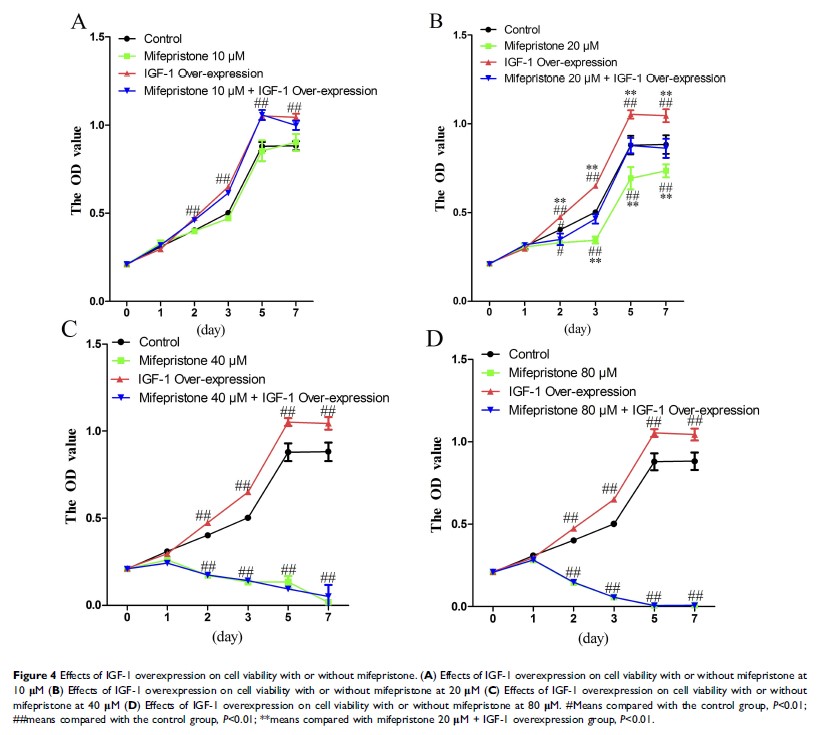
Results: Inhibition of cell viability by mifepristone was found dependent on drug concentration and treatment time. IGF-1 and phosphorylation-ERK1/2 expression were decreased, while phosphorylation-AKT expression was increased after mifepristone treatment. IGF-1 significantly promoted cell growth, while IGF-1 knockdown and mifepristone showed synergistic inhibition effects on cell growth. The overexpression of IGF-1 reversed the inhibition of cell growth and ERK1/2 phosphorylation but showed no effect on AKT phosphorylation.
Conclusion: Our study for the first time demonstrated that IGF-1 signaling via ERK1/2 appears to be an important target of mifepristone in the treatment of uterine leiomyomas, which may provide a new approach to avoid leiomyoma re-growth after cessation of mifepristone.
Keywords: uterine leiomyomas, mifepristone, IGF-1, signal pathway