118847
论文已发表
注册即可获取德孚的最新动态
IF 收录期刊
- 3.6 Breast Cancer (Dove Med Press)
- 4.3 Clin Epidemiol
- 2.6 Cancer Manag Res
- 3.2 Infect Drug Resist
- 4.1 Clin Interv Aging
- 6.1 Drug Des Dev Ther
- 4.1 Int J Chronic Obstr
- 8.7 Int J Nanomed
- 2.5 Int J Women's Health
- 3.2 Neuropsych Dis Treat
- 2.4 OncoTargets Ther
- 2.6 Patient Prefer Adher
- 2.6 Ther Clin Risk Manag
- 3.1 J Pain Res
- 3.5 Diabet Metab Synd Ob
- 4.5 Psychol Res Behav Ma
- 3.4 Nat Sci Sleep
- 2.4 Pharmgenomics Pers Med
- 2.6 Risk Manag Healthc Policy
- 4.6 J Inflamm Res
- 2.3 Int J Gen Med
- 3.9 J Hepatocell Carcinoma
- 3.3 J Asthma Allergy
- 2.5 Clin Cosmet Investig Dermatol
- 3.0 J Multidiscip Healthc

利拉鲁肽对脂肪分解和 AC3/PKA/HSL 通路的影响
Authors Li Z, Yang P, Liang Y, Xia N, Li Y, Su H, Pan H
Received 20 May 2019
Accepted for publication 29 July 2019
Published 3 September 2019 Volume 2019:12 Pages 1697—1703
DOI https://doi.org/10.2147/DMSO.S216455
Checked for plagiarism Yes
Review by Single-blind
Peer reviewers approved by Dr Melinda Thomas
Peer reviewer comments 2
Editor who approved publication: Dr Juei-Tang Cheng
Background: Liraglutide reduces blood glucose, body weight and blood lipid levels. Hormone-sensitive lipase (HSL) is a key enzyme in lipolysis. Evidence from our and other studies have demonstrated that adenylate cyclase 3 (AC3) is associated with obesity and can be upregulated by liraglutide in obese mice. In the present study, we investigated whether hepatic HSL activity is regulated by liraglutide and characterized the effect of liraglutide in the AC3/protein kinase A (PKA)/HSL signalling pathway.
Methods: Obese mice or their lean littermates were treated with liraglutide or saline for 8 weeks. Serum was collected for the measurement of insulin and lipids. We investigated hepatic AC3, HSL and phosphorylated HSL Ser-660 (p-HSL(S660)) protein expression levels andAC3 and HSL mRNA expression levels and cyclic adenosine monophosphate (cAMP), PKA activity in liver tissue.
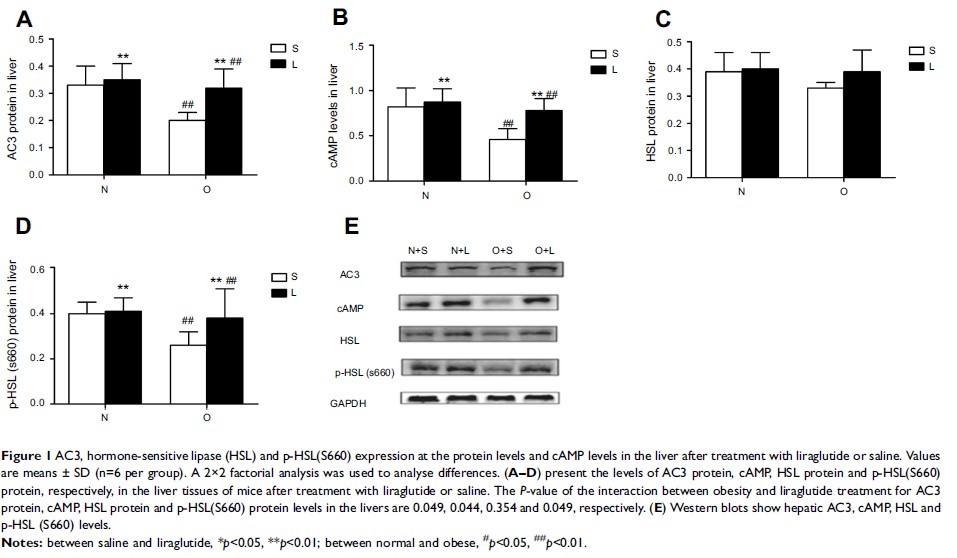
Results: Liraglutide treatment decreased triglycerides (TGs) and free fatty acids (FFAs), increased glycerol, and upregulated hepatic AC3 and p-HSL(s660) levels and cAMP and PKA activities.
Conclusion: The results suggest that liraglutide can upregulates AC3/PKA/HSL pathway and may promotes lipolysis.
Keywords: liraglutide, obesity, lipolysis, adenylate cyclase 3, hormone-sensitive lipase