118847
论文已发表
注册即可获取德孚的最新动态
IF 收录期刊
- 3.6 Breast Cancer (Dove Med Press)
- 4.3 Clin Epidemiol
- 2.6 Cancer Manag Res
- 3.2 Infect Drug Resist
- 4.1 Clin Interv Aging
- 6.1 Drug Des Dev Ther
- 4.1 Int J Chronic Obstr
- 8.7 Int J Nanomed
- 2.5 Int J Women's Health
- 3.2 Neuropsych Dis Treat
- 2.4 OncoTargets Ther
- 2.6 Patient Prefer Adher
- 2.6 Ther Clin Risk Manag
- 3.1 J Pain Res
- 3.5 Diabet Metab Synd Ob
- 4.5 Psychol Res Behav Ma
- 3.4 Nat Sci Sleep
- 2.4 Pharmgenomics Pers Med
- 2.6 Risk Manag Healthc Policy
- 4.6 J Inflamm Res
- 2.3 Int J Gen Med
- 3.9 J Hepatocell Carcinoma
- 3.3 J Asthma Allergy
- 2.5 Clin Cosmet Investig Dermatol
- 3.0 J Multidiscip Healthc

镁血症:甲状腺切除术后低钙血症的独立危险因素
Authors Wang W, Meng C, Ouyang Q, Xie J, Li X
Received 3 June 2019
Accepted for publication 7 August 2019
Published 3 September 2019 Volume 2019:11 Pages 8135—8144
DOI https://doi.org/10.2147/CMAR.S218179
Checked for plagiarism Yes
Review by Single-blind
Peer reviewers approved by Dr Justinn Cochran
Peer reviewer comments 2
Editor who approved publication: Dr Sanjeev Srivastava
Background: This study was designed to investigate the impact of serum magnesium (Mg) levels on hypocalcemia after thyroidectomy.
Patients and methods: In total, 242 patients with differentiated thyroid cancer were retrospectively analyzed.
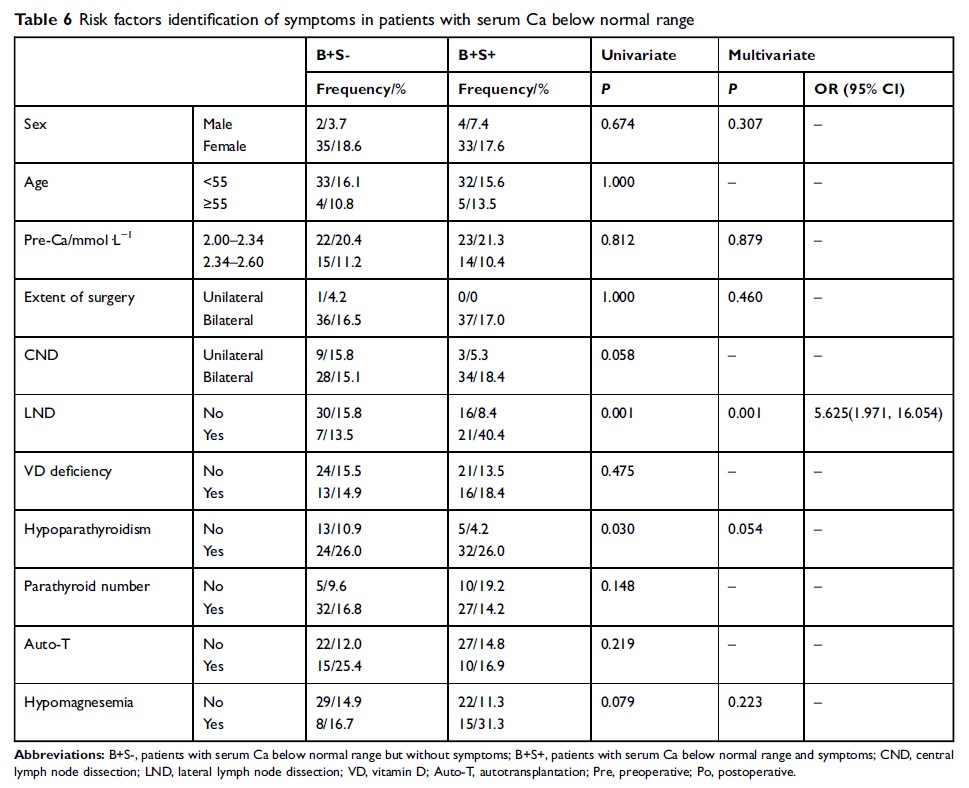
Results: Multivariate regression analysis showed hypomagnesemia was an independent risk factor for hypocalcemia (P <0.001). While Mg in low levels (0.66 mmol/L ≤ Po-Mg ≤0.74 mmol/L) increased the risk of hypocalcemia, postoperative serum Ca (Po-Ca) levels were significantly lower in patients with hypomagnesemia than in patients with normomagnesemia (P =0.01), and the former patients suffered significant decreases in serum Ca (P =0.02). Compared to patients with a mild decline of serum Mg after surgery (ΔMg <0.17), serum Ca decline significantly increased (P <0.001) in patients with a severe decline of serum Mg (ΔMg ≥0.17), while the change in amounts of parathyroid hormone (PTH) after surgery was similar between the two groups (P >0.05). In patients with normal Po-Ca levels, hypomagnesemia increased the risk of symptoms related to hypocalcemia by 4.478 times (OR =5.478, 95% CI 1.724–17.403).
Conclusion: Hypomagnesemia, or even a low serum Mg level within the normal range, can increase the risk of hypocalcemia. After excluding the potential effects of PTH on serum magnesium and calcium, serum Mg reduction is one of the most important factors that influences postoperative serum Ca reduction. What’s more, hypomagnesemia is closely linked with symptoms.
Keywords: hypocalcemia, hypomagnesemia, thyroidectomy, magnesium, calcium