118847
论文已发表
注册即可获取德孚的最新动态
IF 收录期刊
- 3.6 Breast Cancer (Dove Med Press)
- 4.3 Clin Epidemiol
- 2.6 Cancer Manag Res
- 3.2 Infect Drug Resist
- 4.1 Clin Interv Aging
- 6.1 Drug Des Dev Ther
- 4.1 Int J Chronic Obstr
- 8.7 Int J Nanomed
- 2.5 Int J Women's Health
- 3.2 Neuropsych Dis Treat
- 2.4 OncoTargets Ther
- 2.6 Patient Prefer Adher
- 2.6 Ther Clin Risk Manag
- 3.1 J Pain Res
- 3.5 Diabet Metab Synd Ob
- 4.5 Psychol Res Behav Ma
- 3.4 Nat Sci Sleep
- 2.4 Pharmgenomics Pers Med
- 2.6 Risk Manag Healthc Policy
- 4.6 J Inflamm Res
- 2.3 Int J Gen Med
- 3.9 J Hepatocell Carcinoma
- 3.3 J Asthma Allergy
- 2.5 Clin Cosmet Investig Dermatol
- 3.0 J Multidiscip Healthc

第三级格里森模式 5 对格里森评分 7 前列腺癌根治术后癌症的意义:一项回顾性队列研究
Authors Li J, Guo Y, Qiu S, He M, Jin K, Zheng X, Tu X, Liao X, Yang L, Wei Q
Received 1 June 2019
Accepted for publication 15 August 2019
Published 2 September 2019 Volume 2019:12 Pages 7157—7164
DOI https://doi.org/10.2147/OTT.S218001
Checked for plagiarism Yes
Review by Single-blind
Peer reviewers approved by Ms Shreya Arora
Peer reviewer comments 3
Editor who approved publication: Prof. Dr. Nicola Silvestris
Purpose: To evaluate the association between tertiary Gleason pattern 5 (TGP5) and biochemical recurrence (BCR) in patients with prostate cancer (PCa) with a Gleason score (GS) of 7 after radical prostatectomy (RP).
Patients and methods: This retrospective study identified 350 patients who received RP and were graded as GS 7 (3+4 or 4+3) at the West China Hospital from January 2009 to December 2017. Initially, the patients were divided into two groups, TGP5 absence and TGP5 presence, independent of Gleason score. We further stratified the patients by adding the Gleason score into four groups: GS 3+4, GS 3+4/TGP5, GS 4+3, and GS 4+3/TGP5. Cox proportional-hazards models were used to evaluate the association between the status of TGP5 and BCR after adjusting for the confounding factors.
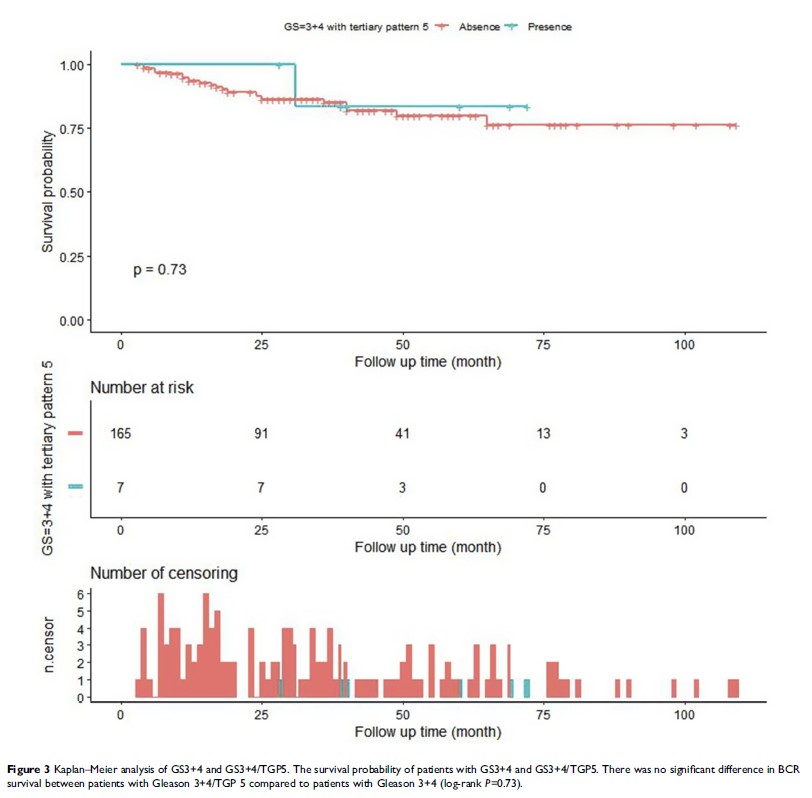
Results: The risk of BCR was significantly higher in patients with TGP5 when compared to patients without TGP5 (P =0.04, HR=2.17 95%, Cl: 1.03–4.59). For patients with primary Gleason pattern 4, the risk of BCR for patients with Gleason 4+3/TGP5 was statistically significantly higher than Gleason 4+3 (P =0.04, HR=2.45, 95% Cl: 1.04–5.76).
Conclusion: The TGP5 in patients with GS 7 had strong association with the risk of BCR and was an independent predictor for BCR. Further research on larger data sets is needed to confirm these findings.
Keywords: prostate cancer, biochemical recurrence, Gleason score, tertiary Gleason pattern, radical prostatectomy