118847
论文已发表
注册即可获取德孚的最新动态
IF 收录期刊
- 3.6 Breast Cancer (Dove Med Press)
- 4.3 Clin Epidemiol
- 2.6 Cancer Manag Res
- 3.2 Infect Drug Resist
- 4.1 Clin Interv Aging
- 6.1 Drug Des Dev Ther
- 4.1 Int J Chronic Obstr
- 8.7 Int J Nanomed
- 2.5 Int J Women's Health
- 3.2 Neuropsych Dis Treat
- 2.4 OncoTargets Ther
- 2.6 Patient Prefer Adher
- 2.6 Ther Clin Risk Manag
- 3.1 J Pain Res
- 3.5 Diabet Metab Synd Ob
- 4.5 Psychol Res Behav Ma
- 3.4 Nat Sci Sleep
- 2.4 Pharmgenomics Pers Med
- 2.6 Risk Manag Healthc Policy
- 4.6 J Inflamm Res
- 2.3 Int J Gen Med
- 3.9 J Hepatocell Carcinoma
- 3.3 J Asthma Allergy
- 2.5 Clin Cosmet Investig Dermatol
- 3.0 J Multidiscip Healthc

HOXC13-AS-miR-122-5p-SATB1-C-Myc 反馈回路促进神经胶质瘤的迁移、侵袭和 EMT 过程
Authors Liu N, Wang Z, Liu D, Xie P
Received 19 June 2019
Accepted for publication 16 August 2019
Published 2 September 2019 Volume 2019:12 Pages 7165—7173
DOI https://doi.org/10.2147/OTT.S220027
Checked for plagiarism Yes
Review by Single-blind
Peer reviewers approved by Ms Shreya Arora
Peer reviewer comments 4
Editor who approved publication: Dr William Cho
Purpose: Differentially expressed long non-coding ribonucleic acids (lncRNAs) have been reported as a key factor of glioma carcinogenesis, but the underlying mechanism involved is still unknown.
Materials and methods: In the present study, lncRNA HOXC13 antisense RNA (HOXC13-AS) was identified as a potential oncogene in glioma, and Western blotting, wound healing and Transwell assays were carried out to explore the effects of HOXC13-AS on the epithelial-mesenchymal transition (EMT) process as well as the migration and invasion of glioma cells.
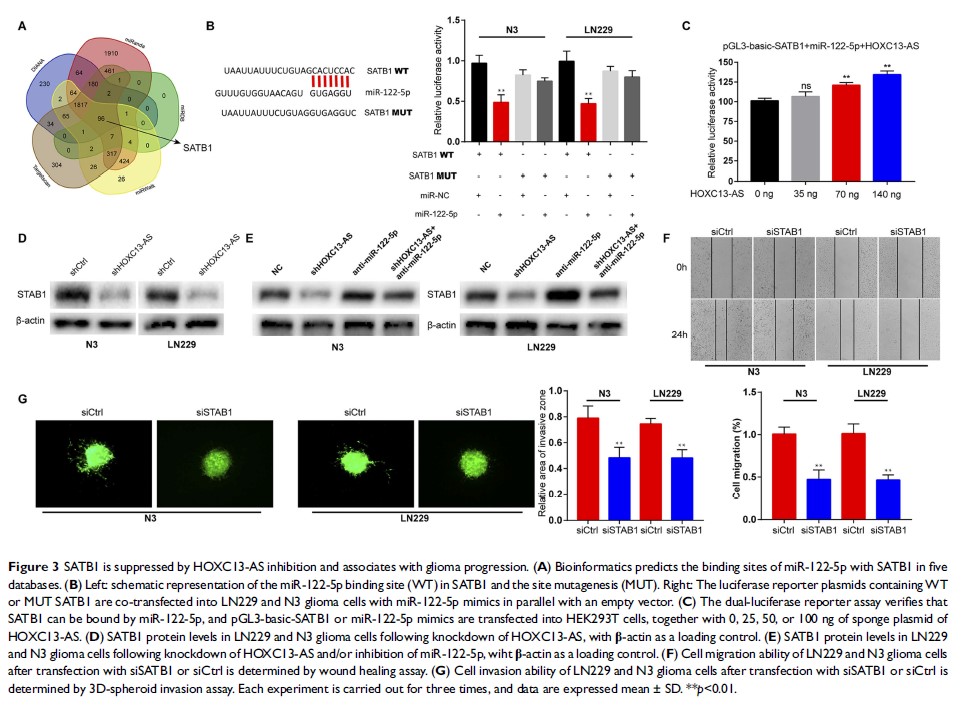
Results: A further mechanistic study showed that HOXC13-AS sponged miR-122-5p to indirectly regulate SATB1 expression and affect the EMT process via the Wnt/β-catenin pathway. Meanwhile, the promoter activity was significantly increased via c-Myc, a key factor of the Wnt/β-catenin pathway, thus forming a positive HOXC13-AS-miR-122-5p-SATB1-c-Myc feedback loop to drive the malignant behavior in glioma.
Discussion: This study evidences the constitutive HOXC13-AS-miR-122-5p-SATB1-c-Myc feedback loop and provides a potential therapeutic target for glioma treatment.
Keywords: HOXC13-AS, epithelial-mesenchymal transition, competing endogenous RNA, miR-122-5p, glioma