118847
论文已发表
注册即可获取德孚的最新动态
IF 收录期刊
- 3.6 Breast Cancer (Dove Med Press)
- 4.3 Clin Epidemiol
- 2.6 Cancer Manag Res
- 3.2 Infect Drug Resist
- 4.1 Clin Interv Aging
- 6.1 Drug Des Dev Ther
- 4.1 Int J Chronic Obstr
- 8.7 Int J Nanomed
- 2.5 Int J Women's Health
- 3.2 Neuropsych Dis Treat
- 2.4 OncoTargets Ther
- 2.6 Patient Prefer Adher
- 2.6 Ther Clin Risk Manag
- 3.1 J Pain Res
- 3.5 Diabet Metab Synd Ob
- 4.5 Psychol Res Behav Ma
- 3.4 Nat Sci Sleep
- 2.4 Pharmgenomics Pers Med
- 2.6 Risk Manag Healthc Policy
- 4.6 J Inflamm Res
- 2.3 Int J Gen Med
- 3.9 J Hepatocell Carcinoma
- 3.3 J Asthma Allergy
- 2.5 Clin Cosmet Investig Dermatol
- 3.0 J Multidiscip Healthc

导致中国长沙妇女尿路感染的大肠杆菌 O25b-ST131 和 O16-ST131:分子流行病学和临床特征
Authors Zhong YM, Liu WE, Meng Q, Li Y
Received 17 April 2019
Accepted for publication 24 July 2019
Published 30 August 2019 Volume 2019:12 Pages 2693—2702
DOI https://doi.org/10.2147/IDR.S212658
Checked for plagiarism Yes
Review by Single-blind
Peer reviewers approved by Dr Amy Norman
Peer reviewer comments 3
Editor who approved publication: Dr Joachim Wink
Objective: This study aimed to investigate the prevalence of Escherichia coli ST131 and molecularly characterize the O25b-ST131 and O16-ST131 subgroups among urinary tract infection (UTI) E. coli isolates from women in central China. We also assessed the clinical characteristics and outcomes of infections caused by E. coli ST131.
Methods: Between January 2014 and December 2015, a total of 216 consecutive, non-repetitive E. coli isolates were recovered from UTI urine samples from women in Changsha, China. All isolates were analyzed for phylogenetic groups, antimicrobial resistance and virulence genotypes. ST131 clonal groups were identified using PCR and characterized using O serotyping, CTX-M genotypes, fimH , gyrA , and parC alleles, fluoroquinolone resistance genes and pulsed-field gel electrophoresis (PFGE). Clinical data were obtained from medical records.
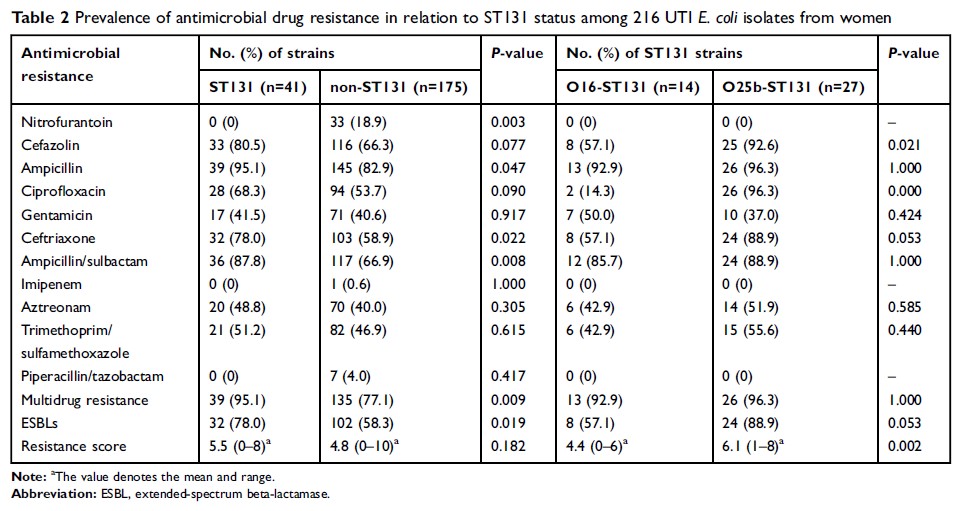
Results: Overall, 41 (19.0%) of 216 E. coli isolates were identified to contain ST131 strains, among which 27 were O25b-ST131 strains and 14 were O16-ST131 strains. The clinical characteristics and outcomes of the ST131 group did not differ significantly from those of the non-ST131 group, except for the presence of urinary stones (43.9% vs 27.4%, P =0.039). Ciprofloxacin resistance was found to be significantly higher in O25b-ST131 isolates than O16-ST131 isolates (96.3% vs 14.3%, P <0.001). The majority of O25b-ST131 isolates belonged to fimH 30 (92.6%), followed by fimH 41 (3.7%) and fimH 27 (3.7%). O25b-H 30 and O25b-H 41 isolates were resistant to ciprofloxacin, and possessed gyrA 1AB/parC 1aAB combination. All of the O16-S131 isolates were found to belong to fimH 41, and of which, two of the ciprofloxacin-resistant strains harbored gyrA 1AB/parC 3A combination. Three PFGE clusters, consisting of 38 (92.7%) isolates, with more than 70% similarity were identified.
Conclusion: The O25b and O16 sub-lineages have emerged as an important group of E. coli ST131 in UTI isolates from women in China. UTI patients with a history of urinary stones may need to be particularly vigilant against ST131 infection.
Keywords: E. coli , ST131, fimH -based subclones, fluoroquinolone resistance, urinary tract infection