118847
论文已发表
注册即可获取德孚的最新动态
IF 收录期刊
- 3.6 Breast Cancer (Dove Med Press)
- 4.3 Clin Epidemiol
- 2.6 Cancer Manag Res
- 3.2 Infect Drug Resist
- 4.1 Clin Interv Aging
- 6.1 Drug Des Dev Ther
- 4.1 Int J Chronic Obstr
- 8.7 Int J Nanomed
- 2.5 Int J Women's Health
- 3.2 Neuropsych Dis Treat
- 2.4 OncoTargets Ther
- 2.6 Patient Prefer Adher
- 2.6 Ther Clin Risk Manag
- 3.1 J Pain Res
- 3.5 Diabet Metab Synd Ob
- 4.5 Psychol Res Behav Ma
- 3.4 Nat Sci Sleep
- 2.4 Pharmgenomics Pers Med
- 2.6 Risk Manag Healthc Policy
- 4.6 J Inflamm Res
- 2.3 Int J Gen Med
- 3.9 J Hepatocell Carcinoma
- 3.3 J Asthma Allergy
- 2.5 Clin Cosmet Investig Dermatol
- 3.0 J Multidiscip Healthc

肝细胞癌中长非编码 RNA FOXP4-AS1 及其调控网络的上调
Authors Wang D, Bai T, Chen G, Liu J, Chen M, Zhao Y, Luo T, Chen J, Li L, Zhang C, Li H
Received 26 June 2019
Accepted for publication 10 August 2019
Published 29 August 2019 Volume 2019:12 Pages 7025—7038
DOI https://doi.org/10.2147/OTT.S220923
Checked for plagiarism Yes
Review by Single-blind
Peer reviewers approved by Dr Shashank Kaushik (PT)
Peer reviewer comments 3
Editor who approved publication: Dr Takuya Aoki
Objective: FOXP4-AS1 (FOXP4 antisense RNA 1) is putatively a functional oncogene in colorectal cancer. This study constructed a regulatory network involving FOXP4-AS1 for better understanding of its function in hepatocellular carcinoma (HCC).
Methods: FOXP4-AS1 was assessed in HCC and adjacent normal (control) liver samples via quantitative real-time PCR. Differentially expressed micro RNAs (DEmiRNAs) were predicted. Their target genes were verified via the gene expression profiling interaction analysis (GEPIA) database, and subjected to gene ontology (GO) annotation and KEGG (Kyoto Encyclopedia of Genes and Genome) pathway enrichment analysis. Protein-protein interaction (PPI) networks were established and hub genes identified with Cytoscape software. The GEPIA database was used to assess the prognostic roles of 20 hub genes in liver cancer. The cBioPortal database was used to exhibit alterations of the genes.
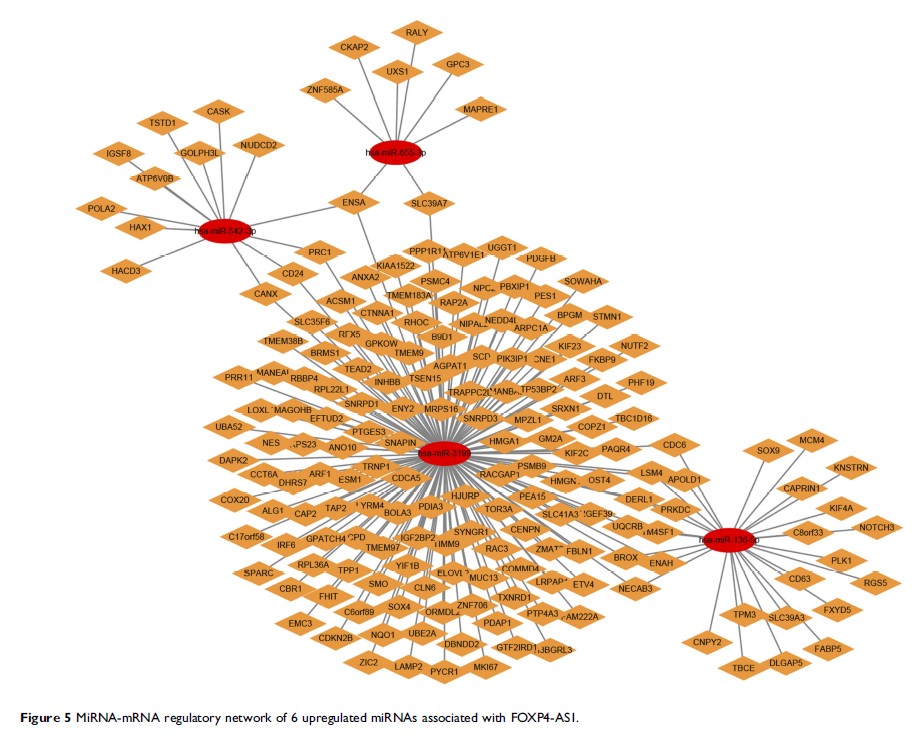
Results: The HCC samples had significantly higher levels of FOXP4-AS1 compared with the control (P =0.001). Six upregulated and 4 downregulated DEmiRNAs were identified. Over- and under-expressed predicted target genes (183 and 147, respectively) were selected for GO annotation and KEGG pathway enrichment analysis. The downregulated genes were significantly prominent in the PI3K-Akt signaling pathway; the upregulated genes in the cell cycle. The PPI networks indicated IGFBP3 and PRC1 as hub genes with the highest node degrees. Higher expressions of 9 (6) genes were associated with worse (better) prognosis in HCC.
Conclusion: An HCC-associated FOXP4-AS1-miRNA-mRNA regulatory network was constructed, and molecular mechanisms involved in HCC development were elucidated. This work provides direction for finding new HCC therapeutic targets.
Keywords: quantitative real-time PCR, hepatocellular carcinoma, long non-coding RNA, FOXP4-AS1