118847
论文已发表
注册即可获取德孚的最新动态
IF 收录期刊
- 3.6 Breast Cancer (Dove Med Press)
- 4.3 Clin Epidemiol
- 2.6 Cancer Manag Res
- 3.2 Infect Drug Resist
- 4.1 Clin Interv Aging
- 6.1 Drug Des Dev Ther
- 4.1 Int J Chronic Obstr
- 8.7 Int J Nanomed
- 2.5 Int J Women's Health
- 3.2 Neuropsych Dis Treat
- 2.4 OncoTargets Ther
- 2.6 Patient Prefer Adher
- 2.6 Ther Clin Risk Manag
- 3.1 J Pain Res
- 3.5 Diabet Metab Synd Ob
- 4.5 Psychol Res Behav Ma
- 3.4 Nat Sci Sleep
- 2.4 Pharmgenomics Pers Med
- 2.6 Risk Manag Healthc Policy
- 4.6 J Inflamm Res
- 2.3 Int J Gen Med
- 3.9 J Hepatocell Carcinoma
- 3.3 J Asthma Allergy
- 2.5 Clin Cosmet Investig Dermatol
- 3.0 J Multidiscip Healthc

BRMS1 下调是间变性甲状腺癌患者预后不良的生物标志物
Authors Wu Y, Wang H, Zhi J, Hu L, Hou X, Ruan X, Zheng X, Liu H, Gao M
Received 14 June 2019
Accepted for publication 10 August 2019
Published 28 August 2019 Volume 2019:12 Pages 6937—6945
DOI https://doi.org/10.2147/OTT.S219506
Checked for plagiarism Yes
Review by Single-blind
Peer reviewers approved by Ms Aruna Narula
Peer reviewer comments 2
Editor who approved publication: Dr Gaetano Romano
Background: Anaplastic thyroid carcinoma (ATC) is the most aggressive cancer in humans with no optimal treatment strategy available. The molecular mechanisms of ATC remain unclear. The aim of this study was to investigate the prognostic value and role of BRMS1 in the progression of ATC.
Methods: BRMS1 expression was examined in thyroid cell lines using Western blot analysis. Immunohistochemistry was also performed to assess BRMS1 expression in ATC and papillary thyroid cancer (PTC) tissue. Cell proliferation assays, colony formation analysis, cell migration assays, cell apoptosis analysis, and animal studies were used to examine the effects of BRMS1 expression on ATC progression.
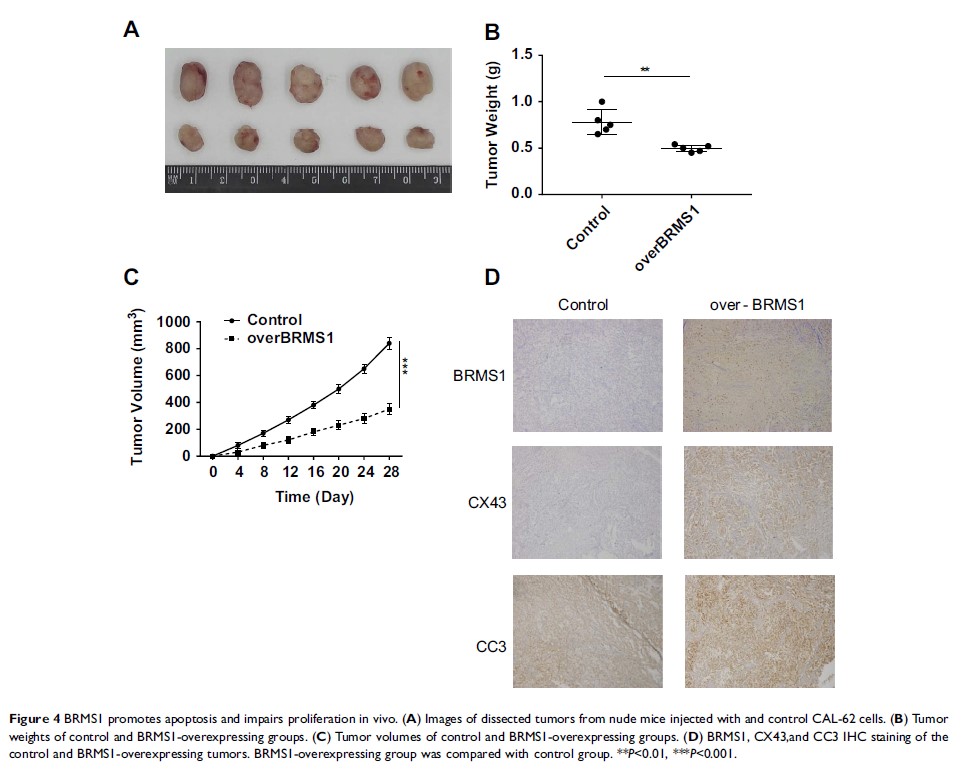
Results: The expression of BRMS1 was significantly lower in ATC than in PTC and was associated with poor prognosis in ATC patients. Downregulation of BRMS1 expression promoted the proliferation and migration of 8505C cells and decreased their expression of CX43. Over-expressed BRMS1 promoted the apoptosis and impaired the proliferation and migration of CAL-62 cells via upregulated CX43. In vivo, BRMS1 significantly promoted apoptosis and impaired cell proliferation.
Conclusion: Taken together, these findings demonstrate that decreased expression of BRMS1 is a poor prognostic biomarker in ATC patients. BRMS1 significantly promoted apoptosis and impaired cell proliferation via CX43 and P53. Loss of BRMS1 expression is therefore, one of the key pathomechanisms in ATC.
Keywords: BRMS1, anaplastic thyroid carcinoma, prognosis, CX43