118847
论文已发表
注册即可获取德孚的最新动态
IF 收录期刊
- 3.6 Breast Cancer (Dove Med Press)
- 4.3 Clin Epidemiol
- 2.6 Cancer Manag Res
- 3.2 Infect Drug Resist
- 4.1 Clin Interv Aging
- 6.1 Drug Des Dev Ther
- 4.1 Int J Chronic Obstr
- 8.7 Int J Nanomed
- 2.5 Int J Women's Health
- 3.2 Neuropsych Dis Treat
- 2.4 OncoTargets Ther
- 2.6 Patient Prefer Adher
- 2.6 Ther Clin Risk Manag
- 3.1 J Pain Res
- 3.5 Diabet Metab Synd Ob
- 4.5 Psychol Res Behav Ma
- 3.4 Nat Sci Sleep
- 2.4 Pharmgenomics Pers Med
- 2.6 Risk Manag Healthc Policy
- 4.6 J Inflamm Res
- 2.3 Int J Gen Med
- 3.9 J Hepatocell Carcinoma
- 3.3 J Asthma Allergy
- 2.5 Clin Cosmet Investig Dermatol
- 3.0 J Multidiscip Healthc

PD-1 抑制剂依赖性 CD8+ T 细胞可遏制小鼠结肠癌细胞的转移
Authors Gao CE, Zhang M, Song Q, Dong J
Received 25 January 2019
Accepted for publication 31 May 2019
Published 28 August 2019 Volume 2019:12 Pages 6961—6971
DOI https://doi.org/10.2147/OTT.S202941
Checked for plagiarism Yes
Review by Single-blind
Peer reviewers approved by Ms Rachel Predeepa
Peer reviewer comments 2
Editor who approved publication: Dr Sanjeev Srivastava
Background: Colon cancer is a common digestive tract malignancy which ranks as the third leading cause of cancer death worldwide. A current focus of anti-cancer research is harnessing the patient’s own immune system for therapy. Programmed cell death protein 1 (PD-1), an immune suppressor, is upregulated in various activated immune cells, such as T cells, and in viral infections and tumors.
Purpose: The objective of this study was to investigate the function of PD-1 inhibitor on the metastasisi of mouse colon cancer cells.
Patients and methods: In the present study, we established an in situ colon cancer mouse model using the CT26 cell line. Hematoxylin-eosin (HE) staining was performed to detect colon cancer cell metastasis. The levels of interferon-γ (IFN-γ), tumor necrosis factor-α (TNF-α), and interleukin-12 (IL-12) in serum and mesenteric lymph nodes (MLNs) were detected by Enzyme-linked immunosorbent assay (ELISA). CD44high CD62Llow memory T cells, CD4+ FoxP3+ regulatory T cells, and IFN-γ and TNF-α levels in MLNs and spleen were detected by flow cytometry (FCM).
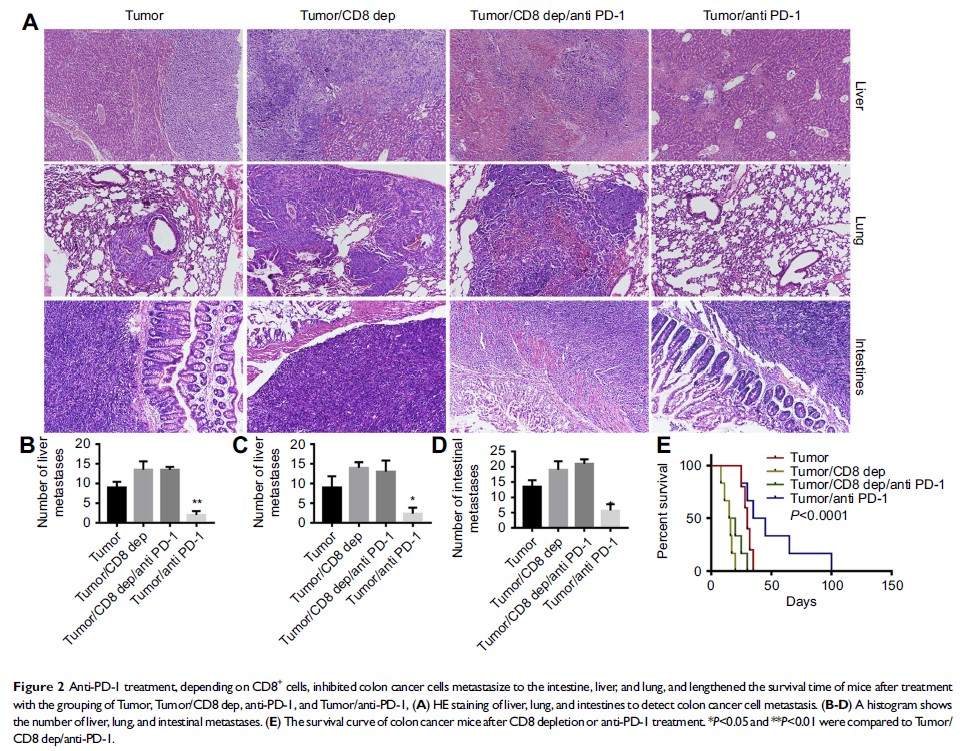
Results: We found that anti-PD-1 therapy inhibited colon cancer cells metastasis to the small intestine, liver, and lung, and lengthened the survival time of mice. However, the depletion of CD8 suppressed the activity of anti-PD-1 antibodies. In response to anti-PD-1 immunotherapy, the levels of interferon-γ (IFN-γ), tumor necrosis factor-α (TNF-α), and interleukin-12 (IL-12) in serum and mesenteric lymph nodes (MLNs) were significantly increased, while IL-6, IL-17, and transforming growth factor-β (TGF-β) were decreased. CD8 depletion had the opposite effect. In addition, anti-PD-1 treatment significantly increased CD44high CD62Llow memory T cells, decreased CD4+ FoxP3+ regulatory T cells, and increased IFN-γ and TNF-α levels in MLNs and spleen. Furthermore, anti-PD-1 treatment cannot exert these roles when CD8 is depleted.
Conclusion: These results suggest that PD-1 inhibitors rely on CD8+ T cells to exert anti-tumor immunity in colon cancer.
Keywords: programmed death 1 (PD-1), CD8 depletion, metastasis, IFN-γ, TNF-α, colon cancer