118847
论文已发表
注册即可获取德孚的最新动态
IF 收录期刊
- 3.6 Breast Cancer (Dove Med Press)
- 4.3 Clin Epidemiol
- 2.6 Cancer Manag Res
- 3.2 Infect Drug Resist
- 4.1 Clin Interv Aging
- 6.1 Drug Des Dev Ther
- 4.1 Int J Chronic Obstr
- 8.7 Int J Nanomed
- 2.5 Int J Women's Health
- 3.2 Neuropsych Dis Treat
- 2.4 OncoTargets Ther
- 2.6 Patient Prefer Adher
- 2.6 Ther Clin Risk Manag
- 3.1 J Pain Res
- 3.5 Diabet Metab Synd Ob
- 4.5 Psychol Res Behav Ma
- 3.4 Nat Sci Sleep
- 2.4 Pharmgenomics Pers Med
- 2.6 Risk Manag Healthc Policy
- 4.6 J Inflamm Res
- 2.3 Int J Gen Med
- 3.9 J Hepatocell Carcinoma
- 3.3 J Asthma Allergy
- 2.5 Clin Cosmet Investig Dermatol
- 3.0 J Multidiscip Healthc

2-花生四烯酸甘油酯(2-AG)的神经保护机制对抗 MCAO 小鼠海马神经元的非 caspase 依赖性细胞凋亡
Authors Zhong HY, Yang Z, Qiu Z, Lei SQ, Xia ZY
Received 9 March 2019
Accepted for publication 23 July 2019
Published 23 August 2019 Volume 2019:15 Pages 2417—2424
DOI https://doi.org/10.2147/NDT.S208094
Checked for plagiarism Yes
Review by Single-blind
Peer reviewers approved by Dr Colin Mak
Peer reviewer comments 2
Editor who approved publication: Dr Yu-Ping Ning
Objective: In this study, the neuroprotective mechanism of 2-arachidonoylglycerol 2-AG against non-caspase-dependent apoptosis in mice hippocampal neurons following MCAO was investigated.
Method: One hundred and fifty healthy clean male C57BL/6 mice were randomly divided into 3 groups: sham group, model group and 2-AG treatment group, 50 mice in each group. A modified Zea Longa method was used to establish a model of middle cerebral artery occlusion (MCAO) in mice. The apoptosis rate and mitochondrial membrane potential of hippocampal nerve cells were measured by flow cytometry. The mRNA expressions of AIF, Endo G and BNIP3 in hippocampal tissues were determined by qPCR. Western blot was used to determine the protein expressions of AIF, Endo G and BNIP3 in the mitochondria of hippocampal tissue.
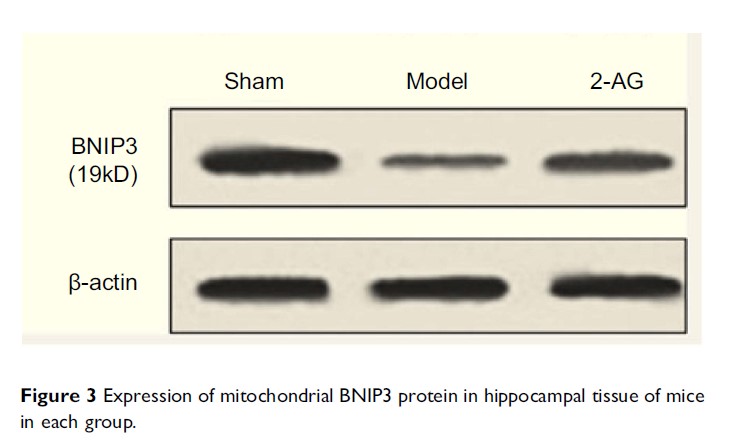
Results: The apoptosis rate of hippocampal neurons in the group treated with 2-AG was significantly lower than that of the model (P <0.01), which indicated that 2-AG could inhibit the apoptosis of hippocampal neurons induced by MCAO. However, the mitochondrial membrane potential of hippocampal neurons in the group treated with 2-AG was significantly higher than that of the model (P <0.01), indicating that 2-AG could improve the mitochondrial membrane potential of hippocampal neurons in MCAO mice. Real-time quantitative PCR (qPCR) showed that 2-AG could inhibit the gene expressions of AIF, Endo G and BNIP3 in hippocampal tissues. Western blot results showed that 2-AG could inhibit the secretions of AIF, Endo G and BNIP3 into cytoplasm in mitochondria.
Conclusion: Endocannabinoids 2-AG had a protective effect on neurons injury, and the mechanism was possibly associated with the protection of the brain nerve cells in the hippocampus and the integrity of the mitochondrial function. Endocannabinoids 2-AG may inhibit the non-caspase-dependent apoptosis pathway, so as to exert its nerve protective effect.
Keywords: 2-arachidonoylglycerol, hippocampus, nerve cell, non-caspase-dependent pathway