118847
论文已发表
注册即可获取德孚的最新动态
IF 收录期刊
- 3.6 Breast Cancer (Dove Med Press)
- 4.3 Clin Epidemiol
- 2.6 Cancer Manag Res
- 3.2 Infect Drug Resist
- 4.1 Clin Interv Aging
- 6.1 Drug Des Dev Ther
- 4.1 Int J Chronic Obstr
- 8.7 Int J Nanomed
- 2.5 Int J Women's Health
- 3.2 Neuropsych Dis Treat
- 2.4 OncoTargets Ther
- 2.6 Patient Prefer Adher
- 2.6 Ther Clin Risk Manag
- 3.1 J Pain Res
- 3.5 Diabet Metab Synd Ob
- 4.5 Psychol Res Behav Ma
- 3.4 Nat Sci Sleep
- 2.4 Pharmgenomics Pers Med
- 2.6 Risk Manag Healthc Policy
- 4.6 J Inflamm Res
- 2.3 Int J Gen Med
- 3.9 J Hepatocell Carcinoma
- 3.3 J Asthma Allergy
- 2.5 Clin Cosmet Investig Dermatol
- 3.0 J Multidiscip Healthc

源自具有不同侵袭特征的 HCC 细胞的外来体通过 TGF-β/Smad 信号通路来介导 EMT
Authors Qu Z, Feng J, Pan H, Jiang Y, Duan Y, Fa Z
Received 3 April 2019
Accepted for publication 27 July 2019
Published 23 August 2019 Volume 2019:12 Pages 6897—6905
DOI https://doi.org/10.2147/OTT.S209413
Checked for plagiarism Yes
Review by Single-blind
Peer reviewers approved by Ms Rachel Predeepa
Peer reviewer comments 3
Editor who approved publication: Dr Sanjay Singh
Background: Exosomes are nano-sized biological vesicles released by many kinds of cells, which play an important role in tumor metastasis through transporting cytokines, RNAs and proteins. However, the molecular mechanisms of exosomes in hepatocellular carcinoma (HCC) metastasis are not completely understood.
Materials and methods: Exosomes derived from hepatoma cell lines with different invasion characteristics. Exosome characteristics, cell migration and invasion, and effects on major signal transduction pathways deregulated in cancer cells were analyzed by transmission electron microscopy (TEM), wound-healing assay, Trans-well invasion assay and Western blot-based assays, respectively. Moreover, exosomes effects on tumor metastasis in vivo were investigated by subcutaneous transplantation tumor model of athymic nude mice.
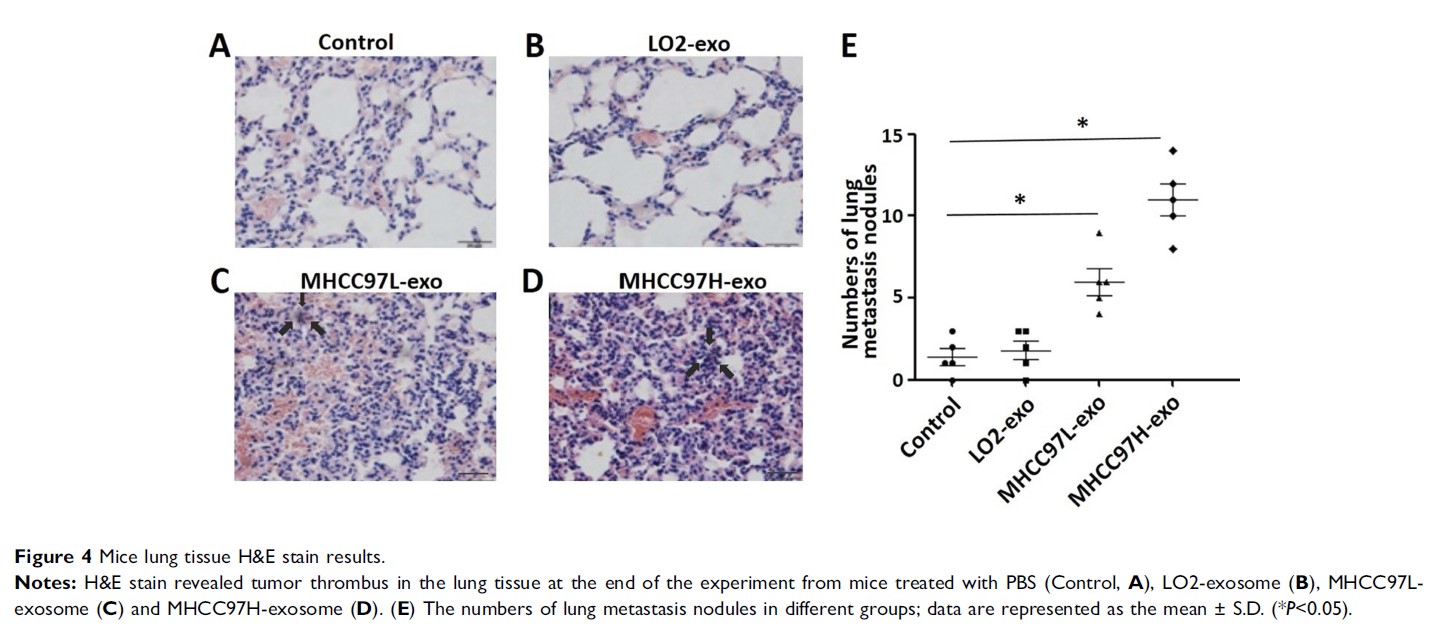
Results: Exosomes derived from hepatoma cells can promote the migration and invasion of recipient cells, induce the decrease of E-cadherin expression, increase the expression of Vimentin and promote epithelial-mesenchymal transition (EMT) in cells. Moreover, highly invasive hepatoma-cells-derived exosomes effects are stronger than low-invasive hepatoma cells and normal liver cells exosomes. Mechanistic studies showed that the biological alterations in recipient HCC cells treated with MHCC97H and MHCC97L-derived exosomes were caused by inducing EMT via TGF-β/Smad signaling pathway. In vivo experiments also suggest that highly invasive hepatoma cells derived exosomes are more likely to promote lung metastasis of HCC in nude mice.
Conclusion: Our results reveal the important role of tumor-derived exosomes in the migration and invasion of recipient cells and exosomes may be the novel therapeutic and prognostic targets for HCC patients.
Keywords: HCC, exosomal, TGF-β, EMT, tumor metastasis