118847
论文已发表
注册即可获取德孚的最新动态
IF 收录期刊
- 3.6 Breast Cancer (Dove Med Press)
- 4.3 Clin Epidemiol
- 2.6 Cancer Manag Res
- 3.2 Infect Drug Resist
- 4.1 Clin Interv Aging
- 6.1 Drug Des Dev Ther
- 4.1 Int J Chronic Obstr
- 8.7 Int J Nanomed
- 2.5 Int J Women's Health
- 3.2 Neuropsych Dis Treat
- 2.4 OncoTargets Ther
- 2.6 Patient Prefer Adher
- 2.6 Ther Clin Risk Manag
- 3.1 J Pain Res
- 3.5 Diabet Metab Synd Ob
- 4.5 Psychol Res Behav Ma
- 3.4 Nat Sci Sleep
- 2.4 Pharmgenomics Pers Med
- 2.6 Risk Manag Healthc Policy
- 4.6 J Inflamm Res
- 2.3 Int J Gen Med
- 3.9 J Hepatocell Carcinoma
- 3.3 J Asthma Allergy
- 2.5 Clin Cosmet Investig Dermatol
- 3.0 J Multidiscip Healthc

在中国新鲜蔬菜中出现共生的两种大肠杆菌菌株 mcr-1 和 bla NDM
Authors Liu BT, Song FJ
Received 11 April 2019
Accepted for publication 30 July 2019
Published 23 August 2019 Volume 2019:12 Pages 2627—2635
DOI https://doi.org/10.2147/IDR.S211746
Checked for plagiarism Yes
Review by Single-blind
Peer reviewers approved by Dr Colin Mak
Peer reviewer comments 2
Editor who approved publication: Professor Suresh Antony
Background: The concurrence of mcr and carbapenemase genes among Enterobacteriaceae has been a great clinical concern. In our study, we aimed to investigate the prevalence of mcr-positive carbapenem-resistant Enterobacteriaceae (CRE) in fresh vegetables and shed light on the possibility of transmission of mcr -positive CRE via fresh vegetables.
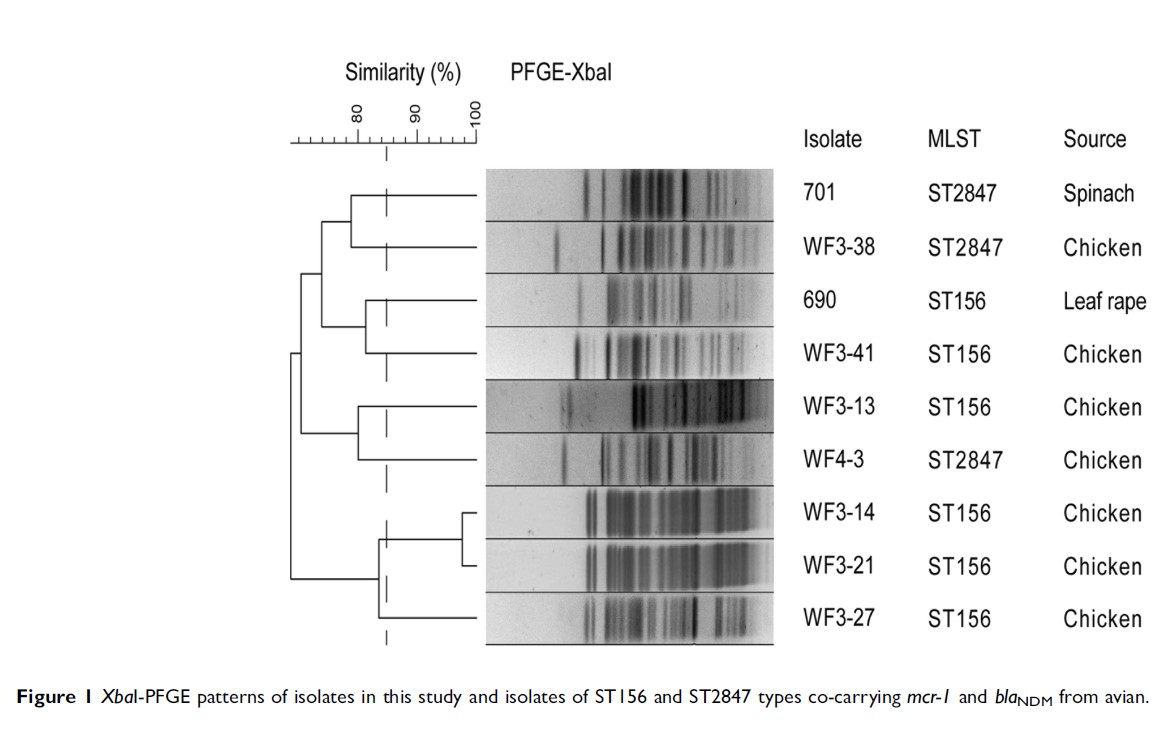
Methods: In this study, 712 fresh vegetable samples from 10 provinces in China were collected between May 2017 and Dec 2018 and were screened for mcr and carbapenemase genes. Antibiotic susceptibilities for isolates co-harboring carbapenemase genes and mcr were determined by an agar dilution or a broth microdilution method. Pulsed-field gel electrophoresis (PFGE) and multilocus sequence typing (MLST) analysis were also performed. Transferability of the carbapenemase/mcr -bearing plasmids was determined by conjugation, replicon typing and S1-PFGE-Southern blotting. The sequences of these plasmids were analyzed by using whole-genome sequencing with Illumina Hiseq platform.
Results: Two E. coli isolates concomitantly carrying mcr-1 and bla NDM-5/9 from leaf rape and spinach, respectively, were found and both isolates showed multidrug resistance. Notably, mcr-1 -positive 690 harboring bla NDM-5 and 701 carrying bla NDM-9 belonged to ST156 and ST2847, respectively, similar to the prevalent MLST types of E. coli co-carrying mcr-1 and bla NDM from avian in our previous study. mcr-1 was on ∼33-kb IncX4 plasmid or ∼60-kb IncI2 plasmid, while bla NDM-5/9 was on ∼46-kb IncX3 plasmid or ∼120-kb untypable plasmid. The plasmids were highly similar to those from animals and clinical patients reported in various countries.
Conclusion: E. coli isolates concomitantly carrying mcr-1 and bla NDM-5/9 in fresh vegetables may serve as a direct source of pathogens in humans, and such discovery in fresh vegetables emphasizes the importance of prompt surveillance and intervention in limiting the spread of E. coli co-carrying bla NDM and mcr-1 . To our knowledge, this is the first report of Enterobacteriaceae co-carrying bla NDM and mcr-1 in fresh vegetables.
Keywords: carbapenem resistance, colistin resistance, coexistence, plasmids, Enterobacteriaceae