118847
论文已发表
注册即可获取德孚的最新动态
IF 收录期刊
- 3.6 Breast Cancer (Dove Med Press)
- 4.3 Clin Epidemiol
- 2.6 Cancer Manag Res
- 3.2 Infect Drug Resist
- 4.1 Clin Interv Aging
- 6.1 Drug Des Dev Ther
- 4.1 Int J Chronic Obstr
- 8.7 Int J Nanomed
- 2.5 Int J Women's Health
- 3.2 Neuropsych Dis Treat
- 2.4 OncoTargets Ther
- 2.6 Patient Prefer Adher
- 2.6 Ther Clin Risk Manag
- 3.1 J Pain Res
- 3.5 Diabet Metab Synd Ob
- 4.5 Psychol Res Behav Ma
- 3.4 Nat Sci Sleep
- 2.4 Pharmgenomics Pers Med
- 2.6 Risk Manag Healthc Policy
- 4.6 J Inflamm Res
- 2.3 Int J Gen Med
- 3.9 J Hepatocell Carcinoma
- 3.3 J Asthma Allergy
- 2.5 Clin Cosmet Investig Dermatol
- 3.0 J Multidiscip Healthc

使用分位数转换的代谢数据对超重和肥胖人群进行 K 均值聚类
Authors Li L, Song Q, Yang X
Received 24 February 2019
Accepted for publication 9 July 2019
Published 23 August 2019 Volume 2019:12 Pages 1573—1582
DOI https://doi.org/10.2147/DMSO.S206640
Checked for plagiarism Yes
Review by Single-blind
Peer reviewers approved by Dr Melinda Thomas
Peer reviewer comments 2
Editor who approved publication: Dr Konstantinos Tziomalos
Objective: Use of K-means clustering for big data technology to cluster an overweight and obese population metabolically.
Methods: K-means clustering with the help of quantile transformation of attribute values was applied to overcome the impact of the considerable variation in the values of obesity attributes involving outliers and skewed distribution.
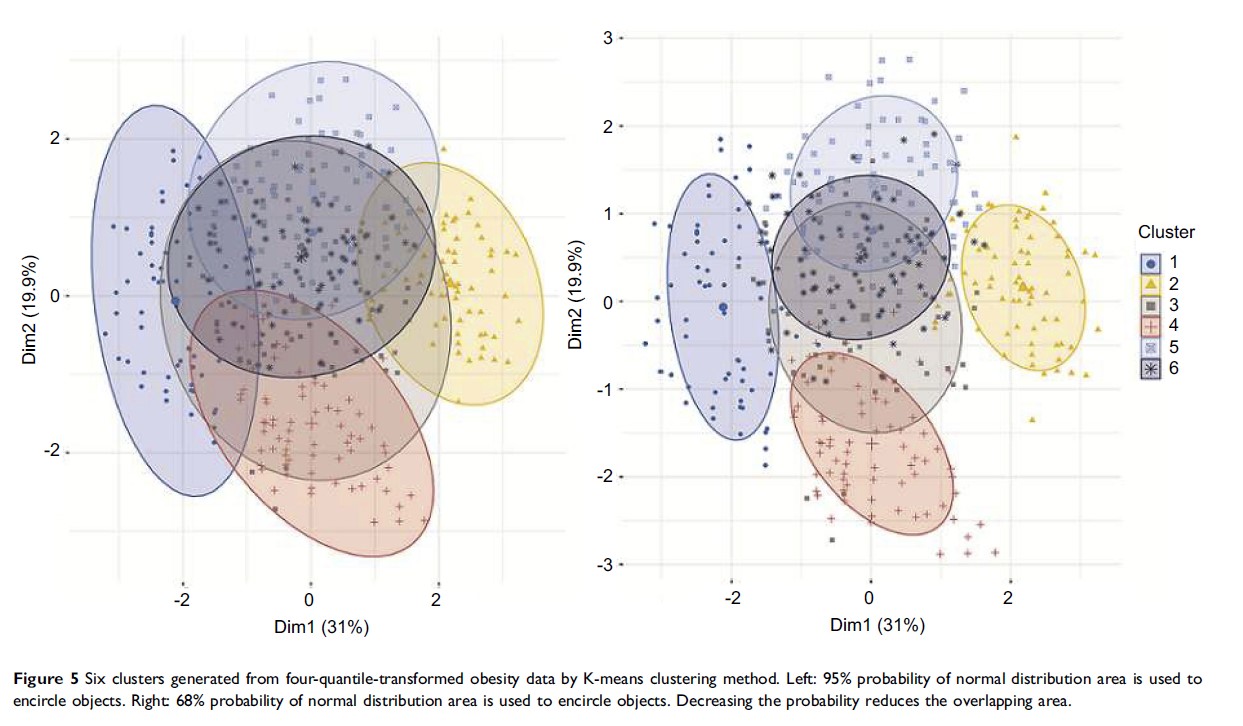
Results: Overall, 447 subjects were categorized into six clusters; metabolically normal, mild, and severe categories. There were clearly separated metabolically normal Cluster 1 and severe Cluster 2, as well as intermediate Cluster 3, 4, and 5 that had profiles of fewer attributes with abnormal values. Cluster 3 was characteristic of sole hypertension. Cluster 3 and 4 exhibited contrasting HDL-C and LDL-C levels despite similarly elevated total cholesterol. Cluster 6 with slightly elevated triglyceride was closest to the normal group. Four- and 10-quantile-transformations yielded consistent clustering results. Compared with the original data, the quantile-transformed data produced more regular and spherical clusters and evenly distributed clusters in terms of object numbers.
Conclusions: This big data analysis strategy makes use of quantile-transformation of data to overcome the issue of outliers and the irregular distribution and applies to the analysis of other non-communicable diseases.
Keywords: overweight and obesity, big data technology, quantile-transformation, K-means clustering