118847
论文已发表
注册即可获取德孚的最新动态
IF 收录期刊
- 3.6 Breast Cancer (Dove Med Press)
- 4.3 Clin Epidemiol
- 2.6 Cancer Manag Res
- 3.2 Infect Drug Resist
- 4.1 Clin Interv Aging
- 6.1 Drug Des Dev Ther
- 4.1 Int J Chronic Obstr
- 8.7 Int J Nanomed
- 2.5 Int J Women's Health
- 3.2 Neuropsych Dis Treat
- 2.4 OncoTargets Ther
- 2.6 Patient Prefer Adher
- 2.6 Ther Clin Risk Manag
- 3.1 J Pain Res
- 3.5 Diabet Metab Synd Ob
- 4.5 Psychol Res Behav Ma
- 3.4 Nat Sci Sleep
- 2.4 Pharmgenomics Pers Med
- 2.6 Risk Manag Healthc Policy
- 4.6 J Inflamm Res
- 2.3 Int J Gen Med
- 3.9 J Hepatocell Carcinoma
- 3.3 J Asthma Allergy
- 2.5 Clin Cosmet Investig Dermatol
- 3.0 J Multidiscip Healthc

通过灭活 p38 MAPK 和 NF-κB 信号通路,埃索美拉唑不仅可以减轻大鼠应激性溃疡的损伤,还可以削弱其抗氧化作用
Authors Xie W, Huang X, Chen R, Chen R, Li T, Wu W, Huang Z
Received 6 November 2018
Accepted for publication 16 May 2019
Published 22 August 2019 Volume 2019:13 Pages 2969—2984
DOI https://doi.org/10.2147/DDDT.S193641
Checked for plagiarism Yes
Review by Single-blind
Peer reviewers approved by Dr ZhiQiang Yin
Peer reviewer comments 2
Editor who approved publication: Dr Georgios D. Panos
Background: Stress ulcer is a severe complication in critically ill patients and causes a high mortality. The proton pump inhibitor esomeprazole is widely applied in the treatment of stress ulcers because of its powerful acid suppression ability. However, the mechanism of stress ulcer and the precise gastroprotective effect of esomeprazole in stress ulcer remain unclear.
Purpose: In the present study, the rats with water-immersed and restraint (WIR)-induced stress ulcer were used to further elucidate the anti-ulcerogenic capacity of esomeprazole in stress ulcer in addition to its anti-acid secreting ability.
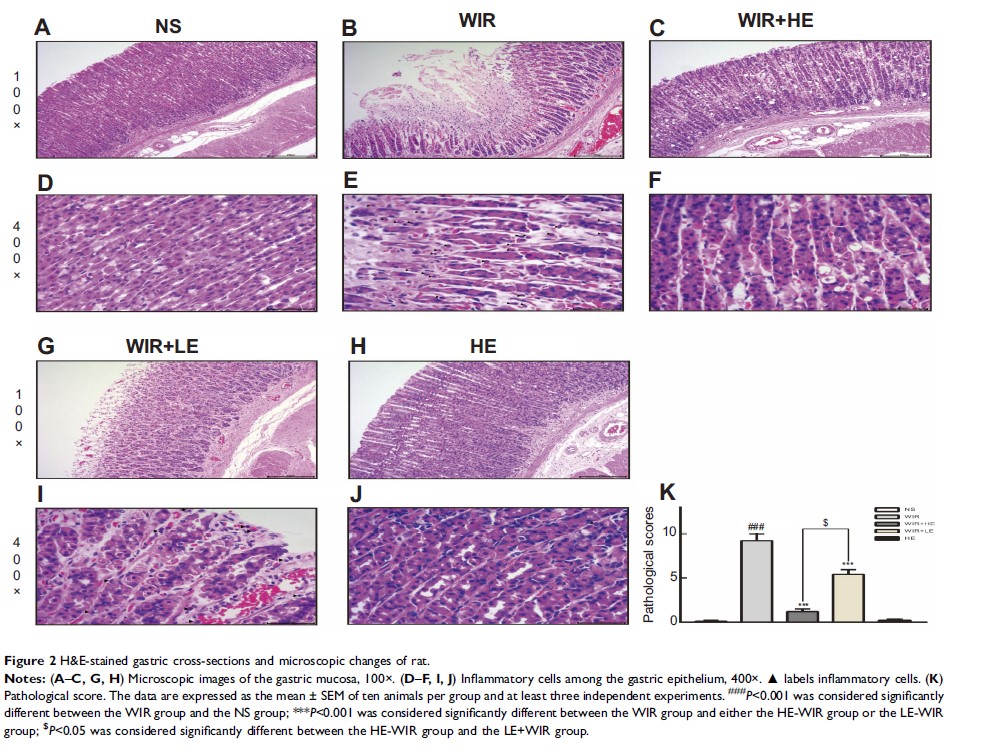
Methods and results: The rats were randomly divided into 5 groups: control group (NS), water-immersed and restraint group (WIR), high-dose application of esomeprazole plus stress ulcer-induced group (HE+WIR), low-dose application of esomeprazole plus stress ulcer-induced group (LE+WIR), and high-dose application of esomeprazole without stress ulcer-induced group (HE). Our study showed that the pretreatment of esomeprazole alleviated gastric tissue damage in both macroscopic and histopathological manifestations. Pretreatment of esomeprazole elevated the decline in PEG2 level affected by WIR; and it inhibited the secretion of gastric acid, gastrin and pepsin. Moreover, esomeprazole exerted its antioxidant effects by reducing malondialdehyde levels, enhancing the expressions of antioxidant factors like glutathione and superoxide dismutase (SOD) and reducing the compensatory transcriptional elevation of SOD1 gene. Esomeprazole also reduced the levels of MPO (myeloperoxidase), tumor necrosis factor (TNF)-α and interleukin (IL)-1β according to its anti-inflammatory effects. We further explored the possible mechanism of esomeprazole pretreatment on stress ulcer and demonstrated that esomeprazole attenuated the high phosphorylation levels of nuclear factor kappa B (NF-κB) p65 and p38 MAPK, and decreased the NF-κB p65 nuclear translocation induced by WIR related stress ulcer.
Conclusion: Our study provides some evidence that the esomeprazole pretreatment exerts gastroprotective effects in WIR-induced stress ulcer through not only its antisecretory effect but also its antioxidant effect by inactivating the p38 MAPK and NF-κB signaling pathways.
Keywords: stress ulcer, esomeprazole, oxidative stress, NF-κB, MAPK-p38