118847
论文已发表
注册即可获取德孚的最新动态
IF 收录期刊
- 3.6 Breast Cancer (Dove Med Press)
- 4.3 Clin Epidemiol
- 2.6 Cancer Manag Res
- 3.2 Infect Drug Resist
- 4.1 Clin Interv Aging
- 6.1 Drug Des Dev Ther
- 4.1 Int J Chronic Obstr
- 8.7 Int J Nanomed
- 2.5 Int J Women's Health
- 3.2 Neuropsych Dis Treat
- 2.4 OncoTargets Ther
- 2.6 Patient Prefer Adher
- 2.6 Ther Clin Risk Manag
- 3.1 J Pain Res
- 3.5 Diabet Metab Synd Ob
- 4.5 Psychol Res Behav Ma
- 3.4 Nat Sci Sleep
- 2.4 Pharmgenomics Pers Med
- 2.6 Risk Manag Healthc Policy
- 4.6 J Inflamm Res
- 2.3 Int J Gen Med
- 3.9 J Hepatocell Carcinoma
- 3.3 J Asthma Allergy
- 2.5 Clin Cosmet Investig Dermatol
- 3.0 J Multidiscip Healthc

在中国一家大型教学医院的抗生素敏感性与抗生素消耗趋势及相关性(2007-2016):监测研究
Authors Wang R, Yang Q, Zhang S, Hong Y, Zhang M, Jiang S
Received 3 April 2019
Accepted for publication 2 August 2019
Published 20 August 2019 Volume 2019:15 Pages 1019—1027
DOI https://doi.org/10.2147/TCRM.S210872
Checked for plagiarism Yes
Review by Single-blind
Peer reviewers approved by Dr Colin Mak
Peer reviewer comments 2
Editor who approved publication: Professor Deyun Wang
Purpose: To evaluate the trends and correlation between the antibiotic consumption and susceptibility of eight most frequent isolates in the First Affiliated Hospital of Zhejiang University (2007–2016).
Method: This study was based on the yearly surveillance data in a 2500-bed capacity tertiary-care teaching hospital. Trends and correlation were, respectively, analyzed by linear regression and Pearson’s correlation coefficient.
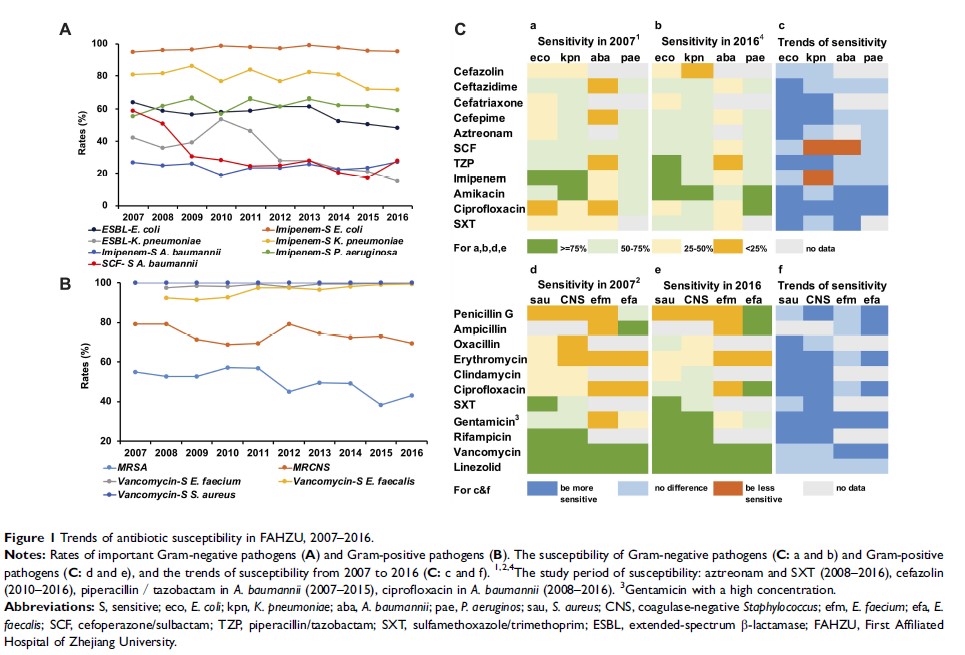
Results: The consumption of all antibiotics decreased by 10.8% over time, especially first-generation cephalosporins (p =0.001), fourth-generation cephalosporins (p =0.01), aminoglycosides (p <0.001), and fluoroquinolones (p <0.001), but increased remarkably in linezolid, carbapenems, glycopeptides, and third-generationcephalosporins (3GCs). 72.7% of trend analyses indicated increased susceptibility to antibiotics with remarkably decreased consumption. In particular, susceptibility to aminoglycosides and fluoroquinolones remarkably increased in seven of eight pathogens and negatively correlated with the corresponding antibiotic consumption (p <0.05). Isolation density significantly declined in methicillin-resistant Staphylococcus aureus (54.9–41.3%, p =0.009) and in extended-spectrum β-lactamase producing Klebsiella pneumoniae (42.4–15.6%, p =0.007), which positively correlated with the consumption of fluoroquinolones. The susceptibility to antibiotics with increased consumption was almost stable. Decreased trends were only found in K. pneumoniae to imipenem (81–71.3%, p =0.046) and cefoperazone/sulbactam (70.8–61.0%, p =0.014) and in Acinetobacter baumannii to cefoperazone/sulbactam (59–28%, p =0.007), which negatively correlated with the consumption of carbapenems (r=−0.649, p =0.042) and 3GCs/β-lactamase inhibitors (p <0.05), respectively. The consumption of glycopeptides even positively correlated with the growing susceptibility to vancomycin in Enterococcus faecium (r=0.633, p =0.049) and Enterococcus faecalis (r=0.752, p =0.012).
Conclusion: The susceptibility to antibiotics with decreased consumption increased remarkably, but maintained stable to those with growing consumption. The stricter management of carbapenems and 3GCs is necessary.
Keywords: antibiotic susceptibility, antibiotic consumption, surveillance, correlation, People’s Republic of China