118847
论文已发表
注册即可获取德孚的最新动态
IF 收录期刊
- 3.6 Breast Cancer (Dove Med Press)
- 4.3 Clin Epidemiol
- 2.6 Cancer Manag Res
- 3.2 Infect Drug Resist
- 4.1 Clin Interv Aging
- 6.1 Drug Des Dev Ther
- 4.1 Int J Chronic Obstr
- 8.7 Int J Nanomed
- 2.5 Int J Women's Health
- 3.2 Neuropsych Dis Treat
- 2.4 OncoTargets Ther
- 2.6 Patient Prefer Adher
- 2.6 Ther Clin Risk Manag
- 3.1 J Pain Res
- 3.5 Diabet Metab Synd Ob
- 4.5 Psychol Res Behav Ma
- 3.4 Nat Sci Sleep
- 2.4 Pharmgenomics Pers Med
- 2.6 Risk Manag Healthc Policy
- 4.6 J Inflamm Res
- 2.3 Int J Gen Med
- 3.9 J Hepatocell Carcinoma
- 3.3 J Asthma Allergy
- 2.5 Clin Cosmet Investig Dermatol
- 3.0 J Multidiscip Healthc

全直肠系膜切除术后局部晚期直肠癌患者的全身炎症评分
Authors Feng Y, Liu L, Zhu Y
Received 28 April 2019
Accepted for publication 30 July 2019
Published 19 August 2019 Volume 2019:12 Pages 6617—6622
DOI https://doi.org/10.2147/OTT.S213720
Checked for plagiarism Yes
Review by Single-blind
Peer reviewers approved by Ms Shreya Arora
Peer reviewer comments 2
Editor who approved publication: Dr Takuya Aoki
Objective: The objective of the study was to evaluate whether any association exists between systemic inflammation score (SIS) and adverse events (AEs) and survival of locally advanced rectal cancer patients treated with total mesorectal excision (TME) followed by adjuvant chemoradiotherapy.
Patients and methods: All of the 109 rectal cancer patients recruited between May 2008 and June 2015 were treated with TME followed by adjuvant chemoradiotherapy. The prognostic ability of SIS for overall survival (OS) was calculated by the receiver operating characteristic (ROC) curves.
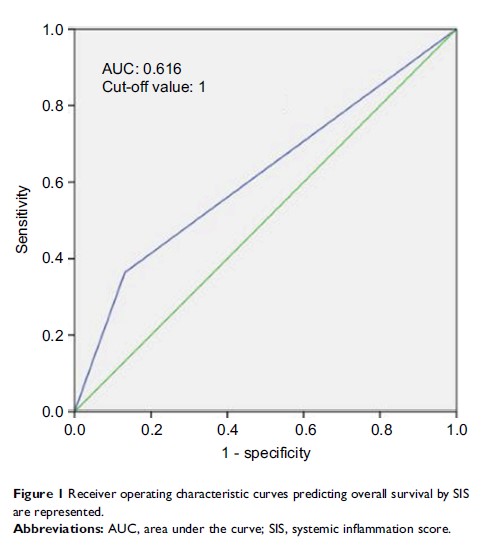
Results: According to the classification of the SIS, 22 (20.2%), 59 (54.1%) and 28 (25.7%) patients were classified as a score of 2, 1 and 0, respectively. With an area under the curve (AUC) of 0.616, the SIS score of 1 was defined as the optimal cut-off value. Therefore, we divided the patients into the SIS-low group (SIS score of 1 or 0, n=87) and SIS-high group (SIS score of 2, n=22). Multivariate analysis indicated that SIS was associated with OS (HR 0.390, 95% CI 0.186–0.817, P =0.012). The 5-year OS rate in patients without adjuvant chemotherapy was lower than the patients with adjuvant chemotherapy (53.3% vs 75.8%, P =0.010). Multivariate analysis showed that adjuvant chemotherapy was associated with OS (HR 0.217, 95% CI 0.089–0.529, P =0.001). A marginal statistically significant difference was observed in terms of leukopenia during adjuvant chemoradiotherapy between the SIS-low group and the SIS-high group (P =0.05).
Conclusion: These results suggest that SIS might serve as an independent biomarker for predicting AEs and prognosis in locally advanced rectal cancer treated with TME followed by adjuvant chemoradiotherapy. Strengthening treatment may be administered to locally advanced rectal cancer with high SIS score obtained before adjuvant chemoradiotherapy.
Keywords: rectal cancer, SIS, chemoradiotherapy, acute adverse event, survival