118847
论文已发表
注册即可获取德孚的最新动态
IF 收录期刊
- 3.6 Breast Cancer (Dove Med Press)
- 4.3 Clin Epidemiol
- 2.6 Cancer Manag Res
- 3.2 Infect Drug Resist
- 4.1 Clin Interv Aging
- 6.1 Drug Des Dev Ther
- 4.1 Int J Chronic Obstr
- 8.7 Int J Nanomed
- 2.5 Int J Women's Health
- 3.2 Neuropsych Dis Treat
- 2.4 OncoTargets Ther
- 2.6 Patient Prefer Adher
- 2.6 Ther Clin Risk Manag
- 3.1 J Pain Res
- 3.5 Diabet Metab Synd Ob
- 4.5 Psychol Res Behav Ma
- 3.4 Nat Sci Sleep
- 2.4 Pharmgenomics Pers Med
- 2.6 Risk Manag Healthc Policy
- 4.6 J Inflamm Res
- 2.3 Int J Gen Med
- 3.9 J Hepatocell Carcinoma
- 3.3 J Asthma Allergy
- 2.5 Clin Cosmet Investig Dermatol
- 3.0 J Multidiscip Healthc

LncSNHG3/miR-139-5p/BMI1 轴可调节肝细胞癌的增殖、迁移和侵袭
Authors Wu J, Liu L, Jin H, Li Q, Wang S, Peng B
Received 30 November 2018
Accepted for publication 25 January 2019
Published 19 August 2019 Volume 2019:12 Pages 6623—6638
DOI https://doi.org/10.2147/OTT.S196630
Checked for plagiarism Yes
Review by Single-blind
Peer reviewers approved by Dr Andrew Yee
Peer reviewer comments 3
Editor who approved publication: Dr Federico Perche
Objective: Emerging evidence has revealed that lncRNA small nucleolar RNA host gene 3 (SNHG3) is involved in cell proliferation, migration, and invasion in various tumors. However, the underlying molecular mechanism of SNHG3 in hepatocellular carcinoma (HCC) is still not fully explored.
Methods: Quantitative reverse transcriptase PCR was employed to detect the expression of SNHG3, miR-139-5p, and BMI1. Colony assay and MTT assay were used to detect the proliferation. Transwell assay was introduced to measure the migration and invasion ability. Bioinformatics analysis and luciferase reporter assay were used to confirm the relationship between SNHG3, miR-139-5p, and BMI1. An animal experiment was adopted to detect the function of SNHG3 in vivo.
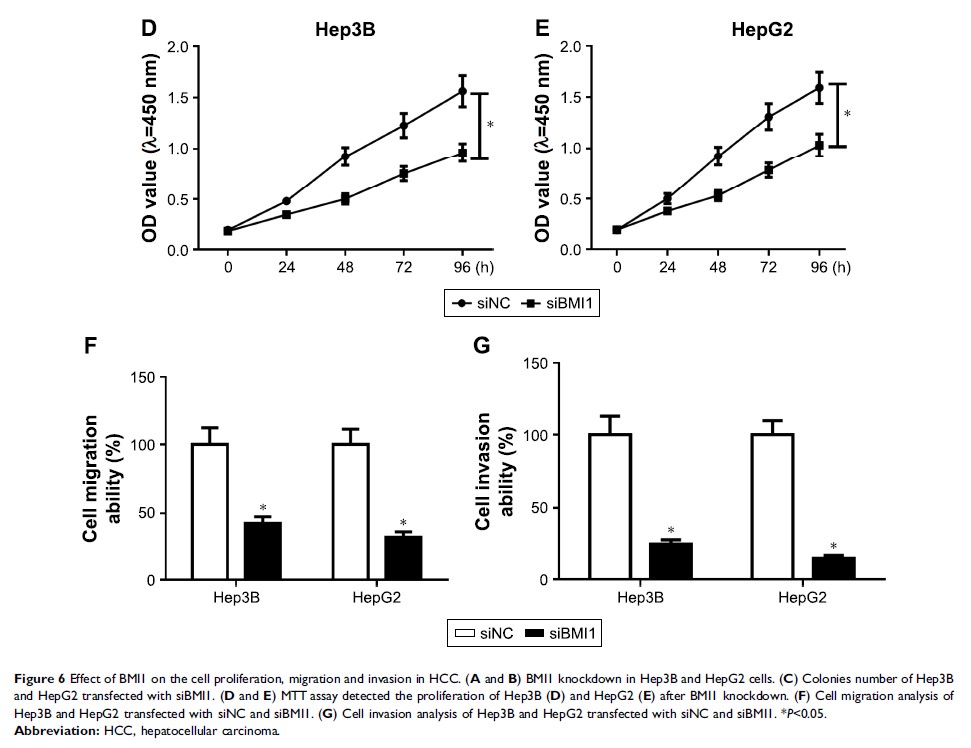
Results: SNHG3 and BMI1 were upregulated in HCC, while miR-139-5p was downregulated. Knockdown of SNHG3 or BMI1 and overexpression of miR-139-5p could inhibit cell proliferation, migration, and invasion in HCC. miR-139-5p was a target of SNHG3 and BMI1 was a direct target mRNA of miR-139-5p. Silencing SNHG3 could impair the tumor progression in vivo.
Conclusion: The lncRNA SNHG3/miR-139-5p/BMI1 axis plays an important role in cell proliferation, migration, and invasion in HCC.
Keywords: SNHG3, miR-139-5p, BMI1, hepatocellular carcinoma