118847
论文已发表
注册即可获取德孚的最新动态
IF 收录期刊
- 3.6 Breast Cancer (Dove Med Press)
- 4.3 Clin Epidemiol
- 2.6 Cancer Manag Res
- 3.2 Infect Drug Resist
- 4.1 Clin Interv Aging
- 6.1 Drug Des Dev Ther
- 4.1 Int J Chronic Obstr
- 8.7 Int J Nanomed
- 2.5 Int J Women's Health
- 3.2 Neuropsych Dis Treat
- 2.4 OncoTargets Ther
- 2.6 Patient Prefer Adher
- 2.6 Ther Clin Risk Manag
- 3.1 J Pain Res
- 3.5 Diabet Metab Synd Ob
- 4.5 Psychol Res Behav Ma
- 3.4 Nat Sci Sleep
- 2.4 Pharmgenomics Pers Med
- 2.6 Risk Manag Healthc Policy
- 4.6 J Inflamm Res
- 2.3 Int J Gen Med
- 3.9 J Hepatocell Carcinoma
- 3.3 J Asthma Allergy
- 2.5 Clin Cosmet Investig Dermatol
- 3.0 J Multidiscip Healthc

部位与转移灶数量对新诊断宫颈癌器官转移患者生存率的影响
Authors Yin Z, Tang H, Li L, Ni J, Yuan S, Lou H, Chen M
Received 26 January 2019
Accepted for publication 22 July 2019
Published 16 August 2019 Volume 2019:11 Pages 7759—7766
DOI https://doi.org/10.2147/CMAR.S203037
Checked for plagiarism Yes
Review by Single-blind
Peer reviewers approved by Dr Melinda Thomas
Peer reviewer comments 2
Editor who approved publication: Dr Antonella D'Anneo
Objective: The aim of this study was to investigate the potential associations of the sites and the number of specific metastases with survival in patients newly diagnosed with cervical cancer.
Methods: Medical records of patients with organ metastases of newly diagnosed cervical cancer at Zhejiang Cancer Hospital from October 2006 to December 2016 were reviewed retrospectively. Survival times were compared using the Kaplan-Meier method. Variables associated with survival were identified using univariate and multivariate Cox proportional hazards models.
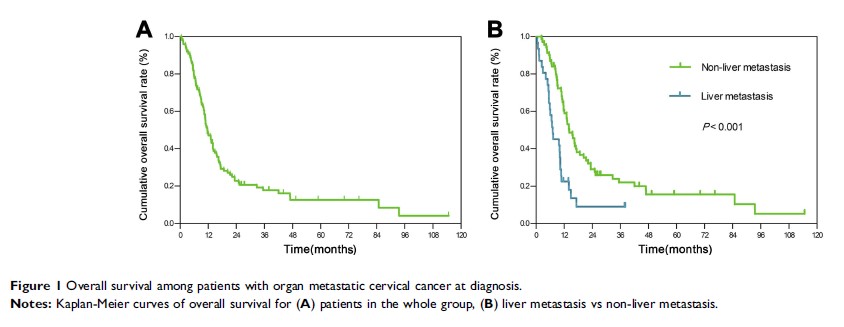
Results: A total of 99 patients with newly diagnosed organ metastatic cervical cancer were identified. Median follow-up was 11.6 months (range, 0.5–114.7 months). Median overall survival (OS) time was 11.7 months from diagnosis, with 1, 2, and 5-year OS rates of 48.2%, 22.8%, and 12.6%, respectively. The most common site of organ metastasis was bone (36.8%), followed by lung (32.8%) and liver (24%). In univariate analysis, OS rates were better for bone metastasis than visceral metastasis (P =0.013), oligometastasis than non-oligometastasis (P =0.003) and single organ metastasis than multiple organ metastases (P =0.016), while that for liver metastasis was poorer than non-liver metastases (P <0.001). In multivariate analysis, liver metastasis (hazard ratio [HR] =4.02; 95% confidence interval [CI], 1.15-14.05, P =0.029) was significantly and independently related to poor overall survival.
Conclusion: Our data revealed the site of metastasis is associated with overall survival of patients with newly diagnosed organ metastatic cervical cancer, with liver metastasis signifying particularly poor overall survival. Individualized treatments should be administered to patients depending on the specific metastatic sites.
Keywords: uterine cervical neoplasm, survival, organ metastasis, metastatic site, number of metastases