118847
论文已发表
注册即可获取德孚的最新动态
IF 收录期刊
- 3.6 Breast Cancer (Dove Med Press)
- 4.3 Clin Epidemiol
- 2.6 Cancer Manag Res
- 3.2 Infect Drug Resist
- 4.1 Clin Interv Aging
- 6.1 Drug Des Dev Ther
- 4.1 Int J Chronic Obstr
- 8.7 Int J Nanomed
- 2.5 Int J Women's Health
- 3.2 Neuropsych Dis Treat
- 2.4 OncoTargets Ther
- 2.6 Patient Prefer Adher
- 2.6 Ther Clin Risk Manag
- 3.1 J Pain Res
- 3.5 Diabet Metab Synd Ob
- 4.5 Psychol Res Behav Ma
- 3.4 Nat Sci Sleep
- 2.4 Pharmgenomics Pers Med
- 2.6 Risk Manag Healthc Policy
- 4.6 J Inflamm Res
- 2.3 Int J Gen Med
- 3.9 J Hepatocell Carcinoma
- 3.3 J Asthma Allergy
- 2.5 Clin Cosmet Investig Dermatol
- 3.0 J Multidiscip Healthc

可调制强度碳离子辐射治疗与可调制强度光子放疗对局部复发性鼻咽癌治疗的比较:剂量学比较
Authors Wang L, Hu J, Liu X, Wang W, Kong L, Lu JJ
Received 14 February 2019
Accepted for publication 21 July 2019
Published 16 August 2019 Volume 2019:11 Pages 7767—7777
DOI https://doi.org/10.2147/CMAR.S205421
Checked for plagiarism Yes
Review by Single-blind
Peer reviewers approved by Ms Justinn Cochran
Peer reviewer comments 2
Editor who approved publication: Dr Beicheng Sun
Purpose: To identify the specific dose advantage of intensity-modulated carbon-ion radiation therapy (IMCT) over photon-based intensity-modulated radiation therapy (IMRT) in the treatment of locally recurrent nasopharyngeal carcinoma (NPC).
Materials and methods: Ten patients with locally recurrent NPC underwent IMCT and IMRT planning. Target definition followed the recommendations of the International Commission on Radiation Units and Measurements (ICRU) reports no. 50, 62 and 83. The real treatment plans which were delivered to patients were designed on the Siemens Syngo planning system while the control plans for dosimetric comparison were generated from the Varian Medical Systems. The optimization constraints of the two designs were basically the same. Target coverage was evaluated using the following parameters: Dmin, Dmax, D1, D2, D50, D95, D98 and D99. Target dose distribution and conformality were evaluated using the homogeneity index and conformity index. Normal tissue sparing of organs at risk (OARs) were evaluated using Dmean, D1 and Dmax. SPSS 22.0 software was used for data analysis.
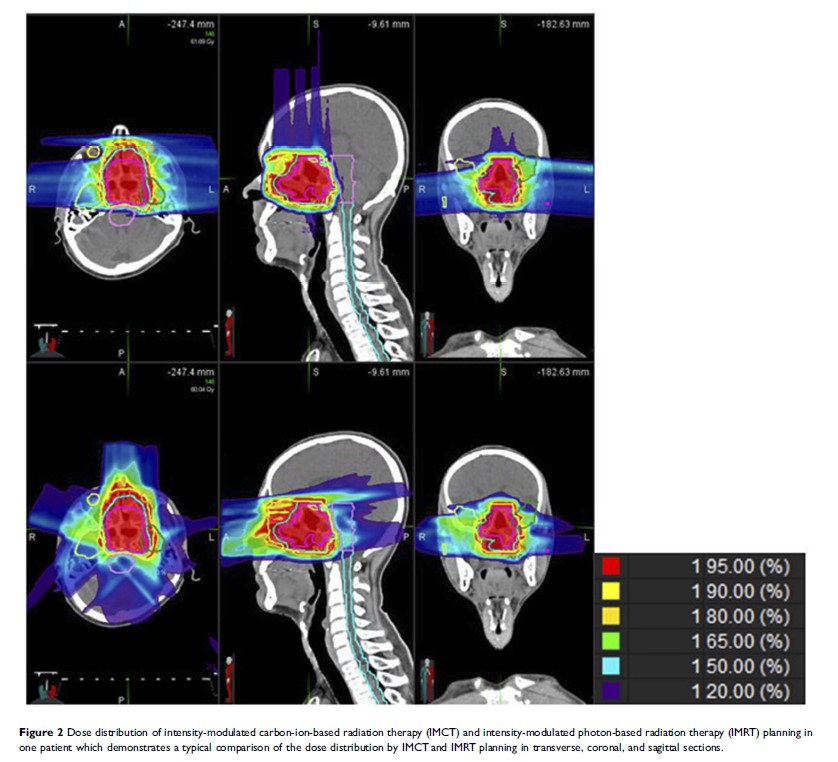
Results: Both IMCT and IMRT plans met clinical prescription dose requirements. Target coverage of D1, D2, D50, D95, D98, D99 were not significantly different between the two plans (P >0.05). The two plans showed satisfactory coverage of the target without significant difference. There was no significant difference in terms of the homogeneity and conformability between the two plans. Dosimetric parameters for the brain stem, spinal cord, parotid gland, optic chiasm, eyeball, lens, temporal lobe and inner ear were significantly reduced in the IMCT plan (P <0.05).
Conclusion: As compared with photon-based IMRT, IMCT significantly reduces radiation dose to the OARs in the treatment of locally recurrent NPC while maintaining the dose coverage to the target volumes. Such a feature is particularly important for patients who experienced previous high-dose irradiation.
Keywords: locally recurrent nasopharyngeal carcinoma, carbon ion, dosimetry comparison