118847
论文已发表
注册即可获取德孚的最新动态
IF 收录期刊
- 3.6 Breast Cancer (Dove Med Press)
- 4.3 Clin Epidemiol
- 2.6 Cancer Manag Res
- 3.2 Infect Drug Resist
- 4.1 Clin Interv Aging
- 6.1 Drug Des Dev Ther
- 4.1 Int J Chronic Obstr
- 8.7 Int J Nanomed
- 2.5 Int J Women's Health
- 3.2 Neuropsych Dis Treat
- 2.4 OncoTargets Ther
- 2.6 Patient Prefer Adher
- 2.6 Ther Clin Risk Manag
- 3.1 J Pain Res
- 3.5 Diabet Metab Synd Ob
- 4.5 Psychol Res Behav Ma
- 3.4 Nat Sci Sleep
- 2.4 Pharmgenomics Pers Med
- 2.6 Risk Manag Healthc Policy
- 4.6 J Inflamm Res
- 2.3 Int J Gen Med
- 3.9 J Hepatocell Carcinoma
- 3.3 J Asthma Allergy
- 2.5 Clin Cosmet Investig Dermatol
- 3.0 J Multidiscip Healthc

免疫治疗与抗血管生成药物相结合治疗晚期非小细胞肺癌的前景展望
Authors Liang H, Wang M
Received 14 April 2019
Accepted for publication 24 July 2019
Published 15 August 2019 Volume 2019:11 Pages 7707—7719
DOI https://doi.org/10.2147/CMAR.S212238
Checked for plagiarism Yes
Review by Single-blind
Peer reviewers approved by Dr Amy Norman
Peer reviewer comments 2
Editor who approved publication: Dr Chien-Feng Li
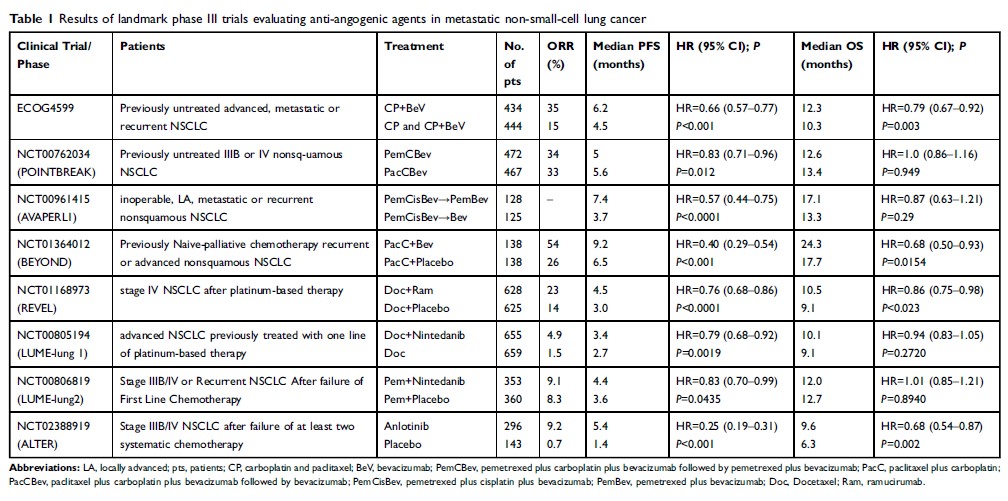
Abstract: In the latest years, some drugs have been approved by European Medicines Agency (EMA) and/or the US Food and Drug Administration (FDA) for the treatment of patients with advanced non-small cell lung cancer (NSCLC), particularly for the treatment of those who have no targeted gene mutations or who have progressed on previously targeted therapy or platinum-containing dual-agent chemotherapy. In general, these drugs fall into two categories: anti-angiogenic agents and immune checkpoint inhibitors (ICIs). Anti-angiogenic agents currently approved by the FDA and/or EMA for advanced NSCLC treatment include bevacizumab, nintedanib, and ramucirumab. Anlotinib has been approved in advanced NSCLC by Chinese Food and Drug Administration (CFDA). These anti-angiogenic agents can induce anti-angiogenesis by targeting vascular endothelial growth factor (VEGF)/VEGF2 or inhibiting multiple small molecules involved in angiogenic and proliferative pathways such as platelet-derived growth factor receptors (PDGFRs) and fibroblast growth factor receptors (FGFRs). Although these drugs show significant therapeutic efficacy, most patients inevitably experience disease progression resulting in death. ICIs approved by the FDA and/or EMA for advanced NSCLC treatment include nivolumab, pembrolizumab, and atezolizumab. These ICIs can significantly improve efficacy compared with standard chemotherapy by targeting programmed cell death protein 1 (PD-1) receptor or PD-2 receptor with longer response duration and acceptable toxicity. However, the response rate of ICIs is suboptimal, and only a few patients ultimately benefit from immunotherapy. So current efforts have focused on exploring new potential combinatorial strategies with synergistic antitumor activity. Here, we summarized the theoretical basis, current clinical data, and potential future perspective of immunotherapy combined with anti-angiogenic agents for advanced NSCLC.
Keywords: non-small cell lung cancer, immunotherapy, anti-angiogenic agents