118847
论文已发表
注册即可获取德孚的最新动态
IF 收录期刊
- 3.6 Breast Cancer (Dove Med Press)
- 4.3 Clin Epidemiol
- 2.6 Cancer Manag Res
- 3.2 Infect Drug Resist
- 4.1 Clin Interv Aging
- 6.1 Drug Des Dev Ther
- 4.1 Int J Chronic Obstr
- 8.7 Int J Nanomed
- 2.5 Int J Women's Health
- 3.2 Neuropsych Dis Treat
- 2.4 OncoTargets Ther
- 2.6 Patient Prefer Adher
- 2.6 Ther Clin Risk Manag
- 3.1 J Pain Res
- 3.5 Diabet Metab Synd Ob
- 4.5 Psychol Res Behav Ma
- 3.4 Nat Sci Sleep
- 2.4 Pharmgenomics Pers Med
- 2.6 Risk Manag Healthc Policy
- 4.6 J Inflamm Res
- 2.3 Int J Gen Med
- 3.9 J Hepatocell Carcinoma
- 3.3 J Asthma Allergy
- 2.5 Clin Cosmet Investig Dermatol
- 3.0 J Multidiscip Healthc

中国接受护理的幸存者的心理状况及其相关因素:2008 年四川地震 6 年之后
Authors Liao J, Ma X, Gao B, Zhang M, Zhang Y, Liu M, Li X
Received 2 February 2019
Accepted for publication 3 July 2019
Published 14 August 2019 Volume 2019:15 Pages 2301—2311
DOI https://doi.org/10.2147/NDT.S203909
Checked for plagiarism Yes
Review by Single-blind
Peer reviewers approved by Prof. Dr. Roumen Kirov
Peer reviewer comments 2
Editor who approved publication: Professor Jun Chen
Purpose: Nursing survivors are often not only the victims but also the rescuers in a disaster. Severe natural disasters can cause them long-term psychological impact. This study aimed to investigate the psychological status of nursing survivors and its associated factors 6 years after the severe earthquake that occurred in Wenchuan, Sichuan, on May 12, 2008.
Methods: The study used a cross-sectional design. A total of 597 nurses who survived the earthquake and took care of victims were recruited about 6 years after the disaster. They completed a self-report questionnaire assessing information about demographics, earthquake-related characteristics, psychological status, posttraumatic stress disorder, and posttraumatic growth and resilience.
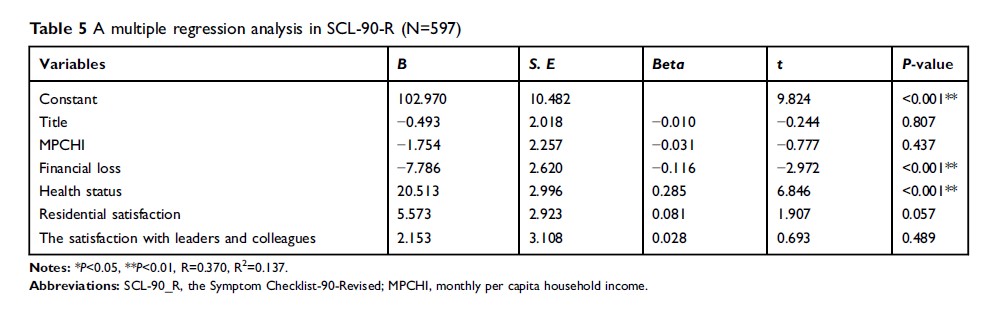
Results: The mean score on the Symptom Checklist-90-Revised (SCL-90-R) was (123.56±41.26). Of symptoms indicated by the SCL-90-R, obsessive-compulsive dimension had the highest score (1.62±0.62). The psychological status of nursing survivors differed with the title, monthly per capita household income, financial loss, health status, residential satisfaction, and satisfaction with leaders and colleagues. Severe financial loss and poor health status were significant factors of psychological distress. In addition, psychological status was negatively related to posttraumatic stress disorder and posttraumatic growth, and positively related to resilience.
Conclusion: Nursing survivors had a relatively normal level of psychological status 6 years after the 2008 Sichuan earthquake. However, psychological symptoms such as obsessive-compulsive patterns still remained. Interventions focusing on the improvement of financial subsidies and physical health may be particularly useful in reducing psychological problems after the disaster.
Keywords: natural disaster, posttraumatic growth, resilience, rescue, mental health, disaster response