118847
论文已发表
注册即可获取德孚的最新动态
IF 收录期刊
- 3.6 Breast Cancer (Dove Med Press)
- 4.3 Clin Epidemiol
- 2.6 Cancer Manag Res
- 3.2 Infect Drug Resist
- 4.1 Clin Interv Aging
- 6.1 Drug Des Dev Ther
- 4.1 Int J Chronic Obstr
- 8.7 Int J Nanomed
- 2.5 Int J Women's Health
- 3.2 Neuropsych Dis Treat
- 2.4 OncoTargets Ther
- 2.6 Patient Prefer Adher
- 2.6 Ther Clin Risk Manag
- 3.1 J Pain Res
- 3.5 Diabet Metab Synd Ob
- 4.5 Psychol Res Behav Ma
- 3.4 Nat Sci Sleep
- 2.4 Pharmgenomics Pers Med
- 2.6 Risk Manag Healthc Policy
- 4.6 J Inflamm Res
- 2.3 Int J Gen Med
- 3.9 J Hepatocell Carcinoma
- 3.3 J Asthma Allergy
- 2.5 Clin Cosmet Investig Dermatol
- 3.0 J Multidiscip Healthc

中国西部地区个体睾丸精原细胞瘤的临床特征:10 年随访研究
Authors Chen Z, Qiu S, Cao D, Guo J, Chen B, Huang Y, Lai L, Bao Y, Dong Q, Liu L, Wei Q
Received 13 May 2019
Accepted for publication 22 July 2019
Published 14 August 2019 Volume 2019:11 Pages 7639—7645
DOI https://doi.org/10.2147/CMAR.S215537
Checked for plagiarism Yes
Review by Single-blind
Peer reviewers approved by Dr Nicola Ludin
Peer reviewer comments 2
Editor who approved publication: Dr Antonella D'Anneo
Objective: To assess the clinical characteristics of testicular seminoma (TS).
Patients and methods: A testicular cancer (TC) survey was conducted by the Department of Urology, West China Hospital, between 2008 and 2018. Tumors were classified according to the NCCN criteria such as age, tumor size, tumor marker levels, histopathology, clinical stage, initial treatment, follow-up, and clinical outcomes, were obtained from the database of our center.
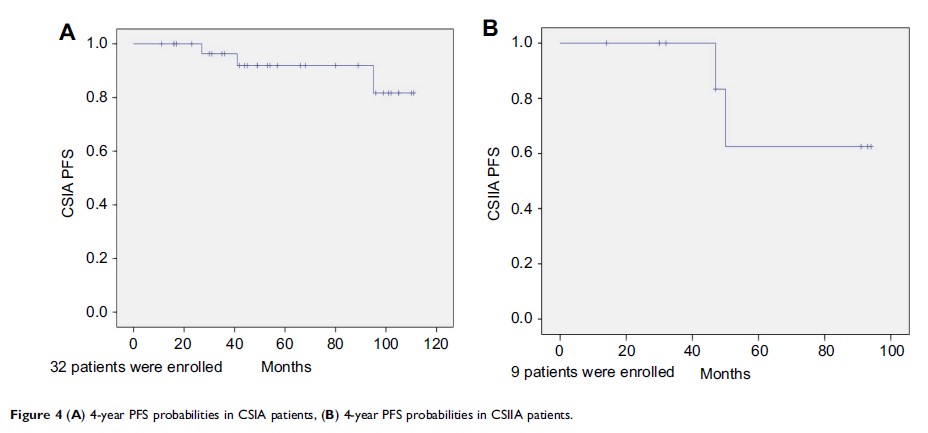
Results: Among 155 registered cases of TC with seminomatous element, 127 cases of pure TS were analyzed. All 127 patients with a median age of 37 years were pathologically diagnosed with orchiectomy specimens. Orchiectomy, chemotherapy, and radiotherapy were the main treatments for these patients. Patients with clinical stages I, II, and III testicular cancer of accounted for 81.1% (n=103), 15.7% (n=20), and 3.2% (n=4) of all patients, respectively. After a median follow-up time of 50 months, five patients presented with relapse during follow-up, and one among them died. Of the patients with stage I TS (T1N0M0S0 CS IA), three patients who only underwent orchiectomy relapsed. Among patients with stage II TS (T1N1M0S1 CS IIA), one patient relapsed after orchiectomy, post-surgery chemotherapy and radiotherapy. In four patients with stage III disease (T2N1M1aS1 CS IIIA), one relapsed after orchiectomy and chemotherapy, and died shortly after salvage chemotherapy and radiotherapy due to recurrence. The median overall survival time was 50 months. In all patients, the 2-year overall survival and progression-free survival probabilitis were 98.6% and 98.8%, respectively.
Conclusion: The present study shows that patients with TS have good prognosis even at an advanced stage. Surveillance after orchiectomy was important for patients with CSI seminoma, and we recommend cisplatin-based chemotherapy as salvage therapy for patients with CSI seminoma. In addition, patients with a maximal tumor diameter >4 cm should undergo post-surgery chemotherapy.
Keywords: testicular cancer, testicular seminoma, orchiectomy, post-orchiectomy therapy