118847
论文已发表
注册即可获取德孚的最新动态
IF 收录期刊
- 3.6 Breast Cancer (Dove Med Press)
- 4.3 Clin Epidemiol
- 2.6 Cancer Manag Res
- 3.2 Infect Drug Resist
- 4.1 Clin Interv Aging
- 6.1 Drug Des Dev Ther
- 4.1 Int J Chronic Obstr
- 8.7 Int J Nanomed
- 2.5 Int J Women's Health
- 3.2 Neuropsych Dis Treat
- 2.4 OncoTargets Ther
- 2.6 Patient Prefer Adher
- 2.6 Ther Clin Risk Manag
- 3.1 J Pain Res
- 3.5 Diabet Metab Synd Ob
- 4.5 Psychol Res Behav Ma
- 3.4 Nat Sci Sleep
- 2.4 Pharmgenomics Pers Med
- 2.6 Risk Manag Healthc Policy
- 4.6 J Inflamm Res
- 2.3 Int J Gen Med
- 3.9 J Hepatocell Carcinoma
- 3.3 J Asthma Allergy
- 2.5 Clin Cosmet Investig Dermatol
- 3.0 J Multidiscip Healthc

在 HPV 感染的子宫颈环境中浸润 CD4 和 CD8 淋巴细胞
Authors Maskey N, Thapa N, Maharjan M, Shrestha G, Maharjan N, Cai H, Liu S
Received 27 May 2019
Accepted for publication 23 July 2019
Published 14 August 2019 Volume 2019:11 Pages 7647—7655
DOI https://doi.org/10.2147/CMAR.S217264
Checked for plagiarism Yes
Review by Single-blind
Peer reviewers approved by Dr Amy Norman
Peer reviewer comments 2
Editor who approved publication: Dr Teng
Purpose: Tumor infiltrating lymphocytes (TILs) have been extensively described in anti-tumor immunity, but their functional alterations in the immunoediting processes during neoplastic progression in the uterine cervix are still not clear. Our aim was to gain insight into cervical tissue T cell populations, determine if there are any differences in the localization and quantity distribution of T lymphocytes, and to evaluate their role in disease regression or progression in the cervical neoplastic milieu.
Patients and methods: Serial section analysis of immunohistochemically stained CD4 and CD8 lymphocytes was performed on a total number of 72 samples, categorized into four cohorts: 23 HPV non-infected (HPV-) normal cervix, 20 HPV infected (HPV+) normal cervix, 17 HPV+ low grade cervical intraepithelial neoplasia (CIN), and 12 HPV+ high grade CIN.
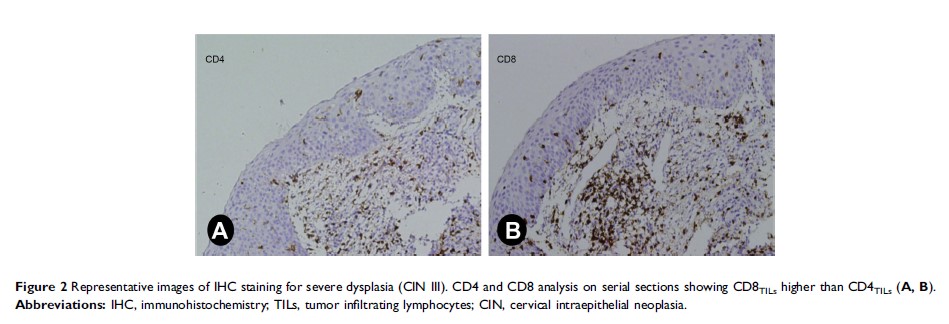
Results: Low infiltrating lymphocytes (ILs) in normal cervix and high ILs in CIN were observed, while the trend of ILs increased with increasing grade of CIN, which was statistically significant (P <0.0001). Quantitative and localization analysis between the subsets of T cells showed that, in the epithelial layer, infiltrating CD8+ lymphocytes (CD8+ILs) were significantly higher than CD4+ILs in HPV+ normal cervix, while the trend decreased with increasing grade of CIN (P =0.011). Whereas, in the stromal layer, CD4+ILs were predominant in all study groups and no statistical difference was found between these groups. However, tumor infiltrating CD8+ lymphocytes (CD8+TILs) were noted to be significantly higher than CD4+TILs in severe dysplastic cases.
Conclusion: T cell infiltrates were predominant as the grade of the lesion progressed into more advanced lesions, which likely represent the lesions that have persisted over time. The variation in the infiltration rate and the location of CD4+ILs and CD8ILs may suggest the efficacious role of CD8 T cells in eliminating HPV infected cervical epithelial cells and also provides insight into the complex role of TILs in facilitating and mediating sustained anti-tumor responses, hence preventing tumor outgrowth.
Keywords: cervical screening test, human papilloma virus, cervical intraepithelial neoplasia, CD4, CD8, immunohistochemistry