118847
论文已发表
注册即可获取德孚的最新动态
IF 收录期刊
- 3.6 Breast Cancer (Dove Med Press)
- 4.3 Clin Epidemiol
- 2.6 Cancer Manag Res
- 3.2 Infect Drug Resist
- 4.1 Clin Interv Aging
- 6.1 Drug Des Dev Ther
- 4.1 Int J Chronic Obstr
- 8.7 Int J Nanomed
- 2.5 Int J Women's Health
- 3.2 Neuropsych Dis Treat
- 2.4 OncoTargets Ther
- 2.6 Patient Prefer Adher
- 2.6 Ther Clin Risk Manag
- 3.1 J Pain Res
- 3.5 Diabet Metab Synd Ob
- 4.5 Psychol Res Behav Ma
- 3.4 Nat Sci Sleep
- 2.4 Pharmgenomics Pers Med
- 2.6 Risk Manag Healthc Policy
- 4.6 J Inflamm Res
- 2.3 Int J Gen Med
- 3.9 J Hepatocell Carcinoma
- 3.3 J Asthma Allergy
- 2.5 Clin Cosmet Investig Dermatol
- 3.0 J Multidiscip Healthc

lncRNA UCA1 在人类癌症中的预后价值和机制
Authors Yao F, Wang Q, Wu Q
Received 4 January 2019
Accepted for publication 29 May 2019
Published 14 August 2019 Volume 2019:11 Pages 7685—7696
DOI https://doi.org/10.2147/CMAR.S200436
Checked for plagiarism Yes
Review by Single-blind
Peer reviewers approved by Dr Colin Mak
Peer reviewer comments 2
Editor who approved publication: Dr Rituraj Purohit
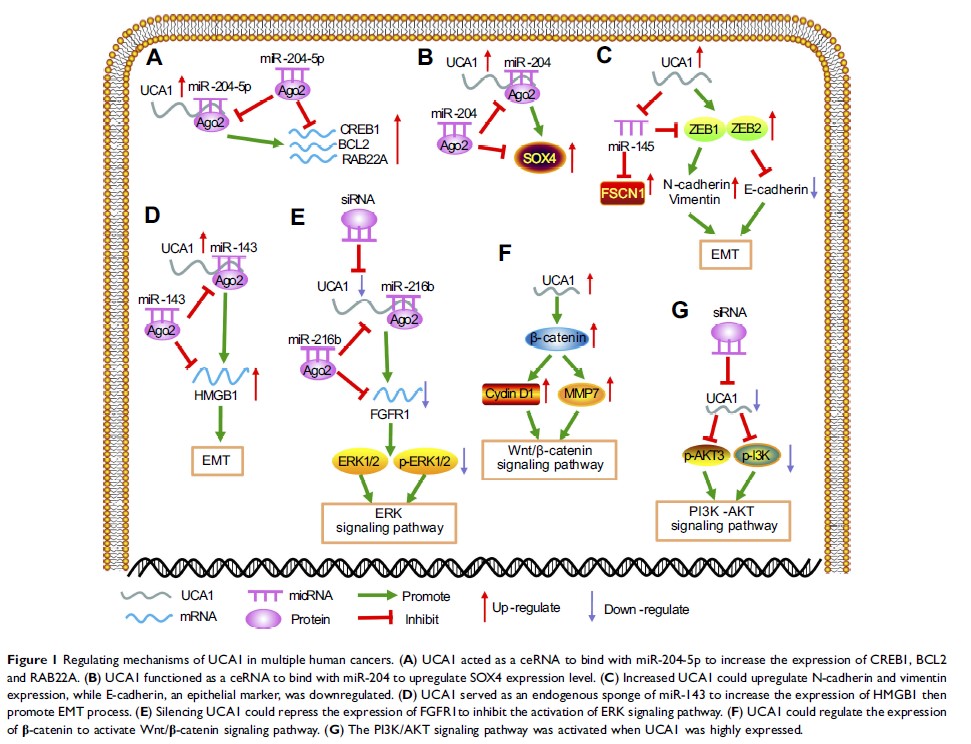
Abstract: Long noncoding RNAs (lncRNAs), longer than 200 nucleotides in length, play important roles in the development and progression of various cancers. An increasing number of studies have revealed that lncRNAs function as potential oncogenes or tumor suppressors to influence biological processes, such as cell growth, invasion, migration and apoptosis. Urothelial carcinoma associated 1 (UCA1), an oncogenic lncRNA, was first found in bladder cancer and highly expressed in multiple cancers, including gastric cancer, colorectal cancer, lung cancer and breast cancer. UCA1 promotes tumorigenesis mainly via binding to tumor-suppressive microRNAs (miRNAs), activating several pivotal signaling pathways and alteration of epigenetic and transcriptional regulation. In addition, high expression of UCA1 is related to poor clinicopathological features especially for shorter overall survival, suggesting that UCA1 might be regarded as a prognosis biomarker in human cancers. In the present review, we summarized current studies on UCA1 to explore its prognostic value and underlying regulation mechanisms in the development of multiple cancers in order to provide a glimmer of hope for the prevention and treatment of malignant tumors.
Keywords: UCA1, lncRNA, cancer, prognostic, mechanism