118847
论文已发表
注册即可获取德孚的最新动态
IF 收录期刊
- 3.6 Breast Cancer (Dove Med Press)
- 4.3 Clin Epidemiol
- 2.6 Cancer Manag Res
- 3.2 Infect Drug Resist
- 4.1 Clin Interv Aging
- 6.1 Drug Des Dev Ther
- 4.1 Int J Chronic Obstr
- 8.7 Int J Nanomed
- 2.5 Int J Women's Health
- 3.2 Neuropsych Dis Treat
- 2.4 OncoTargets Ther
- 2.6 Patient Prefer Adher
- 2.6 Ther Clin Risk Manag
- 3.1 J Pain Res
- 3.5 Diabet Metab Synd Ob
- 4.5 Psychol Res Behav Ma
- 3.4 Nat Sci Sleep
- 2.4 Pharmgenomics Pers Med
- 2.6 Risk Manag Healthc Policy
- 4.6 J Inflamm Res
- 2.3 Int J Gen Med
- 3.9 J Hepatocell Carcinoma
- 3.3 J Asthma Allergy
- 2.5 Clin Cosmet Investig Dermatol
- 3.0 J Multidiscip Healthc

中国人对阿可尼尼治疗 ALK -阳性晚期非小细胞肺癌的临床疗效和安全性的看法
Authors Yu H, Sun S, Hu X, Xia J, Wang J, Chen H
Received 20 February 2019
Accepted for publication 28 June 2019
Published 14 August 2019 Volume 2019:12 Pages 6481—6495
DOI https://doi.org/10.2147/OTT.S185115
Checked for plagiarism Yes
Review by Single-blind
Peer reviewers approved by Ms Shreya Arora
Peer reviewer comments 2
Editor who approved publication: Dr Sanjay Singh
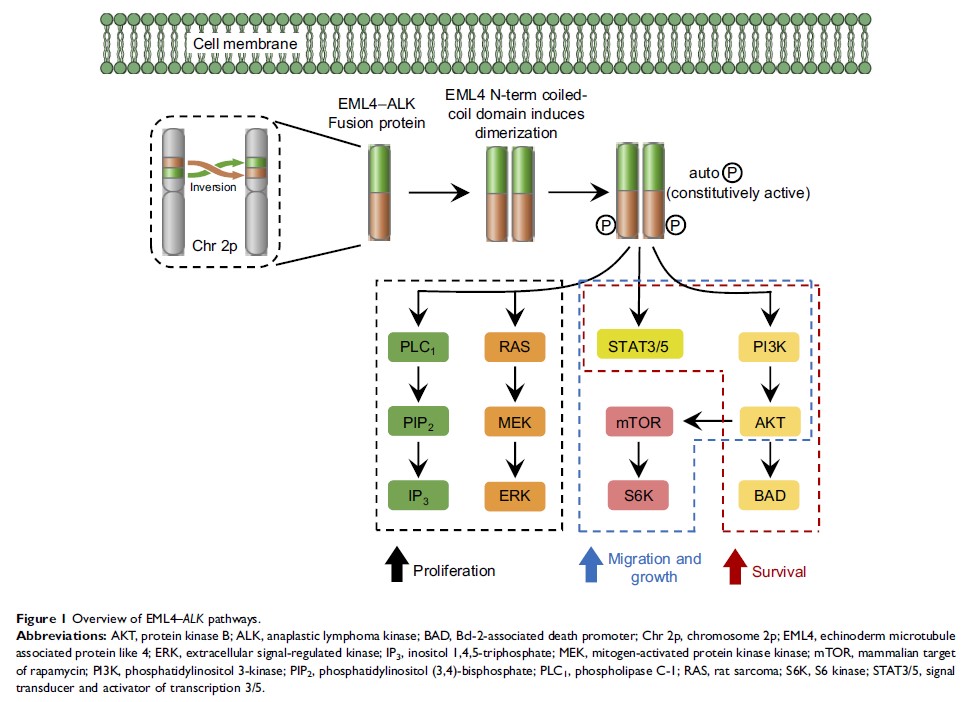
Abstract: The incidence of lung cancer is increasing in China, in contrast to trends in Western countries, due to the increasing numbers of smokers and high levels of air pollution. Non-small-cell lung cancer (NSCLC) is the most common form of lung cancer, accounting for approximately 85% of lung cancers. Better understanding of the pathogenesis of NSCLC has led to the identification of multiple genetic mutations and chromosomal translocations such as those in the anaplastic lymphoma kinase (ALK ) gene. To facilitate the identification of treatment targets, multiple guidelines (European Society for Medical Oncology, National Comprehensive Cancer Network, and American Society of Clinical Oncology) now recommend screening for genetic factors to help guide treatment decisions. In recent years, multiple ALK inhibitors have been developed to treat NSCLC, including the first-generation tyrosine kinase inhibitor (TKI) crizotinib; second-generation TKIs such as ceritinib, ensartinib, brigatinib, and alectinib; the third-generation TKI lorlatinib; and the fourth-generation TKI repotrectinib. These agents differ in structure, potency, and activity, both systemically and their effects on central nervous system (CNS) metastases. Recently, alectinib was approved in China to treat patients with locally advanced or metastatic NSCLC that were ALK +. Alectinib has demonstrated activity against NSCLC, including metastases within the CNS, with better tolerability than crizotinib. These ALK inhibitors represent significant advances in the treatment of NSCLC and yet patients will likely still exhibit disease progression. Alectinib offers greater potency with greater specificity as well as a better toxicity profile than many other TKIs that are currently available. Here, we review the role of ALK as a therapeutic target in NSCLC, the testing methods for identifying ALK -rearranged NSCLC, and the various TKIs currently being used or explored for treatment in this setting, with a focus on alectinib from a Chinese perspective.
Keywords: NSCLC, anaplastic lymphoma kinase, alectinib, tyrosine kinase inhibitor