118847
论文已发表
注册即可获取德孚的最新动态
IF 收录期刊
- 3.6 Breast Cancer (Dove Med Press)
- 4.3 Clin Epidemiol
- 2.6 Cancer Manag Res
- 3.2 Infect Drug Resist
- 4.1 Clin Interv Aging
- 6.1 Drug Des Dev Ther
- 4.1 Int J Chronic Obstr
- 8.7 Int J Nanomed
- 2.5 Int J Women's Health
- 3.2 Neuropsych Dis Treat
- 2.4 OncoTargets Ther
- 2.6 Patient Prefer Adher
- 2.6 Ther Clin Risk Manag
- 3.1 J Pain Res
- 3.5 Diabet Metab Synd Ob
- 4.5 Psychol Res Behav Ma
- 3.4 Nat Sci Sleep
- 2.4 Pharmgenomics Pers Med
- 2.6 Risk Manag Healthc Policy
- 4.6 J Inflamm Res
- 2.3 Int J Gen Med
- 3.9 J Hepatocell Carcinoma
- 3.3 J Asthma Allergy
- 2.5 Clin Cosmet Investig Dermatol
- 3.0 J Multidiscip Healthc

ERK 信号通路的正调节因子 FAM163A 与 14-3-3β 相互作用,促进鳞状细胞肺癌细胞增殖
Authors Liu N, Zhou H, Zhang X, Cai L, Li J, Zhao J, Liu Y, Wang L, Fan C, Li A, Miao Y
Received 7 May 2019
Accepted for publication 23 July 2019
Published 13 August 2019 Volume 2019:12 Pages 6393—6406
DOI https://doi.org/10.2147/OTT.S214731
Checked for plagiarism Yes
Review by Single-blind
Peer reviewers approved by Dr Shashank Kaushik (PT)
Peer reviewer comments 2
Editor who approved publication: Dr Federico Perche
Purpose: FAM163A, also called neuroblastoma-derived secretory protein (NDSP) or C1ORF76, was newly found on chromosome 1q25.2. Previous studies of FAM163A focused on its expression and function in neuroblastoma. However, using an online database, we found that FAM163A may predict poor prognosis in lung squamous cell carcinomas (LUSC). Therefore, the role of FAM163A plays in LUSC needs to be further clarified.
Patients and methods: Western blots, immunofluorescence and immunohistochemistry were used to detect the effect of FAM163A on mediating cell proliferation in vitro and in vivo. Co-immunoprecipitation and immunofluorescence were utilized to evaluate the interaction and co-localization of FAM163A with 14-3-3β and ERK.
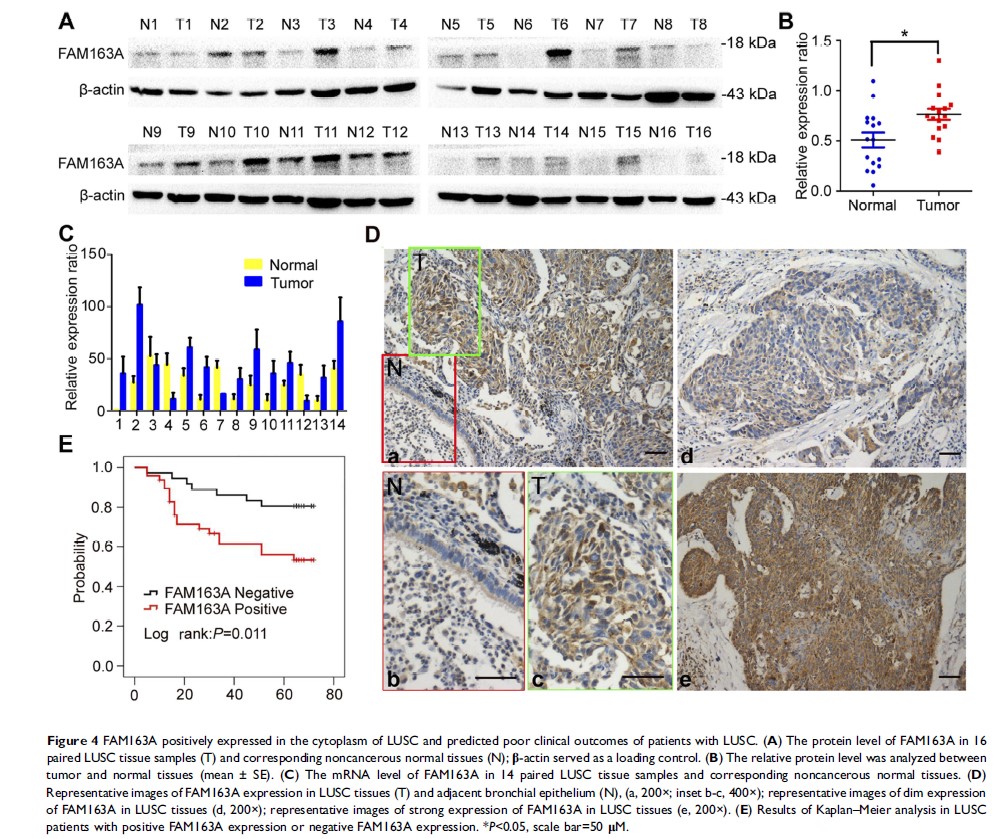
Results: In this study, our data revealed that FAM163A overexpression increased the levels of ERK and p90RSK phosphorylation and promoted the expression of cyclin D1. Incorporation with U0126 reversed the effects of FAM163A overexpression. FAM163A directly interacted with both 14-3-3β and ERK and regulated the phosphorylation of ERK by upregulating the protein level of 14-3-3β. Immunohistochemistry results also showed that FAM163A expression significantly correlated with larger tumor size (P =0.023), TNM staging (P =0.015) and regional lymph node metastasis (P =0.016). Kaplan-Meier survival analysis implied the mean survival time of patients with positive FAM163A expression (49.72±3.97 months) was much shorter than the patients with negative FAM163A expression (63.36±3.14 months, P =0.011).
Conclusion: In summary, the present study identified a novel mechanism that FAM163A, through binding and upregulating 14-3-3β, facilitated ERK phosphorylation that led to an increase of cellular proliferation of LUSC cells. FAM163A may be a useful marker to predict poor prognosis of patients with LUSC.
Keywords: FAM163A, ERK, 14-3-3β, prognosis, lung squamous cell carcinomas