118847
论文已发表
注册即可获取德孚的最新动态
IF 收录期刊
- 3.6 Breast Cancer (Dove Med Press)
- 4.3 Clin Epidemiol
- 2.6 Cancer Manag Res
- 3.2 Infect Drug Resist
- 4.1 Clin Interv Aging
- 6.1 Drug Des Dev Ther
- 4.1 Int J Chronic Obstr
- 8.7 Int J Nanomed
- 2.5 Int J Women's Health
- 3.2 Neuropsych Dis Treat
- 2.4 OncoTargets Ther
- 2.6 Patient Prefer Adher
- 2.6 Ther Clin Risk Manag
- 3.1 J Pain Res
- 3.5 Diabet Metab Synd Ob
- 4.5 Psychol Res Behav Ma
- 3.4 Nat Sci Sleep
- 2.4 Pharmgenomics Pers Med
- 2.6 Risk Manag Healthc Policy
- 4.6 J Inflamm Res
- 2.3 Int J Gen Med
- 3.9 J Hepatocell Carcinoma
- 3.3 J Asthma Allergy
- 2.5 Clin Cosmet Investig Dermatol
- 3.0 J Multidiscip Healthc

FXR 激动剂奥贝胆酸通过靶向肠道微生物群对非酒精性脂肪性肝病的保护作用及机制
Authors Zhang DY, Zhu L, Liu HN, Tseng YJ, Weng SQ, Liu TT, Dong L, Shen XZ
Received 1 March 2019
Accepted for publication 2 June 2019
Published 5 July 2019 Volume 2019:13 Pages 2249—2270
DOI https://doi.org/10.2147/DDDT.S207277
Checked for plagiarism Yes
Review by Single-blind
Peer reviewers approved by Dr Colin Mak
Peer reviewer comments 3
Editor who approved publication: Prof. Dr. Cristiana Tanase
Background: It is reported that various diseases such as non-alcoholic fatty liver disease (NAFLD) are associated with imbalance of microbiome. And FXR has been well investigated in liver diseases.
Purpose: The objective of this study was to identify the role of farnesoid X receptor agonist obeticholic acid via targeting gut microbiota in NAFLD.
Patients and methods: Male C57BL/6 mice were fed either a normal-chow diet or a high-fat diet (HFD). Obeticholic acid(30mg/(kg·d)) and/or a combination of antibiotics were administered orally by gavage to mice for 12 weeks. Gut microbiota profiles were established through 16S rRNA amplicon sequencing. The effects of obeticholic acid on liver inflammation, the gut barrier, endotoxemia, gut microbiome and composition of the bile acid were also investigated.
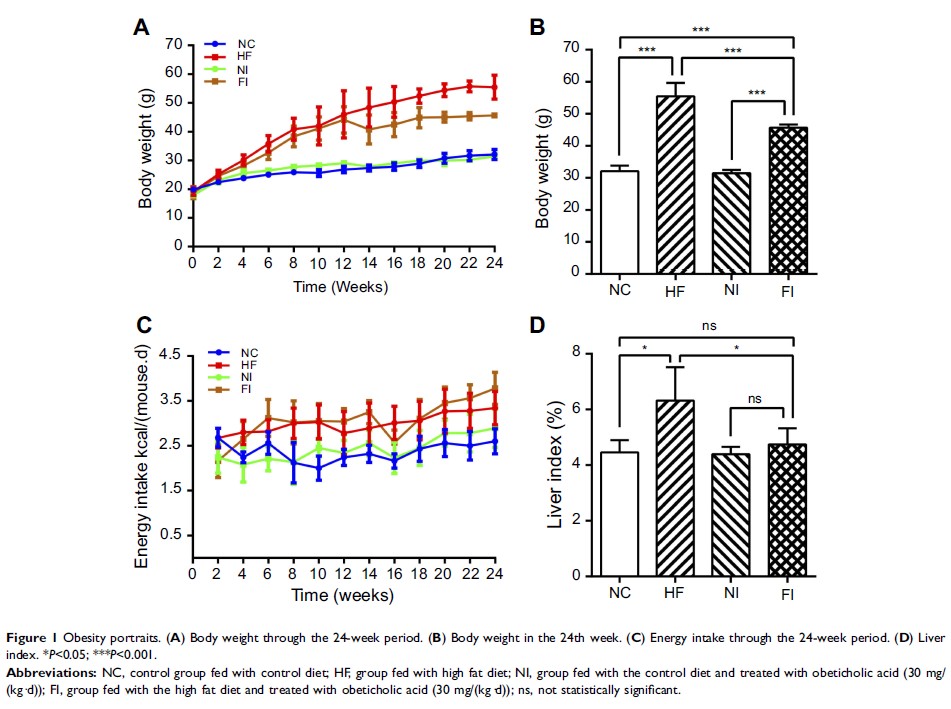
Results: Obeticholic acid treatment can significantly improve obesity, circulation metabolism disorders, liver inflammation and fibrosis, and intestinal barrier damage caused by HFD. Removal of normal commensal bacteria can weaken the effect of obeticholic acid. The gut microbial structure was changed, and abundance of Blautia was increased significantly after treated with obeticholic acid. After obeticholic acid treatment, the concentration of taurine-bound bile acid caused by HFD was reduced in the liver.
Conclusion: Taken together, these data suggest that obeticholic acid has aprotective effect on NAFLD via changing the components of gut microbiota, specifically increasing the abundance of Blautia.
Keywords: non-alcoholic fatty liver disease, farnesoid X receptor, gastrointestinal microbiome, bile acid, metabolic diseases