119942
论文已发表
注册即可获取德孚的最新动态
IF 收录期刊
- 3.6 Breast Cancer (Dove Med Press)
- 4.3 Clin Epidemiol
- 2.6 Cancer Manag Res
- 3.2 Infect Drug Resist
- 4.1 Clin Interv Aging
- 6.1 Drug Des Dev Ther
- 4.1 Int J Chronic Obstr
- 8.7 Int J Nanomed
- 2.5 Int J Women's Health
- 3.2 Neuropsych Dis Treat
- 2.4 OncoTargets Ther
- 2.6 Patient Prefer Adher
- 2.6 Ther Clin Risk Manag
- 3.1 J Pain Res
- 3.5 Diabet Metab Synd Ob
- 4.5 Psychol Res Behav Ma
- 3.4 Nat Sci Sleep
- 2.4 Pharmgenomics Pers Med
- 2.6 Risk Manag Healthc Policy
- 4.6 J Inflamm Res
- 2.3 Int J Gen Med
- 3.9 J Hepatocell Carcinoma
- 3.3 J Asthma Allergy
- 2.5 Clin Cosmet Investig Dermatol
- 3.0 J Multidiscip Healthc

原发性闭角型青光眼的频率依赖性神经活动
Authors Jiang F, Yu C, Zuo MJ, Zhang C, Wang Y, Zhou FQ, Zeng XJ
Received 13 September 2018
Accepted for publication 10 December 2018
Published 18 January 2019 Volume 2019:15 Pages 271—282
DOI https://doi.org/10.2147/NDT.S187367
Checked for plagiarism Yes
Review by Single-blind
Peer reviewers approved by Dr Colin Mak
Peer reviewer comments 3
Editor who approved publication: Dr Yu-Ping Ning
Objective: In this
study, we aimed to investigate the frequency-dependent spontaneous neural
activity in primary angle-closure glaucoma (PACG) using the amplitude of
low-frequency fluctuations (ALFF) method.
Patients and methods: In total,
52 PACG individuals (24 males and 28 females) and 52 normal-sighted controls
(NS; 24 males and 28 females) who were closely matched in age, sex, and
education underwent resting-state magnetic resonance imaging scans. A
repeated-measures ANOVA and post hoc two-sample t -tests were
conducted to analyze the different ALFF values in two different frequency bands
(slow-4, 0.027–0.073 Hz and slow-5, 0.010–0.027 Hz) between the two
groups. Pearson’s correlation analysis was conducted to reveal the relationship
between the mean ALFF values and clinical variables in the PACG group.
Results: Compared to
the NS group, the PACG group had high ALFF values in the right inferior
occipital gyrus and low ALFF values in the left middle occipital gyrus, left
precentral gyrus, and left postcentral gyrus in the slow-4 band. The PACG group
had high ALFF values in the right inferior occipital gyrus and low ALFF values
in the left inferior parietal lobule, left postcentral gyrus, and right
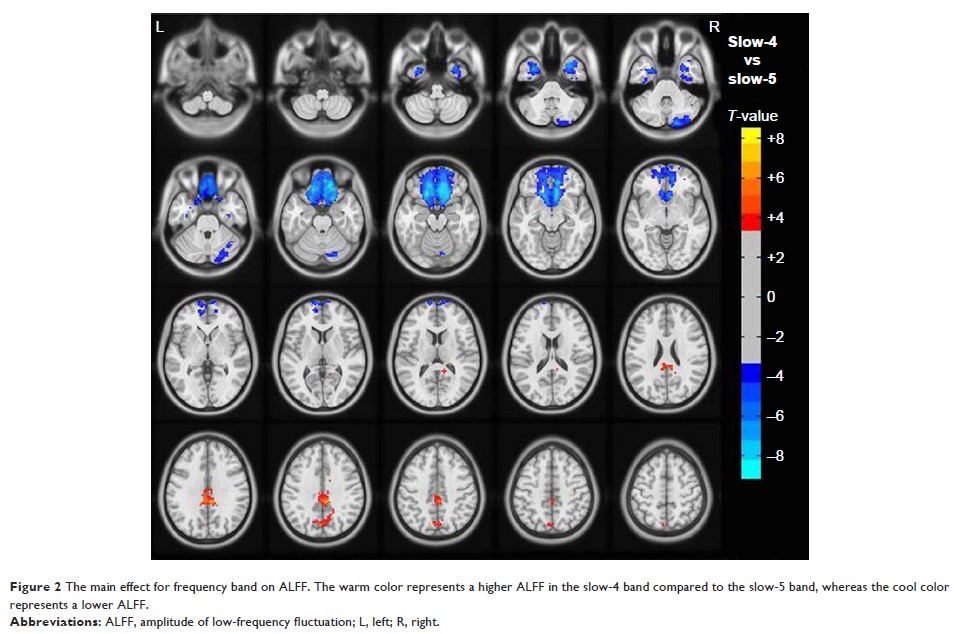
precentral/postcentral gyrus in the slow-5 band. Specifically, we found that
the abnormal ALFF values in the bilateral posterior cingulate gyrus and
bilateral precuneus were higher in the slow-4 than in the slow-5 band, whereas
ALFF in the bilateral frontal lobe, right fusiform, and right cerebellum
posterior lobe were higher in the slow-5 than in the slow-4 band. The greater
mean ALFF values of the right inferior occipital gyrus were associated with
smaller retinal nerve fiber layer thickness and greater visual fields in PACG
group in the slow-4 band.
Conclusion: Our
results highlighted that individuals in the PACG group showed abnormal
spontaneous neural activities in the visual cortices, sensorimotor cortices,
frontal lobe, frontoparietal network, and default mode network at two frequency
bands, which might indicate impaired vision and cognition and emotion function
in PACG individuals. These findings offer important insight into the
understanding of the neural mechanism of PACG.
Keywords: primary
angle-closure glaucoma, amplitude of low-frequency fluctuations, frequency
dependent, resting-state magnetic resonance imaging