119942
论文已发表
注册即可获取德孚的最新动态
IF 收录期刊
- 3.6 Breast Cancer (Dove Med Press)
- 4.3 Clin Epidemiol
- 2.6 Cancer Manag Res
- 3.2 Infect Drug Resist
- 4.1 Clin Interv Aging
- 6.1 Drug Des Dev Ther
- 4.1 Int J Chronic Obstr
- 8.7 Int J Nanomed
- 2.5 Int J Women's Health
- 3.2 Neuropsych Dis Treat
- 2.4 OncoTargets Ther
- 2.6 Patient Prefer Adher
- 2.6 Ther Clin Risk Manag
- 3.1 J Pain Res
- 3.5 Diabet Metab Synd Ob
- 4.5 Psychol Res Behav Ma
- 3.4 Nat Sci Sleep
- 2.4 Pharmgenomics Pers Med
- 2.6 Risk Manag Healthc Policy
- 4.6 J Inflamm Res
- 2.3 Int J Gen Med
- 3.9 J Hepatocell Carcinoma
- 3.3 J Asthma Allergy
- 2.5 Clin Cosmet Investig Dermatol
- 3.0 J Multidiscip Healthc

太极治疗骨质减少和原发性骨质疏松症:荟萃分析和试验序贯分析
Authors Zhang YL, Chai Y, Pan XJ, Shen H, Wei X, Xie YM
Received 14 September 2018
Accepted for publication 3 December 2018
Published 3 January 2019 Volume 2019:14 Pages 91—104
DOI https://doi.org/10.2147/CIA.S187588
Checked for plagiarism Yes
Review by Single-blind
Peer reviewers approved by Dr Cristina Weinberg
Peer reviewer comments 3
Editor who approved publication: Dr Zhi-Ying Wu
Purpose: The aim
of this meta-analysis was to evaluate the efficacy of Tai chi (TC) as an
adjuvant treatment for osteopenia and primary osteoporosis.
Methods: We went
through eight databases to identify relevant randomized controlled trials that
compared TC with a control group. The primary outcome was osteoporosis-related
fractures (fracture incidence). Meta-analyses and trial sequential analyses
(TSA) were conducted using RevMan 5.3 and TSA 0.9.
Results: Fifteen
randomized controlled trials involving a total of 857 patients were included in
the analyses. No trials reported primary outcome; however, bone mineral density
(BMD) values differed significantly in subgroup 1 (TC vs no treatment; weighted
mean difference [WMD] =0.05 g/cm2, 95% CI 0.03 to 0.07; P <0.00001; P for
heterogeneity =0.22, I 2=22%) and subgroup 2 (TC vs conventional treatments;
WMD =0.16 g/cm2, 95% CI 0.11 to 0.21; P <0.00001; P for
heterogeneity =0.008, I 2=75%). In addition, two trials compared TC with
conventional treatments, which found a significant difference in bone gla
protein (standardized mean difference =-1.18, 95% CI −1.66 to −0.70; P <0.00001; P for
heterogeneity =0.58, I 2=75%). The results of the BMD were confirmed by
TSA. Also, TC may have a certain effect on the relief of osteoporotic pain (WMD
= −2.61, 95% CI -3.51 to −1.71; WMD = −1.39, 95% CI −2.01 to −0.77). However,
it did not promote the quality of life, level of serum calcium, serum
phosphorus, and also had no effect on bone turnover markers.
Conclusion: Although
there is no study monitoring fracture incidence, TC may be beneficial for
patients in improving BMD values, level of bone gla protein, and relieving
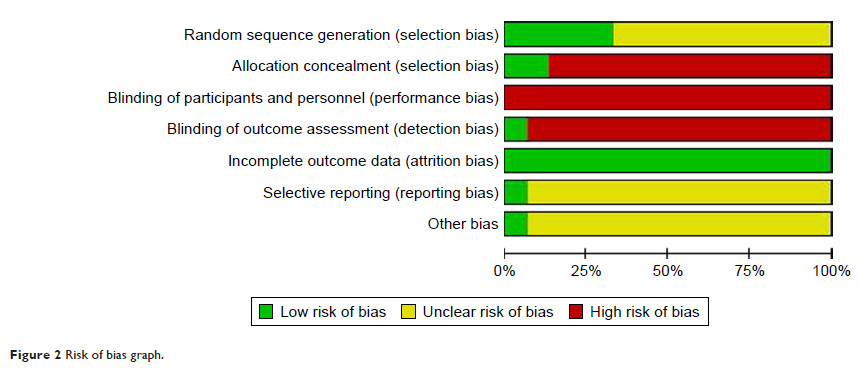
osteoporotic pain. However, due to the low methodological quality, current
evidence for treating osteopenia and primary osteoporosis through TC is
insufficient.
Keywords: Tai chi,
osteopenia, primary osteoporosis, evidence based medicine, trial sequential
analyses